Author

admin

Browsing

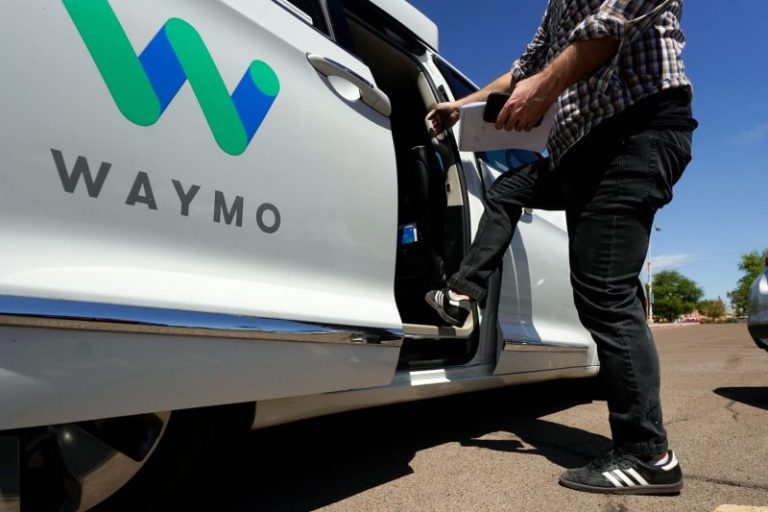
Waymo announced Tuesday that it is offering accounts for teens ages 14 to 17, starting in Phoenix.

The Alphabet-owned company said that, beginning Tuesday, parents in Phoenix can use their Waymo accounts “to invite their teen into the program, pairing them together.” Once their account is activated, teens can hail fully autonomous rides.

Previously, users were required to be at least 18 years old to sign up for a Waymo account, but the age range expansion comes as the company seeks to increase ridership amid a broader expansion of its ride-hailing service across U.S. cities. Alphabet has also been under pressure to monetize AI products amid increased competition and economic headwinds.

Waymo said it will offer “specially-trained Rider Support agents” during rides hailed by teens and loop in parents if needed. Teens can also share their trip status with their parents for real-time updates on their progress, and parents receive all ride receipts.

Teen accounts are initially only being offered to riders in the metro Phoenix area. Teen accounts will expand to more markets outside California where the Waymo app is available in the future, a spokesperson said.

Waymo’s expansion to teens follows a similar move by Uber, which launched teen accounts in 2023. Waymo, which has partnerships with Uber in multiple markets, said it “may consider enabling access for teens through our network partners in the future.”

Already, Waymo provides more than 250,000 paid trips each week across Phoenix, the San Francisco Bay Area, Los Angeles, Atlanta, and Austin, Texas, and the company is preparing to bring autonomous rides to Miami and Washington, D.C., in 2026.

In June, Waymo announced that it plans to manually drive vehicles in New York, marking the first step toward potentially cracking the largest U.S. city. Waymo said it applied for a permit with the New York City Department of Transportation to operate autonomously with a trained specialist behind the wheel in Manhattan.

This post appeared first on NBC NEWS

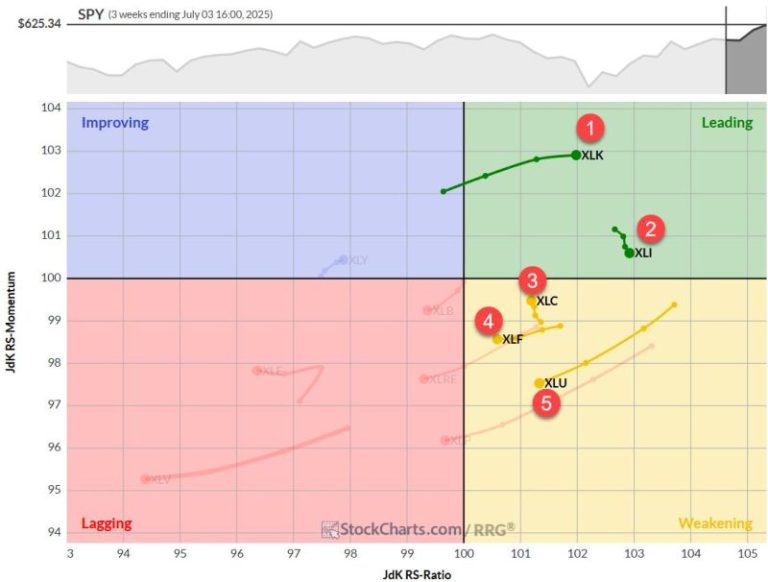
The past week has been relatively stable in terms of sector rankings, with no new entrants or exits from the top five. However, we’re seeing some interesting shifts within the rankings that warrant closer examination. Let’s dive into the details and see what the Relative Rotation Graphs (RRGs) are telling us about the current market dynamics.

Sector Rankings Shuffle

The top three sectors, technology, industrials, and communication services, remain firmly entrenched in their positions. But the real action is happening just below them. Financials climbed to the number four spot, consequently pushing utilities down to fifth place. This shift is significant, as it indicates a move towards more cyclical sectors in the top rankings.

These changes suggest a potential shift towards more economically sensitive and offensive sectors, which supports a bullish scenario or at least a move away from defensive positioning.

  1. (1) Technology – (XLK)
  2. (2) Industrials – (XLI)
  3. (3) Communication Services – (XLC)
  4. (5) Financials – (XLF)*
  5. (4) Utilities – (XLU)*
  6. (8) Materials – (XLB)*
  7. (7) Consumer Staples – (XLP)
  8. (6) Real-Estate – (XLRE)*
  9. (10) Consumer Discretionary – (XLY)*
  10. (9) Energy – (XLE)*
  11. (11) Healthcare – (XLV)

Weekly RRG

The weekly Relative Rotation Graph continues to show strength in the technology sector within the leading quadrant. Industrials is also maintaining its position in the leading quadrant, with a very short tail, indicating a consistent relative uptrend.

Communication services, financials, and utilities are currently in the weakening quadrant. However, communication services have rebounded and appear to be making their way back towards the leading quadrant again.

Financials and utilities, on the other hand, are showing negative headings, with utilities displaying the weakest momentum (longest tail).

Daily RRG

Switching to the daily RRG, we get a more granular view of recent sector movements:

  • Technology remains the strongest sector, with a high RS ratio and a short tail
  • Communication services are rotating at a slightly negative heading but still within the leading quadrant
  • Financials and industrials are showing promise in the improving quadrant
  • Utilities continues to rotate within the lagging quadrant, confirming its weakness

The positioning of these sectors, particularly the strength of technology and improvements in financials and industrials, suggests a shift towards more cyclical and less defensive sectors in the market.

Technology

Tech continues its rally after breaking above the $240 resistance area. The raw RS line is also climbing, having broken out of its falling channel. This sector remains the market leader and shows no signs of slowing down.

Industrials

The industrial sector has cleared its overhead resistance and is pushing higher. Its RS line is putting in new highs, reflecting strong relative performance. The RRG lines remain in the leading quadrant and may be turning up again, a bullish sign.

Communication Services

Comms have broken above their resistance around 105. While still at the lower boundary of its rising RS channel, it’s starting to pick up steam. Both RRG lines are climbing, with RS momentum approaching the 100 level. A cross above that level would put it back in the leading quadrant.

Financials

Financials broke through overhead resistance last week, which is a significant positive development. It’s now above both horizontal resistance and its former support line. The relative strength line needs some work, but with the current price breakout, improvement seems likely in the near future.

Utilities

The weak link in the top five, utilities, remains range-bound. It’s still above support, but not by much. With the broader market rising, utilities’ sideways movement is causing its RS line to drop. The RRG lines are rolling over, and we may soon see this sector rotate into the lagging quadrant on the weekly RRG.

Portfolio Performance Update

I must admit, our portfolio is still underperforming. The current drawdown is a little over 8%, which isn’t ideal. However, this is the nature of trend-following strategies. We’re sticking with our approach through this period of underperformance, confident that historical results support our patience.

If market trends continue as they are, we should see more offensive sectors rotate into the top five. This shift, in turn, should help us overcome the current drawdown and eventually bring us ahead of the S&P again.

Remember, investing is a marathon, not a sprint. Periods of underperformance are normal and to be expected. The key is to stay disciplined and trust in your strategy.

#StayAlert and have a great week. –Julius


The year’s second quarter was a defining period for digital assets.

The industry converged at events like Consensus, held in May in Toronto, where discussions heavily focused on critical themes like regulatory clarity and real-world asset (RWA) tokenization.

Stablecoins, with their promise of enhanced cross-border payment efficiency, were heavily covered, especially regarding the growing interest and innovation in yield-generating products.

Legislative initiatives, policy shifts and infrastructure developments have moved at a dizzying pace, and the ongoing integration of traditional finance with decentralized technologies has driven credibility and institutional engagement.

Looking ahead, continued adoption of digital assets is slated to reshape the global financial landscape fundamentally.

Q2 review: Market maturation, institutional integration and regulatory milestones

Q2 highlighted a maturing market that can absorb shocks while maintaining focus on long-term growth.

While scrutiny of officials’ crypto dealings, including those of US President Donald Trump and his family, kept headlines lively, the broader trend was one of increased credibility.

Early in the quarter, trade tensions between the US and China, combined with ongoing concerns that tariffs will lead to an economic fallout, dampened investor sentiment and weighed on risk assets.

However, investor confidence in Bitcoin was evident in its resilience. After a slide to around US$76,000 at the start of April, it reached the US$90,000s mid-month, before hitting a new all-time high of US$111,000 on May 22.

Institutional accumulation and clearer regulatory signals backed this sentiment, exemplified by the US Securities and Exchange Commission’s (SEC) approval of rule changes allowing Ether exchange-traded fund (ETF) options.

The SEC also updated its guidance on crypto company disclosures, while US President Donald Trump signed a resolution repealing the IRS’s DeFi broker rule. Closing off the quarter, the Federal Housing Finance Agency directed mortgage backers Fannie Mae and Freddie Mac on June 25 to propose single-family mortgage loan risk assessments that consider cryptocurrency on US-regulated exchanges as reserve assets.

These policy shifts were accompanied by surging investor interest in tokenized assets, including tokenized gold — with PAXG and XAUt hitting US$1.54 billion in market cap — and RWA products, particularly within real estate. Momentum was further extended into stablecoin yield products and new ETF filings.

A US$300 million large-scale infrastructure deal between global financial group Macquarie (ASX:MQG) and Bitfarms (TSX:BITF,NASDAQ:BITF) for a high-performance computing center exemplified the growing confidence among fintechs in the long-term viability of digital assets. This growing confidence was further underscored by Robinhood’s (NASDAQ:HOOD) expansion of its crypto footprint, notably with the early June acquisition of Bitstamp.

Combined, these events demonstrated growing market confidence in crypto’s future.

Meanwhile, Ripple’s acquisition of global prime broker Hidden Road signaled a new phase in TradFi-DeFi integration, accompanied by the Fed’s easing of restrictions on banks’ crypto exposure.

The Office of the Comptroller of the Currency’s clarification allowing banks to trade and outsource crypto operations signaled that US regulators increasingly view crypto infrastructure as critical to modern financial services.

Reports of Circle (NYSE:CRCL), BitGo, Coinbase Global (NASDAQ:COIN) and Paxos exploring bank charters further underscored the convergence of TradFi and DeFi, as did Coinbase’s US$100 million credit facility to Riot Platforms (NASDAQ:RIOT); this type of structured financing is typically reserved for banks.

Further solidifying this trend, Stripe finalized a deal to acquire Privy, bringing crypto wallet infrastructure in-house and underscoring how fintech leaders are embedding digital asset rails into their core platforms.

Coinbase also acquired derivatives marketplace Deribit, a US$2.9 billion investment, part of a broader move to dominate digital asset infrastructure and market access. In the retail space, investor exposure widened through Galaxy Digital (NASDAQ:GLXY) and Circle’s Wall Street debut.

Policy also evolved. The GENIUS Act, a legislative companion to the STABLE Act, advanced in the Senate, proposing guardrails for stablecoins while carving out flexibility for banks to issue tokenized deposits, while crypto reserve legislation advanced in New Hampshire, Texas and Arizona.

Still, operational risks remained. A US$223 million exploit hit the Cetus protocol, and Coinbase suffered a US$20 million ransomware attack, reminders that digital assets remain a high-stakes environment.

Bitcoin price performance, Q2 2025. 

Chart courtesy of CoinGecko.

Q3 outlook: Regulatory progress, tokenization growth and market expansion

Further regulatory clarity is expected in Q3, clearing the way to enable more use cases and a deeper integration between DeFi and TradFi. House Republicans are prioritizing the swift enactment of comprehensive stablecoin legislation, aiming to unify the Senate’s GENIUS Act and the House’s STABLE Act.

Meanwhile, the CLARITY Act, which has a broader focus on establishing a general market structure for all digital assets, is positioned for a vote in the House of Representatives after clearing two committees.

Regulators on the SEC’s Crypto Task Force are considering a conditional exemptive order to allow crypto firms to bypass certain broker-dealer, clearing agency and exchange registration requirements. The nuances of regulated staking activities are still being worked out, especially regarding how they apply to specific products like ETFs.

On the retail front, tokenization momentum shows no sign of slowing. A discussion group on RWAs at Consensus agreed that the resurgence of tokenization is largely driven by the utility and functionality it provides to assets.

Beyond efficiency, Carlos Domingo, co-founder and CEO of Securitize, added that tokenization brings assets with intrinsic, real-world value onto the blockchain, allowing new financial applications and broader access to those holdings.

“Now we’re seeing more large-scale production,” he explained.

“We’re seeing (things) like precious minerals coming up, and we’re seeing commodities and other equities, a lot of startups that want to tokenize and use platforms like ours to tokenize their cap tables.”

At Consensus, Arthur Breitman, co-founder of Tezos, explained that his platform, uranium.io, enables the trading of physical uranium using a token, xU3O8, which allows for fractional ownership of a commodity that trades over-the-counter for roughly US$4 million. “Typically, uranium will look at pounds, but you can buy a fraction of a token. So really, you can buy a few cents of xU308,” he told the audience during his presentation.

Additionally, crypto infrastructure development by major fintechs and traditional finance entities, coupled with new public market entrants, could broaden investment opportunities.

For Q3, investors will be monitoring key publicly traded players such as Robinhood, fresh off its Bitstamp acquisition, as well as new Wall Street newcomers Circle and Galaxy Digital.

In the mining and compute infrastructure sector, CoreWeave (NASDAQ:CRWV) is in advanced talks to acquire Core Scientific (NASDAQ:CORZ), marking a move to merge compute-intensive infrastructure with mining operations, driven by crossover demand from AI and crypto sectors.

Beyond dedicated crypto firms, Strategy (NASDAQ:MSTR) and Japan’s Metaplanet (TSE:3350,OTCQX:MTPLF) added substantially to their crypto holdings in Q2, with no signs of slowing down.

For Bitcoin, price projections for Q3 range between a new resistance level around US$120,000 and support at US$75,000. ARK Invest increased its Bitcoin price forecast for 2030 from US$1.5 million to US$2.4 million in Q2, citing growing institutional interest and Bitcoin’s expanding role as “digital gold.’

These developments suggest Q3 will may continue building on the credibility and utility that defined Q2. With regulation advancing, institutional rails expanding and tokenization gaining real-world traction, digital assets are increasingly seen not as a parallel world to the world of finance, but as the next evolution of it.

Securities Disclosure: I, Meagen Seatter, hold no direct investment interest in any company mentioned in this article.

This post appeared first on investingnews.com

Here’s a quick recap of the crypto landscape for Friday (July 4) as of 12:00 p.m. UTC.

Get the latest insights on Bitcoin, Ethereum and altcoins, along with a round-up of key cryptocurrency market news.

Bitcoin and Ethereum price update

Bitcoin (BTC) is priced at US$108,948, down by 1.6 percent in the last 24 hours. The day’s range for the cryptocurrency brought a low of US$107,741 and a high of US$109,997.

Bitcoin price performance, July 4, 2025.

Chart via TradingView.

Bitcoin’s rally to US$108,000 followed strong US labor data that boosted risk appetite early on, alongside continued inflows into Bitcoin spot ETFs (nearly US$50 billion), which helped anchor prices despite broader equity market pullbacks.

Market watchers also noted heightened volatility following the reactivation of two long-dormant Bitcoin wallets containing roughly 20,000 BTC (worth over US$2 billion), raising questions about potential future dumping.

Ethereum (ETH) is priced at US$2,549.85, down by 2.7 percent over the past 24 hours. Its lowest valuation on Wednesday was US$2,502.39 and its highest was US$2,600.55.

Altcoin price update

  • Solana (SOL) was priced at US$150.30, up by 5 percent over 24 hours. Its highest valuation as of Friday was US$153.26, and its lowest was US$146.61.
  • XRP was trading for US$2.24, down by 1.4 percent in 24 hours. The cryptocurrency’s lowest valuation was US$2.21 and its highest was US$2.28.
  • Sui (SUI) is trading at US$2.92, showing a decrease of 3.6 percent over the past 24 hours. Its lowest valuation was US$2.87 and its highest was US$3.07.
  • Cardano (ADA) is priced at US$0.5817, down by 3.1 percent in the last 24 hours. Its lowest valuation as of Wednesday was US$0.5715 and its highest was US$0.6028.

Today’s crypto news to know

Trump’s Big Beautiful Bill passes Congress, sending cryptos higher

US President Donald Trump’s flagship Big Beautiful Bill, featuring sweeping tax cuts, narrowly passed the House of Representatives on July 3 with a 218 to 214 vote and now awaits his signature.

Elon Musk criticized the bill for potentially inflating the deficit by trillions, while Trump suggested Musk’s criticism stemmed from policy clashes on EV incentives.

Coinbase Global (NASDAQ:COIN) CEO Brian Armstrong also raised concerns that a ballooning debt could paradoxically fuel Bitcoin’s status as a reserve asset.

Bitcoin traded near US$109,886 after the news, with other leading coins including Ethereum and Solana also posting gains. The total crypto market cap climbed to US$3.39 trillion following the vote.

Bitcoin power shift as whales sell 500,000 BTC to institutions

A major redistribution of Bitcoin is underway as long-time holders of large amounts of Bitcoin have sold off around 500,000 Bitcoin over the past year, worth more than US$50 billion at current prices.

According to a Bloomberg report, these sales are being absorbed almost equally by institutional buyers, including spot ETFs and corporate treasuries. That pattern is turning Bitcoin from a high-volatility speculative bet into a steadier institutional portfolio allocation. Despite consistent positive news for crypto in recent months, the asset has struggled to break through resistance around US$110,000, showing a consolidation phase.

Some of the whales cashing out are early holders dating back to Bitcoin’s earliest cycles, Bloomberg reports, who are swapping Bitcoin for stock-linked deals instead of simply liquidating.

Russian giant Rostec to issue ruble-backed stablecoin

State-owned Russian conglomerate Rostec is moving to launch a ruble-pegged stablecoin called RUBx and a payments network named RT-Pay before year-end, according to Russian state media.

The stablecoin will be anchored one-to-one with ruble deposits held in treasury accounts, and its code will be independently audited by CertiK. RT-Pay will integrate directly with Russia’s banking system, aiming for instant settlement and smart contract functionality even outside business hours.

Rostec says its platform will follow Russia’s anti-money-laundering and terrorism-financing requirements, in line with the Bank of Russia’s rules.

The stablecoin will run on the Tron blockchain, with its smart contract code to be published on GitHub.

Coinbase’s Base sees US$4 billion in outflows, Ethereum gains US$8.5 billion

Coinbase’s Layer 2 network Base has lost significant traction this year, registering US$4.3 billion in net outflows through cross-chain bridges, data shows.

This downturn is a sharp reversal from the US$3.8 billion of inflows Base attracted in 2024, when it led the sector in bridge activity. Meanwhile, Ethereum has staged a comeback, seeing US$8.5 billion in inflows compared to net outflows last year.

The slowdown in stablecoin supply growth on Base, now holding steady above US$4 billion since May, points to a maturing user base and declining trading volumes.

Bridges are key pieces of crypto infrastructure that allow assets to move between chains, supporting interoperability.

Nano Labs starts US$1 billion BNB buying plan with US$50 million purchase

Hong Kong-based chipmaker Nano Labs (NASDAQ:NA) has made its first major move in an ambitious plan to hold up to 10 percent of Binance Coin (BNB) in circulation, snapping up US$50 million of BNB this week.

The company disclosed buying around 74,315 BNB at an average price of US$672, funded partly by convertible notes.

Nano Labs ultimately plans to allocate US$1 billion to BNB holdings, signaling a vote of confidence in Binance’s ecosystem. However, its shares fell nearly 5 percent on Thursday and lost another 2 percent after hours, reflecting investor worries about its exposure to volatile crypto reserves.

Nano Labs’ reserves, including Bitcoin, now stand around US$160 million in total.

Securities Disclosure: I, Giann Liguid, hold no direct investment interest in any company mentioned in this article.

This post appeared first on investingnews.com

Asara Resources (ASX:AS1,FSE:ALM) is leading the next West African gold rush from a strategic position in Guinea’s underexplored Siguiri Basin—an emerging gold district with over 30 million ounces of historical and current gold production.

Asara Resources’ flagship Kada Kold project hosts a 923,000-ounce, oxide-dominant gold resource just 35 km south of AngloGold Ashanti’s 6.2 Moz Siguiri mine. The company is systematically advancing development using the proven “string-of-pits” model that has driven success across West Africa, guided by a seasoned team behind the Kiniero Project, now a cornerstone asset for Robex (TSX:RBX).

Asara’s near-term strategy focuses on three key priorities: accelerating resource growth with 33,600 metres of RC and diamond drilling planned for 2025; advancing a low-CAPEX, oxide-first development approach that capitalizes on free-dig saprolite, strong gold recoveries, and a conventional CIL flowsheet; and preserving upside exposure to copper and silver-zinc through its Loreto joint venture with Teck and the optional Paguanta asset in Chile.

Company Highlights

  • Flagship Kada gold project – 923,000 oz gold and counting: 30.3 Mt @ 0.95 g/t gold with 59 percent oxide-transition ounces that show over 90 percent CIL recoveries and <3.5:1 strip ratio; resource remains open in every direction along a 15 km corridor.
  • Aggressive growth runway: Three contiguous licence applications (Talico, Banan and Syli) would lift the land package to 348 sq km and extend strike control to 35 km, only ~6 percent of which is drilled.
  • Experienced team who took the Kiniero project from an exploration resource to construction: Senior executives previously turned Robex’s Kiniero from 1 Moz to ~3.5 Moz and into a C$750 million market cap company, bringing an identical on-ground team, in-country relationships and proven workflows to Asara.
  • Strategic Land Package: Kada is in the heart of the prolific Siguiri Basin (>30 Moz gold endowment), just 35 km south of AngloGold Ashanti’s Siguiri Mine.
  • Strong Institutional Support: Top 20 shareholders control 70+ percent of the company.

This Asara Resources profile is part of a paid investor education campaign.*

Click here to connect with Asara Resources (ASX:AS1) to receive an Investor Presentation

This post appeared first on investingnews.com

I like to trade stocks that are relative leaders and belong to industry groups that are leaders as well. For the past 2-3 months, much has been written about and discussed with respect to semiconductors ($DJUSSC), software ($DJUSSW), electrical components & equipment ($DJUSEC), electronic equipment ($DJUSAI), recreational services ($DJUSRQ), travel & tourism ($DJUSTT), etc. These groups were laggards prior to showing absolute and relative strength and, many times, it’s the absolute strength (think breakout) that triggers money flows into that particular area of the market.

With that in mind, where’s one area that we could see upcoming strength during the summer months?

Computer Hardware

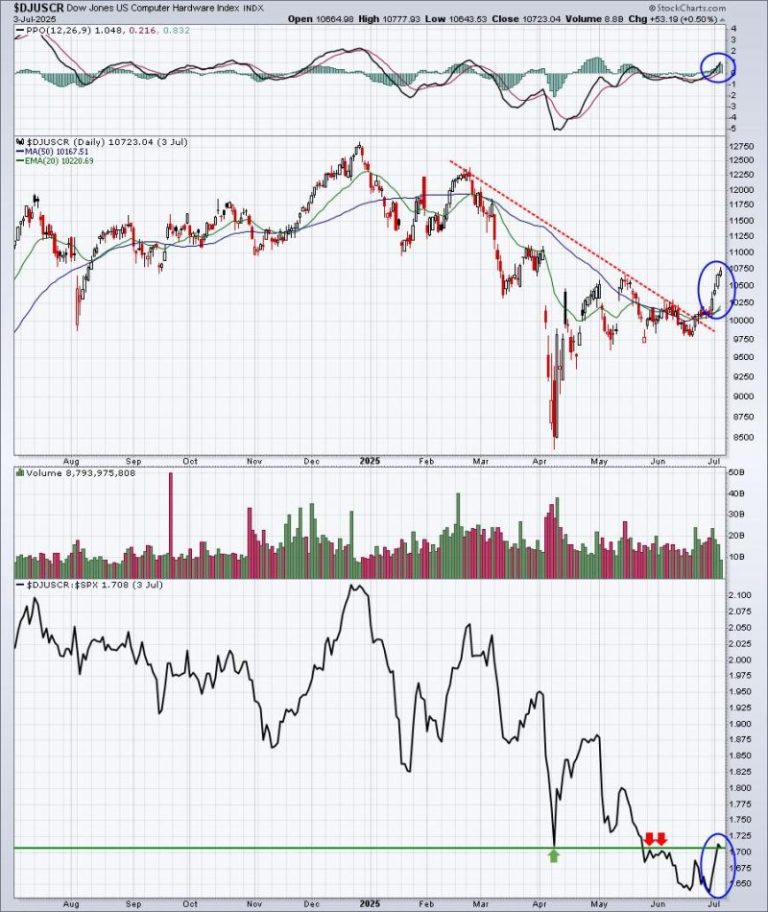
I know this group has been out of favor, but that seemed to change last week:

Its absolute downtrend seems to have been broken and we saw a glimpse of solid relative strength. Seasonality also leads me to believe that this run could very well just be getting started. Check this out:

Over the past 20 years, the DJUSCR has crushed the S&P 500 during the months of July and August. It’s easily been the group’s best two calendar months historically. These two months have consistently been great months for computer hardware stocks as they’ve each gained ground in roughly 3 out of every 4 years. Apple, Inc. (AAPL), the leading computer hardware stock, absolutely loves the months of July and August.

I expect last week’s rally to continue right up to AAPL’s earnings report on July 31st, and possibly beyond.

I’ll be featuring one other computer hardware stock in our FREE EB Digest newsletter on Monday morning that has CRUSHED the S&P 500 during July and August historically and it boasts one of the strongest charts in technology since the April low. If you’re not already an EB Digest subscriber, simply CLICK HERE to provide your name and email address. I’ll get that chart out to you first thing tomorrow morning!

Happy trading!

Tom


FPX Nickel Corp. (TSXV: FPX) (OTCQB: FPOCF) (‘ FPX ‘ or the ‘ Company ‘) is pleased to report that it has received a multi-year area-based (‘ MYAB ‘) permit from the government of British Columbia to support the renewal of drilling activities at the Baptiste Nickel Project (‘ Baptiste ‘ or ‘ the Project ‘) in 2025.  This year’s drilling program has commenced successfully, targeting the completion of geomechanical, hydrogeological, and condemnation holes to complement the Project dataset for the feasibility study and the Company’s planned entry into the environmental assessment (‘ EA ‘) process in the second half of 2025.


  Highlights  


  • Receipt of multi-year area-based permit covers all anticipated Baptiste field activities required for the feasibility study (‘ FS ‘) and follows a robust engagement process with nearby First Nations communities before and throughout the permitting process
  •  

  • Phase one FS engineering field investigations to be completed with drilling to occur over an approximate 8-week period beginning in early July
  •  

  • Approximately 2,800 m of geomechanical, hydrogeological, and condemnation drilling is planned around the Project site for this first phase of the FS field program, with most of the meterage focused within the open-pit footprint, focused on long-lead data collection for the EA and FS
  •  

  • Over 75% of fieldwork expenditures are anticipated to be disbursed under the terms of contracts awarded to First Nations-owned or -affiliated businesses operating in central British Columbia  
  •  

‘We are pleased to have received the MYAB permit, which sets the stage for conducting all field activities required for the feasibility study and the commencement of the EA process,’ said Martin Turenne , FPX’s President and CEO. ‘Throughout the permitting process, we have continued to benefit from our collaboration with the government of British Columbia’s Critical Minerals Office, which has played an important role in ensuring a robust engagement process with all impacted First Nations. We continue to build on our inclusive relationships with the multiple First Nations communities connected to the Project, including the proposed mine site and associated off-site infrastructure such as the powerline and access road, and we are proud to support those communities in maximizing their economic participation in this year’s program.’


  Feasibility Study Field Work  


In connection with the environmental and cultural baseline study works ongoing at Baptiste since 2022, FPX has commenced the first phase of FS engineering field investigations. This year’s program is focused on long-lead data collection that will support the EA process, as well as improved engineering definition within the open-pit footprint.


Approximately 2,800 m of geomechanical drilling, hydrogeological drilling, and condemnation drilling is planned around the Project site in 2025, with most of the meterage focused within the open-pit footprint.  The second phase of the FS engineering field investigation program is expected to be undertaken in 2026 and will include resource in-fill drilling, further geomechanical drilling, further hydrogeological drilling, and ex-pit geotechnical drilling. Following the completion of the second phase of engineering field investigations, the FS is expected to be completed in 2027.


  Cultural and Environmental Baseline Studies  


Cultural and environmental baseline studies have been ongoing for the Baptiste Nickel Project since early 2022 and include surface water hydrology and water quality, wildlife, vegetation, fisheries and aquatics, and archeology programs. Ongoing and expanded programs were completed in 2024 in preparation for the EA process. The 2025 program is continuing to study the Project area, and includes ongoing wildlife, climate, hydrology, water quality and hydrogeology work.


The cultural and environmental studies for the Project are being conducted by local First Nations-owned and -affiliated businesses in the Project area. This approach targets the integration of First Nations perspectives into the scoping and execution of these studies and provides a strong collaborative basis for the EA process, which the Company plans to initiate in the second half of 2025.


  Daniel Apai , P.Eng., FPX’s Vice President, Projects, FPX’s Qualified Person under NI 43-101, has reviewed and approved the technical content of this news release.


  About the Baptiste Nickel Project  


The Company’s Baptiste Nickel Project represents a large-scale greenfield discovery of nickel mineralization in the form of a sulphur-free, nickel-iron mineral called awaruite (Ni 3 Fe) hosted in an ultramafic/ophiolite complex.  The absence of sulphur and our ability to connect to the BC Hydro grid means that Baptiste has the potential to be one of the lowest carbon-intensive nickel producers in the world and will produce a very high-grade product that does not require any intermediate smelting or complex refining.  The Baptiste mineral claims cover an area of 453 km 2 west of Middle River and north of Trembleur Lake, in central British Columbia.  In addition to the Baptiste Deposit itself, awaruite mineralization has been confirmed through drilling at several target areas within the same claims package, most notably at the Van Target which is located 6 km to the north of the Baptiste Deposit.  Since 2010, approximately US$55 million has been spent on the exploration and development of Baptiste.


FPX has conducted mineral exploration activities to date subject to the conditions of agreements with First Nations and keyoh holders. In 2024, the Province of British Columbia identified the Baptiste Nickel Project as the first project to be included in the Province’s new Critical Minerals Office (‘ CMO ‘) concierge service initiative, a provincial strategy action to enable the prioritization of critical minerals projects in B.C. The CMO initiative is providing an excellent structure to proactively identify and address issues and opportunities ahead of the Project’s entry into the environmental assessment process.


  About FPX Nickel Corp.  


 FPX Nickel Corp. is focused on the exploration and development of the Baptiste Nickel Project, located in central British Columbia , and other occurrences of the same unique style of naturally occurring nickel-iron alloy mineralization known as awaruite. For more information, please view the Company’s website at https://fpxnickel.com/.  


On behalf of FPX Nickel Corp.


‘Martin Turenne’
Martin Turenne , President, CEO and Director


   Forward-Looking Statements   


  Certain of the statements made and information contained herein is considered ‘forward-looking information’ within the meaning of applicable Canadian securities laws. These statements address future events and conditions and so involve inherent risks and uncertainties, as disclosed in the Company’s periodic filings with Canadian securities regulators. Actual results could differ from those currently projected. The Company does not assume the obligation to update any forward-looking statement.  


  Neither the TSX Venture Exchange nor its Regulation Services Provider accepts responsibility for the adequacy or accuracy of this release.  


SOURCE FPX Nickel Corp.


  View original content to download multimedia: http://www.newswire.ca/en/releases/archive/July2025/07/c0114.html  


News Provided by Canada Newswire via QuoteMedia

This post appeared first on investingnews.com


 Kobo Resources Inc. (TSX.V: KRI):


This press release features multimedia. View the full release here: https://www.businesswire.com/news/home/20250707763650/en/  


2024 Kobo Cup Winner, Kossou


  Kobo Cup  


The Kobo Cup was created as a way to launch Kobo Resources’ community engagement efforts in a way that felt local and genuinely rooted in the lives of the people we work alongside. In Côte d’Ivoire, as across much of Africa, football is more than a sport. It’s a shared language, a daily ritual, and a powerful force that brings people together across generations.


Despite its modest scale, the Kobo Cup 2024 sparked something powerful. It proved that football could be more than a game; it could be a platform for community connection, for showcasing local identity and for inspiring youth. It showed us what’s possible when we invest in more than just infrastructure, we invest in culture.


That initial match planted the seed for a bigger vision: to make the Kobo Cup an annual, community-rooted tournament that grows in both reach and impact each year. That’s why, for the second edition of the Kobo Cup, Kobo Resources has stepped it up, transforming the single match into a dynamic multi-team tournament featuring the villages of Kossou, Bocabo, and Angossé, all located in the vicinity of Kobo’s flagship property The Kossou Gold Project for the 2025 edition, scheduled for late November. This expansion reflects our ongoing commitment to community engagement and inclusion, ensuring more youth, more talent, and more villages get to take part in the celebration.


For 2025, we introduced a village jersey design workshop, allowing young people who may never play on the field to still be part of the tournament in a powerful way.


  The Workshop  


On Monday June 16 th , 2025 at the Kobo Camp situated on the Kossou License, creativity took center stage. A handful of young people from Kossou, Bocabo, and Angossé gathered for an inspiring art workshop, hosted by Kobo Resources in partnership with African Boyz Club, to design the official jerseys their villages will proudly wear at Kobo Cup 2025.


This workshop marked more than a moment of artistic expression. It was the beginning of something bigger: a celebration of identity, talent, and the belief that everyone, on and off the field, has a role to play in the story of their community.


The session began with freehand sketching. Pens, pencils, and blank pages quickly filled with bold symbols, vibrant colors, and personal visions, each design inspired by the history, culture, and energy of the youth’s own communities.


The workshop was led by two Ivorian artists from African Boyz Club, who brought not only artistic expertise but a deep understanding of how art can empower. They guided the youth through a process that was both creative and intentional, encouraging them to think of their designs as visual representations of village pride, unity, and voice.


Each village’s final jersey design was converted into a professional tech pack by Kobo’s design team. These original creations will be produced and unveiled for the upcoming Kobo Cup tournament, bringing authenticity, pride, and ownership to the pitch like never before.


  More Than a Match  


At Kobo Resources, our commitment to community runs deeper than development. This initiative reflects our belief in youth empowerment, cultural expression, and meaningful local engagement. It’s part of our broader Corporate Social Responsibility (CSR) vision, one that celebrates not just what we do, but how and with whom we do it.


This entire journey, from creative expression in June to athletic excellence later this year, is enhanced by incredible local partnerships:


  •   African Boyz Club , a company based in Abidjan, is leading the way in the youth workshop, offering creative guidance and mentorship as the children design jerseys and create transfer art rooted in their local experiences.
  •  

  •   Coast 2 Coast Entertainment is playing a key role in the tournament itself, by providing high-quality football equipment to every player across all participating teams. This ensures that when it’s time to step on the pitch, every player is equally equipped and ready to play, no matter where they come from.
  •  

Together, these partners help Kobo Resources ensure that both the workshop and the tournament reflect our shared values: inclusion, fairness, and celebration of local talent.


Both partners, led by Ivorian men deeply connected to their communities, embody the spirit of the Kobo Cup: grassroots empowerment, local talent, and sustainable contribution. Through art they’re helping transform the Kobo Cup into a space where creativity, culture, and sport intersect.


  Kobo is proud to sponsor the Kobo Cup for its second year and even more so with local partners such as African Boyz Club and Coast 2 Coast Entertainment. Our commitment to maintaining strong community relations is being reflected through the organization of such sporting events which in turn help infuse a sense of hope that anything is possible in this world through selfless engagement. – Edward Gosselin, CEO, Kobo Resources.   


  Football became a tool for social transformation, a universal language that unites, inspires, and opens real pathways for youth in Côte d’Ivoire. We’re proud to support young players by making sure every player steps onto the field equipped, equal, and inspired. – Cheikh-Louis Tall, CEO, Coast 2 Coast   


  To us like sport, art is a highway to a better tomorrow by winning self- confidence and developing curiosity. Through our involvement in the Kobo Cup, we’re proud to guide young people as they turn their ideas into symbols of village pride, unity, and expression. – Fred Gnaoré, Founder, African Boyz Club   


At Kobo Resources, community integration is more than a commitment, it’s a cornerstone of how we work. Through initiatives like this workshop, we aim to create opportunities that go beyond the project and stay rooted in the lives of those around us.


As the countdown to Kobo Cup 2025 begins, the energy is already building. And when the players step onto the field, they’ll wear more than a jersey, they’ll wear a story, designed by the youth, for the village, and for the future.


About Kobo Resources Inc. 


 Kobo Resources is a growth-focused gold exploration company with a compelling new gold discovery in Côte d’Ivoire, one of West Africa’s most prolific and developing gold districts, hosting several multi-million-ounce gold mines. The Company’s 100%-owned Kossou Gold Project is located approximately 20 km northwest of the capital city of Yamoussoukro and is directly adjacent to one of the region’s largest gold mines with established processing facilities.


For more information, please visit www.koboresources.com .


  View source version on businesswire.com:    https://www.businesswire.com/news/home/20250707763650/en/   


For further information:


Edward Gosselin
Chief Executive Officer and Director
1-418-609-3587
ir@kobores.com  


Twitter: @KoboResources | LinkedIn: Kobo Resources Inc. 

 

News Provided by Business Wire via QuoteMedia

This post appeared first on investingnews.com

Here’s a quick recap of the crypto landscape for Monday (July 7) as of 9:00 am UTC.

Get the latest insights on Bitcoin, Ethereum and altcoins, along with a round-up of key cryptocurrency market news.

Bitcoin and Ethereum price update

Bitcoin (BTC) is priced at US$108,960, trading flat in the last 24 hours. The day’s range for the cryptocurrency brought a low of US$108,077 and a high of US$109,574.

Bitcoin price performance, July 7, 2025.

Chart via TradingView

Ethereum (ETH) is priced at US$2,581.84, up by 1.8 percent over the past 24 hours. Its lowest valuation as of Monday was US$2,513.50 and its highest was US$2,598.09.

Altcoin price update

  • Solana (SOL) was priced at US$152.49, up by three percent over 24 hours. Its highest valuation as of Monday was US$153.27, and its lowest was US$148.10.
  • XRP was trading for US$2.27, trading flat in the past 24 hours. The cryptocurrency’s lowest valuation was US$2.25 and its highest was US$2.29.
  • Sui (SUI) is trading at US$2.91, trading flat over the past 24 hours. Its lowest valuation was US$2.88 and its highest was US$2.96.
  • Cardano (ADA) is priced at US$0.5877, up by 1.2 percent in the last 24 hours. Its lowest valuation as of Monday was US$0.5776 and its highest was US$0.5922.

Today’s crypto news to know

SEC’s crypto ETF guidance signals mainstream shift

The US Securities and Exchange Commission took a major step toward regulating crypto exchange-traded products with its first formal guidance on crypto ETP disclosures, according to a Reuters analysis.

Issued last week, the 12-page document clarifies how issuers should describe risks and custody arrangements in “plain English,” which could speed up approval of dozens of new crypto ETFs tied to Solana, XRP, and even Trump’s meme coin.

The SEC is also developing a more standardized listing rule to replace the case-by-case exemptions that currently delay launches. That change could shrink approval timelines from 240 days to as little as 75.

Insiders expect the next round of SEC guidance, potentially out by autumn, to fully reshape how crypto funds come to market.

Musk’s America Party goes all-in on Bitcoin, calls fiat ‘hopeless’

Elon Musk confirmed that his newly formed America Party will officially embrace Bitcoin after declaring that “fiat is hopeless” in a post on X.

The move follows Musk’s earlier hints at increasing his own Bitcoin exposure and praising Bitcoin as a hedge against traditional currency.

Musk previously supported Donald Trump’s reelection campaign and even headed the Department of Government Efficiency before splitting with Trump over his budget bill, leading to the creation of the America Party.

The shift could inject more digital asset discussions into US politics as Musk tries to build a third-party movement.

Despite hype from Dogecoin supporters, no plans for DOGE adoption were announced.

Metaplanet boosts Bitcoin stash past 15,500 BTC in aggressive buying spree

Japan’s Metaplanet disclosed this week that it purchased another 2,205 BTC at an average price of 15.64 million yen per coin, spending around US$213 million.

This purchase brings the firm’s total bitcoin holdings to 15,555 BTC, making Metaplanet one of the world’s largest corporate holders of the asset.

The company tracks a proprietary metric called BTC Yield, measuring the effect of share dilution on per-share bitcoin value.

For the second quarter, Metaplanet reported a BTC Yield of 95.6 percent, down from 309.8 percent the previous quarter, but still strong enough to highlight aggressive growth.

Metaplanet’s total BTC investment now tops US$1.38 billion.

Securities Disclosure: I, Giann Liguid, hold no direct investment interest in any company mentioned in this article.

Securities Disclosure: I, Meagen Seatter, hold no direct investment interest in any company mentioned in this article.

This post appeared first on investingnews.com


Trading resumes in:


Company: Stallion Uranium Corp.


TSX-Venture Symbol: STUD


All Issues: Yes


Resumption (ET): 9:30 AM  


CIRO can make a decision to impose a temporary suspension (halt) of trading in a security of a publicly-listed company. Trading halts are implemented to ensure a fair and orderly market. CIRO is the national self-regulatory organization which oversees all investment dealers and trading activity on debt and equity marketplaces in Canada .


SOURCE Canadian Investment Regulatory Organization (CIRO) – Halts/Resumptions


  View original content: http://www.newswire.ca/en/releases/archive/July2025/07/c5804.html  


News Provided by Canada Newswire via QuoteMedia

This post appeared first on investingnews.com