Author

admin

Browsing

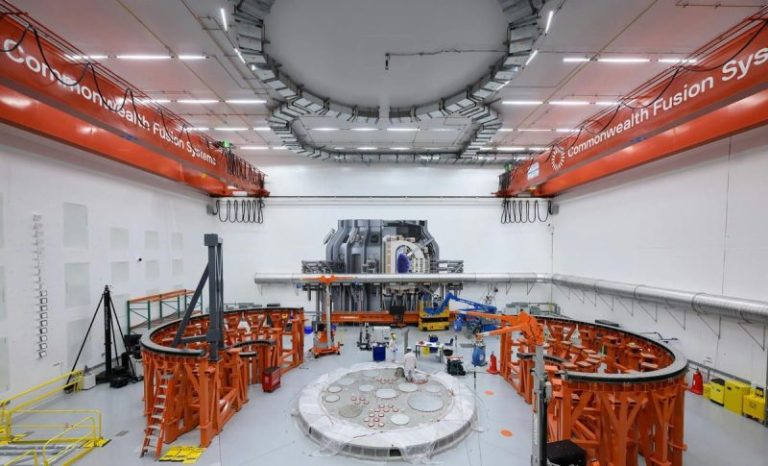
Google on Monday announced a partnership with Commonwealth Fusion Systems, or CFS, a private company spun off from the Massachusetts Institute of Technology, which marks the tech giants first commercial commitment to fusion.

The company unveiled plans to buy 200 megawatts of clean fusion power from what CFS describes as the world’s first grid-scale fusion power plant, known as ARC, based in Chesterfield County, Virginia.

ARC is expected to come online and generate 400 megawatts of clean, zero-carbon power in the early 2030s, which is enough energy to power large industrial sites or roughly 150,000 homes, according to CFS. The agreement also gives Google the option to purchase power from additional ARC plants.

Google, which has invested in CFS since 2021, said it also increased its stake in the Devens, Massachusetts-based company.

Google and CFS did not disclose the financial terms.

“We’re excited to make this longer-term bet on a technology with transformative potential to meet the world’s energy demand, and support CFS in their effort to reach their scientific and engineering milestones needed to get there,” Michael Terrell, head of advanced energy at Google, said in a statement.

Fusion is a process that takes light atomic nuclei and heats them to over 100 million degrees Celsius. At these temperatures, the fuel becomes a plasma, which eventually causes the nuclei to fuse and release significant amounts of energy. The energy is then captured to create carbon-free electricity.

CFS is one of many firms racing to achieve commercial-scale fusion energy and Google has invested in others. Earlier this month, Google announced continued funding for TAE Technologies, a California-based fusion energy company.

This post appeared first on NBC NEWS

 Nuvau Minerals Inc. (TSXV: NMC) (the ‘Company’ or ‘Nuvau’) is pleased to announce the results of its annual and special meeting of shareholders of the Company (the ‘Meeting’) held on June 26, 2025.

A total of 18,122,588 common shares of the Company (‘Common Shares‘) were represented, in person or by proxy, at the Meeting, representing approximately 35.5% of the total issued and outstanding common shares as of the record date of the Meeting.

All matters presented for shareholder approval at the Meeting were overwhelmingly approved as follows:

  • Peter van Alphen, Ewan Downie, Fariah Mir, Christina McCarthy, Michael Vitton and Steven Bowles were each re-elected as directors of the Company for the ensuing year;
  • Ernst & Young LLP was re-appointed as auditor of the Company for the ensuing year and the directors of the Company have been authorized to fix their remuneration; and
  • the Company’s omnibus equity incentive plan was re-approved by shareholders in accordance with the policies of the TSX Venture Exchange (the ‘Omnibus Plan‘).

The Omnibus Plan was last adopted by shareholders of the Company on August 29, 2024. The Omnibus Plan is a fixed 10% plan and provides for the grant of options, restricted share units, performance share units and deferred share units. The aggregate maximum number of Common Shares reserved for issuance pursuant to the Omnibus Plan is 5,109,999 Common Shares (less any Common Shares reserved for issuance under outstanding awards and under other security-based compensation arrangements of the Company). The Omnibus Plan has received conditional acceptance from the TSX Venture Exchange.

In addition, and further to the Company’s commitment to growing its business within Quebec, the Company is pleased to announce the appointment of Quebec based Steven Bowles as Chair of the board of the directors of the Company effective as of June 27, 2025. Steven Bowles has extensive experience in the Mining & Metals sector, encompassing private equity, private credit, M&A, and projects/operations management. He currently serves as Managing Director at Nebari Partners. Prior to this role, he held the position of Senior Director of investment in natural resources and energy within Investment Quebec’s private equity group.

For more details regarding the matters presented at the Meeting, please refer to the management information circular dated May 26, 2025, which is accessible on SEDAR+ (www.sedarplus.ca) under the Company’s issuer profile and on the Company’s website at www.nuvauminerals.com.

About Nuvau Minerals Inc.

Nuvau is a Canadian mining company focused on the Abitibi Region of Québec. Nuvau’s principal asset is the Matagami Property that is host to significant existing processing infrastructure and multiple mineral deposits and is being acquired from Glencore.

For more information go to our website www.nuvauminerals.com.

For further information please contact:

Nuvau Minerals Inc.
Peter van Alphen
President and CEO
Telephone: 416-525-6023
Email: pvanalphen@nuvauminerals.com

Cautionary Statement on Forward-Looking Information

This news release contains ‘forward-looking information’ within the meaning of applicable Canadian securities legislation based on expectations, estimates and projections as at the date of this news release. Any statement that involves predictions, expectations, interpretations, beliefs, plans projections, objectives, assumptions, future events or performance (often, but not always, using phrases such as ‘expects’, or ‘does not expect’, ‘is expected’, ‘interpreted’, ‘management’s view’, ‘anticipates’ or ‘does not anticipate’, ‘plans’, ‘budget’, ‘scheduled’, ‘forecasts’, ‘estimates’, ‘potential’, ‘feasibility’, ‘believes’ or ‘intends’ or variations of such words and phrases or stating that certain actions, events or results ‘may’ or ‘could’, ‘would’, ‘might’ or ‘will’ be taken, occur or be achieved) are not statements of historical fact and may be forward-looking information and are intended to identify forward-looking information. This news release contains forward-looking information pertaining to, among other things: the Company’s ability to complete the earn-in to acquire the Matagami Property; the Matagami Property holding multiple mineral deposits; and the significance of existing infrastructure at the Matagami Property.

Forward-looking information is not a guarantee of future performance and is based upon a number of estimates and assumptions of management, in light of management’s experience and perception of trends, current conditions and expected developments, as well as other factors that management believes to be relevant and reasonable in the circumstances. Forward-looking information involves risks, uncertainties and other factors that could cause actual events, results, performance, prospects and opportunities to differ materially from those expressed or implied by such forward-looking information. Factors that could cause actual results to differ materially from such forward-looking information are set out in the Company’s public disclosure record on SEDAR+ (www.sedarplus.ca) under the Company’s issuer profile. Although the Company believes that the assumptions and factors used in preparing the forward-looking information in this news release are reasonable, undue reliance should not be placed on such information, which only applies as of the date of this news release, and no assurance can be given that such events will occur in the disclosed time frames or at all. The Company disclaims any intention or obligation to update or revise any forward- looking information, whether as a result of new information, future events or otherwise, other than as required by law.

Neither the TSX Venture Exchange nor its Regulation Services Provider (as that term is defined in the policies of the TSX Venture Exchange) accept responsibility for the adequacy or accuracy of this news release. No stock exchange, securities commission or other regulatory authority has approved or disapproved the information contained herein.

To view the source version of this press release, please visit https://www.newsfilecorp.com/release/257278

News Provided by Newsfile via QuoteMedia

This post appeared first on investingnews.com

China’s Zijin Mining Group (OTC Pink:ZIJMF,HKEX:2899,SHA:601899), the country’s largest producer of gold and copper, has agreed to acquire Kazakhstan’s Raygorodok gold mine for US$1.2 billion.

The deal, announced on Monday (June 30) through a filing to the Hong Kong Stock Exchange, furthers the company’s ambition of becoming one of the world’s top three gold producers by 2028.

Raygorodok is reportedly among the largest and most technologically advanced gold projects in Central Asia. It produced 6 metric tons of gold in 2024 at a production cost of US$796 per ounce, excluding non-cash items.

With a remaining mine life of 16 years and average annual output of 5.5 metric tons of gold, Zijin expects the mine, located in Northern Kazakhstan, to boost both its earnings and production starting this year.

Raygorodok’s total ore reserves are estimated at 94.9 million metric tons, containing approximately 100.6 metric tons (3.5 million ounces) of gold, based on a gold price of US$1,750 per ounce.

However, Zijin believes that considering the current market for the yellow metal, there is clear potential to expand production and reserves by improving the pit design under a higher gold price assumption. Furthermore, a US$420 million processing plant, operational since mid-2022, has significantly expanded the mine’s output capacity.

Annual production rose from 50,000 ounces in 2023 to an expected 190,000 ounces in 2025, using carbon-in-pulp and heap-leaching technologies that improve extraction efficiency from low-grade ore. As of the end of 2024, Raygorodok reported net assets of US$291 million and posted a net profit of US$202 million on US$473 million in revenue.

The asset is currently owned by Cantech, a Kazakhstan-based firm 65 percent held by V Group International, one of the country’s largest equity investment companies, and backed by US private equity firm Resource Capital Funds.

Through its subsidiaries, Zijin Gold International and Jinha Mining, Zijin signed definitive agreements to purchase all rights and interests in RG Gold and RG Processing, the Kazakhstan-based entities that own and operate the mine.

The acquisition is expected to close by the end of September of this year, pending regulatory approvals from both Chinese and Kazakh authorities.

Zijin Gold IPO in the works

Zijin operates gold mines in China and globally in locations such as Africa and South America.

But Raygorodok is set to become one of its flagship assets, aligning with the group’s goal of raising annual gold production by 35 percent — from 73 metric tons in 2024 to 100 to 110 metric tons by 2028.

The acquisition also serves a broader corporate strategy: the planned initial public offering (IPO) of Zijin Gold International, the group’s overseas gold division, on the Hong Kong Stock Exchange.

Established in 2007, Zijin Gold International is being positioned as the vehicle for consolidating Zijin’s foreign gold assets and unlocking shareholder value. The IPO is expected to raise between US$1.5 billion and US$2 billion. Proceeds will be used for further expansion across Africa and South America.

The spinoff remains subject to approval from Chinese regulators, Zijin shareholders, the Hong Kong Securities and Futures Commission and the Hong Kong Stock Exchange.

Zijin has emphasized that the listing will not affect its control over the subsidiary. Furthermore, Zijin Gold International will remain under Zijin’s consolidated financial statements post-listing.

Securities Disclosure: I, Giann Liguid, hold no direct investment interest in any company mentioned in this article.

This post appeared first on investingnews.com

Terra Clean Energy (CSE:TCEC,OTCQB:TCEFF,FSE:C9O0) is advancing its 100 percent-owned South Falcon East Project, strategically located in the southeastern Athabasca Basin, Saskatchewan — one of the world’s premier uranium districts. The project stands out among uranium juniors for its shallow mineralization, strong discovery potential, and proximity to established infrastructure.

Anchored by a historical resource of nearly 7 million pounds (Mlbs) U₃O₈ at the Fraser Lakes Zone B, the project also hosts multiple zones of confirmed mineralization and structural alteration. Terra is advancing toward a NI 43-101-compliant resource update in 2025, with the goal of materially expanding its resource base. Situated along the highly prospective Way Lake Conductor — a folded, uranium-enriched corridor — the project offers significant upside for new discoveries beyond the existing resource.

South Falcon East, Terra Clean Energy’s flagship project, spans 12,234 hectares on the southeastern margin of the Athabasca Basin, Saskatchewan, just 55 km east of the historic Key Lake uranium mill. The project hosts the Fraser Lakes Zone B deposit, with a historical inferred resource of 6.96 Mlbs U₃O₈ at 0.03% and 5.34 Mlbs ThO₂ at 0.023 percent, contained within 10.35 Mt using a 0.01 percent U₃O₈ cutoff. While not yet classified under NI 43-101, Terra considers the resource data reliable and a strong foundation for future exploration and growth.

Company Highlights

  • Unique, Shallow Uranium System: Only micro-cap in the Athabasca Basin advancing a near-surface uranium deposit, with significantly reduced exploration and potential development costs.
  • Pounds-in-the-ground Upside: Historical resource of 6.96 Mlbs U₃O₈ and 5.34 Mlbs ThO₂, with considerable expansion potential from historical and recent drilling.
  • Prime Location: Situated 55 km east of the Key Lake Mill within the prolific Athabasca Basin – home to the world’s highest-grade uranium deposits.
  • Strong Technical Leadership: Led by a team with extensive uranium exploration and capital markets experience, including veterans from Skyharbour Resources and Azincourt Energy.
  • Resource Update Underway: 2024–25 infill and step-out drilling will support an NI 43-101 compliant mineral resource estimate, incorporating higher-grade intercepts from Terra’s 2024 campaign.
  • Re-rating Potential: Market cap under $5 million despite having a historical uranium resource, confirmed mineralized zones, and near-term catalysts.

This Terra Clean Energy profile is part of a paid investor education campaign.*

Click here to connect with Terra Clean Energy (CSE:TCEC) to receive an Investor Presentation

This post appeared first on investingnews.com

Investor Insight

With a clear, discovery-focused strategy, Terra Clean Energy is advancing one of the most unique near-surface uranium opportunities in the Athabasca Basin, targeting rapid resource growth and re-rating potential through continuous exploration, aggressive drilling, and disciplined capital deployment.

Overview

Terra Clean Energy (CSE:TCEC,OTCQB:TCEFF,FSE:C9O0) is unlocking value from its wholly owned South Falcon East project, located in the southeastern Athabasca Basin in Saskatchewan, Canada. The project uniquely positions Terra among uranium juniors due to its shallow mineralization and proximity to world-class infrastructure.

With a historical uranium resource of nearly 7 million lbs (Mlbs) U₃O₈ at Fraser Lakes Zone B, and multiple zones of confirmed mineralization and structural alteration, Terra is targeting an updated NI 43-101 resource in 2025, aiming to significantly grow its asset base. The project’s location along the Way Lake Conductor – a folded, fertile corridor – offers blue-sky potential for additional discoveries.

As global demand for uranium surges due to energy security concerns and the electrification boom (AI, EVs, nuclear baseload), Terra offers investors a rare combination of historical resource foundation, shallow mineralization, and transformational growth potential at a micro-cap valuation.

Company Highlights

  • Unique, Shallow Uranium System: Only micro-cap in the Athabasca Basin advancing a near-surface uranium deposit, with significantly reduced exploration and potential development costs.
  • Pounds-in-the-ground Upside: Historical resource of 6.96 Mlbs U₃O₈ and 5.34 Mlbs ThO₂, with considerable expansion potential from historical and recent drilling.
  • Prime Location: Situated 55 km east of the Key Lake Mill within the prolific Athabasca Basin – home to the world’s highest-grade uranium deposits.
  • Strong Technical Leadership: Led by a team with extensive uranium exploration and capital markets experience, including veterans from Skyharbour Resources and Azincourt Energy.
  • Resource Update Underway: 2024–25 infill and step-out drilling will support an NI 43-101 compliant mineral resource estimate, incorporating higher-grade intercepts from Terra’s 2024 campaign.
  • Re-rating Potential: Market cap under $5 million despite having a historical uranium resource, confirmed mineralized zones, and near-term catalysts.

Key Project

South Falcon East – Fraser Lakes B Deposit

Located in the southeastern margin of the Athabasca Basin, Saskatchewan, South Falcon East is Terra Clean Energy’s flagship project, covering approximately 12,234 hectares of prospective uranium ground. The property lies 55 km east of the historic Key Lake uranium mill and hosts the Fraser Lakes B deposit, which hosts an inferred historical resource of 6.96 Mlb U₃O₈ at 0.03 percent and 5.34 Mlb thorium dioxide (ThO₂) at 0.023 percent, within 10.35 Mt of material using a 0.01 percent U₃O₈ cutoff grade. While this resource is not currently classified under NI 43-101, Terra believes the data is reliable and serves as a robust foundation for continued exploration.

The mineralization is hosted in fractured and altered pegmatites and graphitic pelitic paragneiss, with the uranium accompanied by thorium and elevated concentrations of copper, nickel, vanadium, zinc, bismuth, molybdenum, lead and cobalt. Alteration assemblages include illite, dickite, kaolinite, chlorite, fluorite and hematite; these are classic markers of basement-hosted unconformity uranium systems. This setting, along with widespread clay alteration and structural disruption, mirrors some of the most prolific uranium systems in the basin, including Eagle Point, Millennium and Roughrider.

Fraser Lakes B sits on the central limb of the Way Lake Conductor, a folded EM corridor extending more than 25 km across the project area. This conductor hosts three major fold limbs (West, Central, and East), but only the central limb, where Fraser Lakes B is located, has been materially drilled. The deposit currently exhibits a strike length of approximately 1,400 meters, dipping northwest, and remains open in all directions. A north-northeast-trending fault, known as the T-Bone Lineament, intersects the deposit’s eastern margin, suggesting additional structural complexity and potential uranium conduits along strike.

Historic drilling from 2008 to 2015 by Skyharbour Resources and JNR Resources identified numerous mineralized intervals. Highlights include:

  • 0.165 percent U₃O₈ over 2 m (within a broader 6 m grading 0.103 percent U₃O₈) in FP-15-05.
  • 0.183 percent U₃O₈ over 1 m in WYL-50.
  • 0.242 percent U₃O₈ over 0.5 m in WYL-61.
  • 0.057 percent U₃O₈ over 5.5 m in the same hole.

These results demonstrate multiple stacked mineralized horizons over widths up to 65 m, open to depth and laterally.

In early 2024, Terra’s Phase 1 drill program confirmed the presence of uranium-bearing pegmatites in close proximity to historical intercepts. Hole SF-0059 intersected 13.5 m of mineralization, including 0.07 percent eU₃O₈ over 1.1 m, while SF-0060 returned intervals such as 0.02 percent eU₃O₈ over 1.3 m at 142.15 m. These intercepts confirm the extension of mineralization along strike and at depth from FP-15-05 and support the hypothesis of lateral continuity and stacked mineralized bodies.

Planning for an extensive summer 2025 drill program is underway, which consists of approximately 2,500 meters. The program will test areas identified during the winter 2024 program, where it is interpreted that a north-northwest trending brittle structure, a north dipping structure with strong clay alteration, and mineralized pegmatites with hydrothermal hematite alteration hosted in graphitic pelitic gneiss all intersect.

In addition to Fraser Lakes B, the company is evaluating regional targets such as T-Bone Lake, which has returned values up to 0.055 percent U₃O₈ over 0.9 m and features promising clay alteration and structural complexity similar to known high-grade deposits.

The overarching exploration thesis is that the Way Lake Conductor may host a clustered uranium system, with multiple deposits along its folded structure. Very little drilling has been conducted outside the current Fraser Lakes B footprint, giving Terra significant discovery potential across the entire 25 km strike length.

Management Team

Greg Cameron – President, CEO and Director

A seasoned capital markets professional, Greg Cameron has two decades of experience in business development, strategy and M&A. He is a former senior banker at Canaccord Genuity and Macquarie, and managing director at Colby Capital. He brings transactional and restructuring expertise critical to junior exploration growth.

C. Trevor Perkins – VP, Exploration

A professional geologist, C. Trevor Perkins has a track record in uranium exploration, including major results in the Athabasca Basin. He also serves as VP exploration for Azincourt Energy and has led exploration strategy and drill execution across multiple high-impact programs.

Alex Klenman – Director

Alex Klenman is a veteran junior mining executive with 30+ years’ experience, including uranium-specific roles. He is the CEO and director of Azincourt Energy, and has raised more than $18 million for Athabasca exploration. Klenman brings deep investor relations and financing expertise.

Tony Wonnacott – Director

Tony Wonnacott is a Toronto-based securities lawyer with more than 25 years of experience in capital markets. Instrumental in multiple successful listings and over $1 billion in financings and M&A transactions.

Brian Shin – CFO

Brian Shine is a chartered professional accountant with 15 years’ experience across roles in public companies. He specializes in reporting, risk management and corporate finance.

Jordan Trimble – Technical Advisor

Jordan Trimble is the CEO of Skyharbour Resources and a leading voice in the uranium investment community. He brings global capital markets insight and technical expertise, enhancing Terra’s industry reach and credibility.

This post appeared first on investingnews.com

Here’s a quick recap of the crypto landscape for Friday (June 27) as of 9:00 a.m. UTC.

Get the latest insights on Bitcoin, Ethereum and altcoins, along with a round-up of key cryptocurrency market news.

Bitcoin and Ethereum price update

Bitcoin (BTC) is priced at US$107,027, trading flat in the last 24 hours. The day’s range for the cryptocurrency brought a low of US$106,709 and a high of US$107,884.

Bitcoin price performance, June 27, 2025.

Chart via TradingView.

Ethereum (ETH) closed at US$2,449.37, trading flat over the past 24 hours. Its lowest valuation on Friday was US$2,402.46 and its highest valuation was US$2,459.96 at the opening bell.

Altcoin price update

  • Solana (SOL) was priced at US$142.26, down 0.6 percent over 24 hours. Its highest valuation as of Friday was US$143.46, and its lowest was US$143.46.
  • XRP was trading for US$2.10, down by 1.3 percent in 24 hours. The cryptocurrency’s highest valuation was US$2.08, and its lowest price on Wednesday was US$2.14.
  • Sui (SUI) is trading at US$2.63, showing an increaseof 1.4 percent over the past 24 hours. Its lowest valuation was US$2.59, and its highest valuation was US$2.67.
  • Cardano (ADA) is priced at US$0.5580, trading flat in the last 24 hours. Its highest valuation as of Friday was US$0.5631, and its lowest was US$0.5496.

Today’s crypto news to know

Trump’s World Liberty adds UK DeFi partner, eyes stablecoin vault

World Liberty Financial, the crypto venture connected to Donald Trump’s family, has secured a partnership with Re7 Capital, a London-based decentralized finance hedge fund, in a bid to scale its USD1 stablecoin.

Backed by up to US$10 million in investment from Hong Kong’s VMS Group, Re7 Capital will work with World Liberty on deploying a stablecoin vault on the Euler and Lista protocols, while also expanding to Binance’s BNB Chain.

VMS Group, a family office for wealthy Hong Kong clients, is making its first crypto move through its stake in Re7.

Meanwhile, the Middle East’s Aqua 1 Foundation disclosed a US$100 million investment into World Liberty tokens, becoming its largest single investor.

UAE’s Aqua 1 buys US$100 million of Trump’s World Liberty Tokens

The Aqua 1 Foundation, a relatively low-profile fund based in the United Arab Emirates, confirmed a US$100 million purchase of World Liberty tokens, linked to Donald Trump’s family-backed crypto initiative.

The tokens, known as $WLFI, function as governance tokens, meaning holders vote on protocol changes but cannot yet freely trade them. World Liberty said it hopes to eventually allow these tokens to become transferable.

The partnership will also help identify and develop blockchain projects across South America, Europe, and Asia. The fund also plans to launch a separate vehicle to advance Middle East digital economic initiatives using blockchain and artificial intelligence.

Despite the investment, Aqua 1 maintains a very minimal online footprint, with only three posts on X and a website registered just weeks ago.

World Liberty says Aqua 1’s teams will support its compliance and expansion efforts going forward.

Bitcoin logs weakest monthly growth despite strong ETF flows

Bitcoin’s performance is stalling despite massive inflows to spot ETFs, pointing to shifting market forces.

The leading crypto asset has climbed just 2 percent for the month, marking its smallest gain since July 2023, even with US$3.9 billion in inflows over recent weeks.

Data shows that whales holding over 10,000 BTC have leaned toward selling, dampening bullish momentum. Smaller wallets have also been net sellers, further pressuring prices as opportunistic traders take profits.

Between January and April, most market participants had offloaded assets until accumulation restarted near US$76,000 in April.

Now, Bitcoin is consolidating with realized profits in the current cycle hitting US$650 billion, higher than last cycle’s $US550 billion.

Securities Disclosure: I, Giann Liguid, hold no direct investment interest in any company mentioned in this article.

This post appeared first on investingnews.com

It’s a bittersweet day for Windows users.

Microsoft is scrapping its iconic “blue screen of death,” known for appearing during unexpected restarts on Windows computers. The company revealed a new black iteration in a blog post on Thursday, saying that it is “streamlining the unexpected restart experience.”

The new black unexpected restart screen is slated to launch this summer on Windows 11 24H2 devices, the company said. Microsoft touted the updates as an “easier” and “faster” way to recover from restarts.

The software giant’s blue screen of death dates back to the early 1990s, according to longtime Microsoft developer Raymond Chen.

Travelers walk past screens after a major disruption in Microsoft’s cloud services caused widespread flight cancellations and delays at T3 IGI Airport in New Delhi, India, on July 19.Vipin Kumar / Hindustan Times via Getty Images file

Microsoft also said it plans to update the user interface to match the Windows 11 design and cut downtime during restarts to two seconds for the majority of users.

“This change is part of a larger continued effort to reduce disruption in the event of an unexpected restart,” Microsoft wrote.

The iconic blue screen was seemingly everywhere in July 2024 after a faulty update from CrowdStrike crashed computer systems around the world.

This post appeared first on NBC NEWS

Apple Thursday made changes to its App Store European policies, saying it believes the new rules will help the company avoid a fine of 500 million euro ($585 million) from the EU for violating the Digital Markets Act.

The new policies are a complicated system of fees and programs for app makers, with some developers now paying three separate fees for one download. Apple also is going to introduce a new set of rules for all app developers in Europe, which includes a fee called the “core technology commission” of 5% on all digital purchases made outside the App Store.

The changes Apple announced are not a complete departure from the company’s previous policy that drew the European Commission’s attention in the first place.

Apple said it did not want to make the changes but was forced to by the European Commission’s regulations, which threatened fines of up to 50 million euros per day. Apple said it believed its plan is in compliance with the DMA and that it will avoid fines.

“The European Commission is requiring Apple to make a series of additional changes to the App Store,” an Apple spokesperson said in a statement. “We disagree with this outcome and plan to appeal.”

A spokesperson for the European Commission did not say that Apple was no longer subject to the fine. He said in a statement that the EC is looking at Apple’s new terms to see if the company is in compliance.

“As part of this assessment the Commission considers it particularly important to obtain the views of market operators and interested third parties before deciding on next steps,” the spokesperson said in a statement.

The saga in Brussels is the latest example of Apple fiercely defending its App Store policies, a key source of profit for the iPhone maker through fees of between 15% and 30% on downloads through its App Store.

It also shows that Apple is continuing to claim it is owed a commission when iPhone apps link to websites for digital purchases overseas despite a recent court ruling that barred the practice in the U.S.

Under the Digital Markets Act, Apple was required to allow app developers more choices for how they distribute and promote their apps. In particular, developers are no longer prohibited from telling their users about cheaper alternatives to Apple’s App Store, a practice called “steering” by regulators.

In early 2024, Apple announced its changes, including a 50 cent fee on off-platform app downloads.

Critics, including Sweden’s Spotify, pushed back on Apple’s proposed changes, saying that the tech firm chose an approach that violated the spirit of the rules, and that its fees and commissions challenge the viability of the alternative billing system. The European Commission investigated for a year, and it said on Thursday that it would again seek feedback from Apple’s critics.

“From the beginning, Apple has been clear that they didn’t like the idea of abiding by the DMA,” Spotify said last year.

Epic Games CEO Tim Sweeney, whose company successfully changed Apple’s steering rules in the U.S. earlier this year, accused Apple of “malicious compliance” in its approach to the DMA.

“Apple’s new Digital Markets Act malicious compliance scheme is blatantly unlawful in both Europe and the United States and makes a mockery of fair competition in digital markets,” Sweeney posted on social media on Thursday. “Apps with competing payments are not only taxed but commercially crippled in the App Store.”

The European Commission announced the 500 million euro fine in April. The commission at the time said that the tech company might still be able to make changes to avoid the fine.

Apple’s restrictions on steering in the United States were tossed earlier this year, following a court order in the long-running Epic Games case. A judge in California found that Apple had purposely misled the court about its steering concessions in the United States and instructed it to immediately stop asking charging a fee or commission on for external downloads.

The order is currently in effect in the United States as it is being appealed and has already shifted the economics of app development. As a result, companies like Amazon and Spotify in the U.S. can direct customers to their own websites and avoid Apple’s 15% to 30% commission.

In the U.S., Amazon’s iPhone Kindle app now shows an orange “Get Book” button that links to Amazon.com.

This post appeared first on NBC NEWS

It was a week of downward momentum for the gold price.

The yellow metal neared the US$3,400 per ounce level on Monday (June 23) as investors reacted to the weekend’s escalation in tensions in the Middle East, but sank to just above US$3,300 the next day.

The decline came as US President Donald Trump announced that Israel and Iran had agreed to a ceasefire. While the ceasefire has not gone entirely smoothly, with Trump expressing displeasure about violations, the news appeared to calm investors.

Gold’s safe-haven appeal took another hit toward the end of the week, when Trump said late on Thursday (June 26) that the US had signed a trade deal with China. Although details remain scarce — China’s commerce ministry confirmed the arrangement, but said little else — the gold price dropped on the news, closing Friday (June 27) at about US$3,274.

It was a different story for other precious metals this week.

Silver enjoyed an uptick, rising as high as US$36.79 per ounce before pulling back to the US$36 level. Whether it can continue breaking higher remains to be seen, but many experts are optimistic.

In fact, Randy Smallwood of Wheaton Precious Metals (TSX:WPM,NYSE:WPM) said that right now he’s perhaps more excited about silver than he is about gold. Here’s how he explained it:

There’s not a lot of new production coming on stream, just because most silver comes as a by-product from lead, zinc and copper mines — more than half of silver. And we’re just not seeing the investment into the base metals space that we need to sustain that production and grow that production.

As excited as I am about gold, I think silver’s got a few more fundamentals behind it that make it a pretty exciting time to be watching silver … silver’s got some catching up to do with respect to what gold’s done over the last few years.’

Watch the full interview with Smallwood for more on silver, as well as gold and platinum.

Speaking of platinum, it was also on the move this week, rising above US$1,400 per ounce.

The move has turned heads — despite a persistent supply deficit, platinum has spent years trading in a fairly tight range, and it hasn’t crossed US$1,400 since 2014.

Recent trends supporting platinum’s move include a shift toward platinum jewelry due to the high cost of gold, as well as larger platinum imports to the US earlier this year when tariff uncertainty was heating up. At the same time, miners have faced challenges.

‘This has led to tight forward market conditions,’ said Jonathan Butler of Mitsubishi (TSE:8058), ‘with a deep backwardation across the curve.’ In his view, these conditions will continue providing support for the precious metal in the coming weeks.

Bullet briefing — Gold repatriation, Rule Symposium

Germany, Italy to repatriate gold?

Germany and Italy are facing calls to bring home gold stored in the US.

According to the Financial Times, politicians and economists in the two countries are pushing for repatriation as a result of global geopolitical uncertainty, as well as concerns about Trump’s potential influence on the Federal Reserve as he continues to criticize Chair Jerome Powell.

‘We are very concerned about Trump tampering with the Federal Reserve Bank’s independence. Our recommendation is to bring the (German and Italian) gold home to ensure European central banks have unlimited control over it at any given point in time’ — Michael Jäger, Taxpayers Association of Europe

The news outlet calculates that German and Italian gold held in the US has a total value of about US$245 billion. Market participants agree that it would be a blow to relations with America if the countries were to bring their gold home at this time.

At least for now they seem unlikely to do so — although Italy’s central bank hasn’t commented, Germany’s Bundesbank said it sees the New York Fed as ‘trustworthy and reliable.’

Send your questions for the Rule Symposium

The Rule Symposium runs in Boca Raton, Florida, from July 7 to 11, and I’ll be heading there to interview Rick Rule, as well as Adrian Day, Lobo Tiggre, Andy Schectman, Dr. Nomi Prins and more.

Securities Disclosure: I, Charlotte McLeod, hold no direct investment interest in any company mentioned in this article.

This post appeared first on investingnews.com

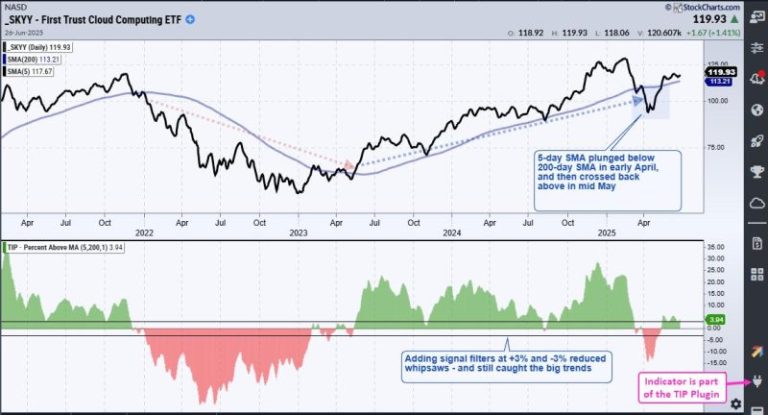
Chartists can improve their odds and increase the number of opportunities by trading short-term bullish setups within bigger uptrends. The first order of business is to identify the long-term trend using a trend-following indicator. Second, chartist can turn to more granular analysis to find short-term bullish setups. Today’s example will use the Cloud Computing ETF (SKYY).

***********************

, which has over a dozen reports. These cover the Zweig Breadth Thrust, trend-following signals, trailing stops and finding bullish setups. Check it out!

//////////////////////////////////////////////////