
Author

admin

Browsing

(TheNewswire)

June 23, 2025 TheNewswire – Vancouver, British Columbia Blue Lagoon Resources Inc. (the ‘ Company ‘) (CSE: BLLG; FSE: 7BL; OTCQB: BLAGF) is pleased to announce that it has entered into a credit agreement with its toll milling partner, Nicola Mining Inc . providing the Company with a $2 million line of credit without any security against the Company’s mineral property or physical assets.

The facility, which carries a competitive interest rate linked to the 3-month SOFR (Secured Overnight Financing Rate), is repayable over a 12-month term with interest-only payments during the first eleven months. At the Company’s discretion, the loan can be extended for an additional 12 months, with adjusted terms.

Importantly, the loan is structured to allow maximum operational flexibility , with no requirement for project collateralization — underscoring Nicola’s confidence in the Dome Mountain Gold Project and its near-term production trajectory.

‘We’re extremely pleased to have the continued support of Nicola Mining, not only as our toll milling partner but also as a continued financial backer,’ said Rana Vig , President and CEO of Blue Lagoon. ‘This line of credit adds an extra layer of security to our already strong balance sheet and gives us added flexibility as we finalize preparations for gold production this summer. It’s a clear sign that sophisticated investors recognize the value of Dome Mountain and its cash flow potential.’

This agreement comes on the heels of Blue Lagoon’s recently completed financing, which was fully subscribed by long time existing shareholders that included Crescat Capital and Phoenix Gold fund as well as new strategic investors. The Company remains fully funded , with no short-term debt and over $3.6 million in in-the-money warrants , positioning it strongly as it enters the final phase of development.

While the Company may ultimately never need to draw on this facility, having access to it provides an important financial backstop. It ensures capital is available if needed to support production ramp-up, seize opportunity, or manage any unforeseen short-term needs – all without causing further dilution to existing shareholders.

Peter Espig , President and CEO of Nicola Mining, commented: ‘We’ve worked closely with the Blue Lagoon team for some time and continue to be impressed by their methodical and disciplined approach. Successfully navigating B.C.’s rigorous permitting process, while also building a strong, trust-based relationship with the Lake Babine Nation, speaks volumes about their leadership. We are pleased to provide this credit facility and look forward to supporting their transition to gold and silver production.’

If the Company chooses to access this facility, Nicola Mining will maintain a short-term security interest over the Company’s gold and silver production from the Dome Mountain Gold Project until the loan is repaid in full.

About Blue Lagoon Resources Inc.

Blue Lagoon Resources is a Canadian based publicly listed mining company (CSE: BLLG; FSE: 7BL; OTCQB: BLAGF) focused on building shareholder value through the aggressive development of its 100% owned Dome Mountain Gold project. The Company is run by professionals with significant finance and mining experience and operates within a prime mining jurisdiction in British Columbia, Canada. With the granting of a full mining permit, a key milestone achieved in February 2025 – one of only nine such permits issued in British Columbia since 2015 – Blue Lagoon is now focused on last preparatory activities and tasks related to the safe and secure opening of the Dome Mountain Gold Mine, targeting Q3 2025 as the start of gold production . The Company’s primary objective has always been to become a cash-flowing mining company, to ultimately deliver tangible monetary value to shareholders, state, and local communities.

The Company is not basing its production decision at Dome Mountain on a feasibility study of mineral reserves demonstrating economic and technical viability. The production decision is based on having existing mining infrastructure, past bulk sampling and processing activity, and the established mineral resource.  The Company understands that there is increased uncertainty, and consequently a higher risk of failure, when production is undertaken in advance of a feasibility study.

For further information, please contact:

Rana Vig

President and CEO

Telephone: 604-218-4766

Email: ranavig@bluelagoonresources.com

The CSE has not reviewed and does not accept responsibility for the adequacy or accuracy of this release.

Statement Regarding Forward-Looking Information: This release includes certain statements that may be deemed ‘forward-looking statements’. All statements in this release, other than statements of historical facts, that address events or developments that Blue Lagoon Resources Inc. (the ‘Company’) expects to occur, are forward-looking statements. Forward-looking statements are statements that are not historical facts and are generally, but not always, identified by the words ‘expects’, ‘targets’, ‘plans’, ‘anticipates’, ‘believes’, ‘intends’, ‘estimates’, ‘projects’, ‘potential’, ‘mine’, ‘production’ and similar expressions, or that events or conditions ‘will’, ‘would’, ‘may’, ‘could’ or ‘should’ occur. Although the Company believes the expectations expressed in such forward-looking statements are based on reasonable assumptions, such statements are not guarantees of future performance and actual results may differ materially from those in the forward-looking statements. Factors that could cause the actual results to

differ materially from those in forward-looking statements include results of exploration activities may not show quality and quantity necessary for further exploration or future exploitation of minerals deposits, volatility of gold and silver prices, delays in mine development activities, future cash flow expectations and continued availability of capital and financing, permitting and other approvals, and general economic, market or business conditions.  Investors are cautioned that any such statements are not guarantees of future performance and actual results or developments may differ materially from those projected in the forward-looking statements. Forward-looking statements are based on the beliefs, estimates and opinions of the Company’s management, contractors and consultants on the date the statements are made. Except as required by applicable securities laws, the Company undertakes no obligation to update these forward-looking statements in the event that management’s, contractor’s and consultants’ beliefs, estimates or opinions, or other factors, should change.

Copyright (c) 2025 TheNewswire – All rights reserved.

News Provided by TheNewsWire via QuoteMedia

This post appeared first on investingnews.com

Canada’s tech sector saw momentum this week, with announcements spanning venture capital and quantum computing, as well as global policy leadership news out of the G7 summit.

Axl on a mission to retain Canadian innovation

On Tuesday (June 17), Axl, a newly founded Canadian venture studio, announced plans to help launch 50 artificial intelligence (AI) companies in Canada over the next five years, supported by a C$15 million fund led by co-founder Daniel Wigdor, a computer science professor at the University of Toronto.

The venture’s other founders are Tovi Grossman, another University of Toronto professor, entrepreneur Ray Sharma and former Telus (TSX:T,NYSE:TU) executive David Sharma. Mining magnate Rob McEwen of McEwen Mining (TSX:MUX,NYSE:MUX) and Smart Technologies co-founder David Martin are also investors.

According to Wigdor, Axl will tackle practical business problems and connect them with promising academic research in a bid to keep Canadian innovation at home. “The social contract academics believe we have with society is that we invent these technologies and inspire people,” he told the Globe and Mail on Tuesday. “The tragedy is that the foundational technologies we’re inventing in Canada are not accruing capital for Canada.’

Wigdor pointed to his own career as a cautionary tale, explaining that the iPhone’s multi-touch interface was presaged by research he conducted in the early 2000s for his University of Toronto thesis, which itself built on concepts pioneered by University of Toronto professor Bill Buxton in the 1980s.

Other University of Toronto AI breakthroughs fueled the international rise of figures like Geoffrey Hinton, OpenAI co-founder Ilya Sutskever and xAI’s Jimmy Ba, all of whom took their expertise to US-based companies.

Carney talks tech leadership at G7 summit

Initiatives like Axl’s signal a proactive approach to Canada’s challenge of retaining tech talent and capitalizing on its world-class research; however, its success will hinge on broader public support.

Prime Minister Mark Carney has signaled that fostering tech innovation at home is a priority. He told G7 leaders that driving the digital transition, led by AI and quantum computing, would be one of his top goals at the summit.

Quantum technology was reportedly discussed at length during the two day meeting, which took place in Kananaskis, Alberta. In addition, a joint statement from members released by the prime minister’s office indicates that Canada will launch the G7 GovAI Grand Challenge and host a series of Rapid Solution Labs “to develop innovative and scalable solutions to the barriers we face in adopting AI in the public sector.”

That emphasis echoes longstanding concerns from the research community.

A 2024 letter acquired by the Logic and sent to then-innovation minister François-Philippe Champagne by the Quantum Advisory Council cites the significant sums that other countries have invested in quantum technology.

“The cost of inaction is tremendous,” the group wrote at the time, pointing to Canada’s history of “inventing core technologies,” but letting other countries “grow industries around our inventions.”

The council proposed a C$1 billion program that would mirror the Quantum Benchmarking Initiative (QBI), which fosters domestic quantum computing in the US. The QBI has selected 18 companies for its first phase, including three from Canada; firms that demonstrate the ability to build a functional quantum computer by 2033 will be eligible to receive up to US$316 million, making it a potential “kingmaker” program.

The second phase of the program is set to launch in August 2025. While no relocation demands have been made, concerns exist that later-stage QBI terms could force Canadian winners to the US.

The Quantum Advisory Council said its proposed program would be run by the National Research Council, which would independently assess firms to accelerate the development of competitive domestic quantum companies.

It would build on a C$360 million national quantum strategy announced in April 2021.

The council’s recommendations include increased grants for scientific and social science research into quantum technologies, and a new federal clusters program to foster regional quantum ecosystems encompassing research, development and training, alongside ethical and secure use. It also calls for significant investment in quantum-safe software certification and the development of other security systems.

In a speech at the Quantum Now conference in Montreal on Thursday (June 19), Canada’s AI minister, Evan Solomon, emphasized the need to protect Canada’s talent pipeline. “We cannot allow short-term funding opportunities to hollow out our domestic capabilities or transfer generations of Canadian innovation outside our borders,” he said.

Earlier this month, the minister said he would move away from “over-indexing on warnings and regulation” and instead focus on finding ways to unleash the economic potential of AI. The ongoing collaboration between government initiatives and private ventures will be key to unlocking Canada’s full potential in the new digital era.

Securities Disclosure: I, Meagen Seatter, hold no direct investment interest in any company mentioned in this article.

This post appeared first on investingnews.com

In the face of geopolitical strife oil and gas prices were able to register moderate gains through the first half of 2025, although the second half of the year is likely to be punctuated with continued unrest and supply chain fragility.

Oil benchmarks ended the first quarter slightly off their 2025 start positions, with Brent crude coming in at US$76.08 per barrel and West Texas Intermediate (WT) hitting US$72.87 per barrel before headwinds began sending values lower.

In early May, both benchmarks dropped sharply, Brent slipping nearly 6 percent to US$60.48 while WTI fell to US$57.42, a near two year low. The decline was driven by a combination of weak demand and rising supply as OPEC+ signaled plans to boost production in July, adding to existing oversupply concerns after a surge in global inventories.

Additionally, signs of cooling economic growth in China and renewed trade war anxiety between the US and China further pressured market sentiment. As concerns over a trade war and energy tariffs subsided, prices were able to rally through the rest of May and June to hold in the US$78.42 and US$77.19 range for Brent and WTI, respectively.

Now approaching the year-to-date high level global strife and potential supply constraints are adding support.

During an International Energy Agency (IEA) presentation, Fatih Birol, executive director of the IEA, addressed the current challenges in the global landscape, particularly the mounting conflict in the Middle East.

“The situation is still unfolding, and there are many uncertainties (about) how and if it is going to have structural impacts on the oil and energy markets,” he said, noting that the IEA would not be speculating.

However, Birol did underscore Iran’s position in the global oil market.

“According to our oil market report, currently, Iran produces about 4.8 million barrels per day (mb/d) of crude, condensate and NGL and exports are around 1.8 mb/d of crude oil and 800,000 b/d of products,” he said. “For now, when we look at the markets, we do not see a major supply disruption.”

WTI price performance, December 19, 2024, to June 19, 2025.

Demand expected to trend lower

Although the regional conflicts have infused uncertainty into markets, longer term fundamentals like supply and demand trends are painting a volatile picture.

As noted in the IEA’s recently released Oil 2025: Analysis and Forecast to 2030 report, supply is likely to outpace demand this year and next.

“Our expectations for demand growth are much less than the supply growth,” explained Birol. “We expect demand this year to grow about 700,000 barrels per day, whereas the supply growth we expect is more than double, about 1.8 mb/d.”

More broadly, the IEA report forecasts global oil demand to rise by 2.5 mb/d between 2024 and 2030, reaching 105.5 mb/d by decade’s end.

However, most of that growth will occur early in the period, with gains slowing after 2026 and dipping slightly by 2030. Weaker economic growth and a shift away from oil use in transportation and power generation are the main factors behind the long term slowdown.

Much of the demand forecast is dominated by powerhouse countries US and China which account for 20 mb/d and 13 mb/d respectively, comprising 33 percent of global demand. As such changes to either country’s market can have a large sale effect across the sector.

“When we look at the supply side, global oil production in the last 10 years or so, more than 90 percent of the growth came from the United States. And on the demand side, more than 60 percent of the global oil demand growth came from China,” said Birol. “This came almost parallel and simultaneously.”

Now, again working in tandem, US oil production growth is slowing due to economic and geological factors, while China’s oil demand is also losing momentum as its economy shifts and its transportation sector evolves according to Birol.

Economic headwinds could impede demand

Economic concerns are also an issue across the globe, and historically gross domestic product is heavily correlated to oil demand.

Global GDP is expected to grow at an average annual rate of 3 percent through 2030, but that growth is uneven. OECD countries will see slower expansion at 1.8 percent, while non-OECD nations are projected to grow at 3.9 percent.

This global pace falls short of the 2010s trend, with factors like aging populations and reduced globalization weighing on long-term growth and trade.

China’s slowdown is particularly sharp, with its annual GDP growth nearly four percentage points lower than in the previous decade due to structural economic and demographic challenges.

While GDP remains a key driver of oil demand, its influence is fading.

Oil consumption is set to rise in 2025 and 2026 in line with economic growth, but from 2027 onward, demand is expected to plateau and then slightly decline. That shift is being driven by the growing use of alternatives in transportation and power generation.

Supply growth steady through 2030

Despite a projected decline in US output, the IEA expects oil supply to remain robust in other regions.

“We expect between now and 2030, about 5 mb/d of additional production capacity,” the CEO of the IEA remarked.

“A big chunk of it is coming from what we call the American quintet, namely US, Brazil, Canada, Guyana and Argentina. These five countries will bring a lot of oil to the markets.”

Providing a more detailed look at the supply picture, Toril Bosoni, head of oil industry and markets division at the IEA reiterated that global oil supply is on track to outpace demand through 2030, offering a stabilizing force in an otherwise uncertain energy landscape.

As Bosoni explained, supply is expected to grow by 1.8 mb/d in 2025, a trend largely being driven by non-OPEC+ countries, particularly in the Americas.

Additionally, natural gas liquids are playing an increasingly important role in this growth, as US shale production shifts focus and Saudi Arabia expands its gas-linked output.

“Looking into the next year, from 2025 until 2030 we can see that the United States is still a big source of supply growth, but the pace of growth is much slower than what we have seen for the past decade, and it’s largely driven by gas liquids, as activity in the shale patch is slowing down and getting more into the gas side,” said Bosoni.

IEA data projects total global oil supply capacity to rise by about 5 mb/d by the end of the decade. Most of this growth will come from outside OPEC, and is closely aligned with rising demand for petrochemical feedstocks, such as ethane and naphtha, which bypass the traditional refining process.

However, traditional crude supply is expected to see only modest gains unless additional projects—many of which have yet to reach a final investment decision—move forward.

The refining sector, meanwhile, may face increasing pressure as fuel demand flattens and high-cost plants, particularly in Europe and parts of Asia, become less competitive.

Despite slowing demand, the coming years are expected to bring ample supply—helping to buffer against geopolitical shocks and lending some reassurance to markets amid broader global economic headwinds, Bosoni added.

Natural gas market remains positive

The natural gas markets faced heightened volatility through H12025, driven by several key factors. A milder-than-expected winter in major consuming regions like the US and Europe led to weaker heating demand, pushing prices lower early in the year.

However, Q2 saw a rebound as unseasonably hot weather in Asia and parts of North America boosted cooling demand. Supply disruptions, including maintenance delays at major LNG export facilities in the U.S. and Australia, further tightened markets.

Starting the year at US$3.65 per metric million British thermal units, prices rose to a H1 high of US$4.49 in March, before falling to a H1 low of US$2.99 in late April.

Geopolitical tensions, particularly instability in the Middle East affecting shipping routes, added upward pressure through May and June pushing prices back above US$4.00 by mid-June.

Natural gas price performance, December 19, 2024, to June 19, 2025.

Natural gas supply growth to outperform oil

Natural gas liquids (NGLs) are emerging as a major driver of global oil supply growth through the end of the decade, with output forecast to rise by 2 mb/d to 15.5 mb/d by 2030, according to the IEA.

Much of this increase will come from North America and the Middle East, which will account for nearly half of all global supply gains over the next five years.

As noted in the report, the surge is being fueled by rising production from lighter, gas-rich fields and unconventional reserves.

The US, already the top NGL producer, will increase output from 6.9 mb/d in 2024 to 7.8 mb/d in 2030. Saudi Arabia is set to boost production from 1.4 mb/d to 2 mb/d over the same timeframe, while Canada will add 300,000 b/d.

This expanding supply is feeding demand for petrochemical feedstocks like ethane, propane and butane, vital in the production of everything from plastics to clean cooking fuel.

Ethane demand alone is expected to climb by 610,000 b/d to 5.2 mb/d by 2030, while LPG consumption is forecast to rise by 1.3 mb/d to 11.8 mb/d. Asia—led by China and India—will account for more than 65 percent of global LPG demand growth.

The rise of NGLs also poses a long-term challenge to traditional refining, as many of these products bypass refining altogether. With petrochemical demand outpacing that for transportation fuels, refiners may face margin pressure and shutdown risks, particularly in high-cost regions like Europe and parts of Asia.

Despite slower year-over-year growth, the IEA sees NGLs playing an increasingly vital role in shaping the future energy mix. This is supported by the 216 percent increase in production the NGL sector has seen over the past decade.

“From 2014 to 2024, global NGLs production grew by 4.3 mb/d to 13.6 mb/d. NGLs will rise by a further 2.0 mb/d to 15.5 mb/d in 2030, with average annual growth slowing to 2.3 percent over the forecast period, from 3.9 percent during the previous decade,” the report read.

Much of the IEA’s outlook falls inline with the short term price projections the US Energy Information Administration released in May, which forecast the average price for Brent crude to be US$66 in 2025 and US$59 in 2026. While natural gas prices will rise from an average US$4.10 in 2025 to US$4.80 in 2026.

Securities Disclosure: I, Georgia Williams, hold no direct investment interest in any company mentioned in this article.

This post appeared first on investingnews.com

Here’s a quick recap of the crypto landscape for Monday (June 23) as of 9:00 a.m. UTC.

Get the latest insights on Bitcoin, Ethereum and altcoins, along with a round-up of key cryptocurrency market news.

Bitcoin and Ethereum price update

Bitcoin (BTC) is priced at US$101,886, an increase of 1.3 percent in the last 24 hours. The day’s range for the cryptocurrency brought a low of US$98,467.41 and a high of US$102,001 as the market opened.

Bitcoin price performance, June 20, 2025.

Chart via TradingView

Ethereum (ETH) is currently priced at US$2,261.19, a 3.9 percent increase over the past 24 hours. Its lowest valuation as of Monday was US$2,134.88, and its highest valuation was US$2,276.37 as trading commenced.

Altcoin price update

  • Solana (SOL) was priced at US$134.35, up 5.5 percent over 24 hours. SOL experienced a low of US$127.01 after peaking at its opening price of US$135.91.
  • XRP is trading at US$2.02, up by 2.9 percent in 24 hours, its highest valuation today. The cryptocurrency’s lowest valuation was US$1.92.
  • Sui (SUI) is trading at US$2.50, showing an increaseof 4.1 percent over the past 24 hours. Its lowest valuation was US$2.31 as the markets opened, and it reached an intraday high of US$2.55
  • Cardano (ADA) is priced at US$0.5474, up 4.0 percent in 24 hours. Its lowest valuation on Monday was US$0.514, and its highest valuation was US$0.5531.

Today’s crypto news to know

Bitcoin dips below US$100K After US strike on Iran nuclear sites

Bitcoin fell below the US$100,000 mark for the first time since May following President Trump’s announcement that the US had bombed three of Iran’s main nuclear facilities.

In weekend trading, Bitcoin dropped as much as 3.8 percent to US$98,904, while Ether tumbled nearly 10 percent to around US$2,157.

The airstrikes, which reportedly targeted Fordow, Natanz, and Isfahan, heightened investor risk aversion, triggering over US$1 billion in liquidations across crypto markets. Derivatives data from Coinglass showed US$915 million of long positions and US$109 million of shorts were wiped out.

Despite the volatility, some see this correction as a precursor to another rally, with Bitcoin often rebounding quickly after geopolitical shocks.

Pompliano launches US$1B Bitcoin treasury firm

Crypto investor Anthony Pompliano has unveiled a new bitcoin treasury company, ProCap Financial, via a merger with SPAC Columbus Circle Capital I.

The venture will hold up to US$1 billion in BTC and aims to follow in the footsteps of Strategy (NASDAQ:MSTR), the software firm turned crypto juggernaut.

ProCap has already raised US$500 million in equity and secured a US$250 million convertible note in what Pompliano called the largest-ever raise for a treasury-focused crypto firm.

Unlike traditional holdings strategies, ProCap intends to actively generate revenue from its BTC through lending, derivatives, and financial services.

Fiserv to roll out Stablecoin platform for 3,000 US banks

Payments giant Fiserv is entering the stablecoin market with FIUSD, a new digital dollar offering aimed at thousands of Main Street banks.

The platform will allow Fiserv’s banking clients—estimated at 3,000 institutions—to launch their own branded stablecoins or integrate FIUSD into their operations.

Built on top of Fiserv’s existing payments infrastructure, the platform will be interoperable with major blockchains and other stablecoins, including Circle’s (NYSE:CRCL) USDC and Paxos. The platform is set to go live by the end of the year.

Metaplanet buys US$117M in BTC, now holds over 11,000 coins

Tokyo-based Metaplanet has added 1,111 bitcoins to its reserves, spending roughly US$117 million during a weekend dip sparked by US-Iran tensions.

The firm purchased the BTC at an average price of US$105,681 per coin, increasing its total holdings to 11,111 BTC—valued at over US$1.1 billion.

Metaplanet has embraced a bold bitcoin-first treasury approach, positioning itself as Asia’s Strategy-equivalent in the corporate crypto playbook.

The weekend correction saw BTC briefly dip below US$99,000 but bounce back to over US$101,000.

Securities Disclosure: I, Giann Liguid, hold no direct investment interest in any company mentioned in this article.

Securities Disclosure: I, Meagen Seatter, hold no direct investment interest in any company mentioned in this article.

This post appeared first on investingnews.com

LaFleur Minerals Inc. (CSE: LFLR) (OTCQB: LFLRF) (FSE: 3WK0) (‘LaFleur Minerals’ or the ‘Company’) is advancing towards a restart of the Company’s 100%-owned Beacon Gold Mill in Val-d’Or, Québec and a Preliminary Economic Assessment (PEA) as it aims to restart production at the mill by early 2026. LaFleur Minerals plans to immediately launch a minimum 5,000-metre diamond drilling program at its highly prospective, district-scale Swanson Gold Project (‘Swanson’). LaFleur Minerals also reiterates key results of its recent exploration programs, including an update on its diamond drilling and bulk sampling plans at Swanson, refer to LaFleur Minerals News Release dated June 4, 2025 and the LaFleur Minerals Webinar Replay dated June 5, 2025.

RESTART PLAN FOR BEACON GOLD MILL

    SWANSON GOLD DEPOSIT

      Bulk Sample Planning in Progress:

      • Planning and permitting is currently underway for an up to 100,000-tonne bulk sample from the existing mining lease hosting the Swanson Gold Deposit, which would be tested for its metallurgical and processing characteristics at the Beacon Mill once it becomes fully operational. A bulk sample mining and environmental closure and remediation plan is currently being finalized for regulatory approval with the Québec government.

      Paul Ténière, CEO of LaFleur Minerals stated:

      ‘We are grateful to have acquired the fully permitted and refurbished Beacon Gold Mill, which received over C$20 million in upgrades by its previous operator and is located in the midst of numerous gold deposits in the historic Val-d’Or and Rouyn-Noranda mining districts, including our own Swanson Gold Deposit. Based on our recent detailed assessments, the Beacon Gold Mill requires minimal repairs and improvements, and we are methodically executing a strategy to eventually restart production at the mill. We are also excited to commence planning for a large bulk sample at Swanson and a PEA to evaluate a mining and processing scenario at current record gold prices. With gold prices at record highs this is a pivotal year for LaFleur Minerals as we focus on restarting gold production at the Beacon Gold Mill and diamond drilling at the Swanson Gold Project to increase mineral resources.’

      SITE VISIT

      The Company plans to coordinate a site visit of its Beacon Gold Mill and Swanson Gold Project in July 2025 for prospective investors, shareholders, and analysts. Those interested are asked to contact the Company directly to coordinate. Interested parties are invited to contact LaFleur Minerals at info@lafleurminerals.com to coordinate air travel, hotel lodging, and transportation to and from the Beacon Gold Mill. The Company is currently in discussions with several groups to finance the restart of the Beacon Gold Mill with mineralized material from the Swanson Gold Deposit.

      Figure 1: Swanson Gold Project located 50 km from the Beacon Gold Mill, and surrounding deposits

      To view an enhanced version of this graphic, please visit:
      https://images.newsfilecorp.com/files/6526/256400_42a8ad0c8458cb47_001full.jpg

      GRANT OF STOCK OPTIONS

      The Company also announces that it has granted incentive stock options (‘Options‘) to Directors of the Company to acquire an aggregate of 1,000,000 common shares at $0.35 per share, for a period of three years. These Options have been granted in accordance with the Company’s stock option plan, and any common shares issued upon the exercise of, are subject to a four month hold period from the date of grant in accordance with the policies of the Canadian Securities Exchange.

      QUALIFIED PERSON STATEMENT AND DATA VERIFICATION

      All scientific and technical information in this news release has been prepared and approved by Louis Martin, P.Geo. (OGQ), Exploration Manager and Technical Advisor of the Company and considered a Qualified Person for the purposes of NI 43-101. Mr. Martin has reviewed and verified the rock sampling results and certified analytical data underlying the technical information disclosed. Mr. Martin noted no errors or omissions during the data verification process and the Company’s management have also verified the technical information disclosed. The Company and Mr. Martin do not recognize any factors of sampling or recovery that could materially affect the accuracy or reliability of the assay data and exploration results disclosed in this news release.

      About LaFleur Minerals Inc.

      LaFleur Minerals Inc. (CSE: LFLR) (OTCQB: LFLRF) (FSE: 3WK0) is focused on the development of district-scale gold projects in the Abitibi Gold Belt near Val-d’Or, Québec. Our mission is to advance mining projects with a laser focus on our resource-stage Swanson Gold Project and the Beacon Gold Mill, which have significant potential to deliver long-term value. The Swanson Gold Project is over 16,600 hectares (166 km2) in size and includes several prospects rich in gold and critical metals previously held by Monarch Mining, Abcourt Mines, and Globex Mining. LaFleur has recently consolidated a large land package along a major structural break that hosts the Swanson, Bartec, and Jolin gold deposits and several other showings which make up the Swanson Gold Project. The Swanson Gold Project is easily accessible by road allowing direct access to several nearby gold mills, further enhancing its development potential. LaFleur Minerals’ fully-refurbished and permitted Beacon Gold Mill is capable of processing over 750 tonnes per day and is being considered for processing mineralized material at Swanson and for custom milling operations for other nearby gold projects.

      ON BEHALF OF LaFleur Minerals INC.
      Paul Ténière, M.Sc., P.Geo.
      Chief Executive Officer
      E: info@lafleurminerals.com
      LaFleur Minerals Inc.
      1500-1055 West Georgia Street
      Vancouver, BC V6E 4N7

      Neither the Canadian Securities Exchange nor its Regulation Services Provider accepts responsibility for the adequacy or accuracy of this news release.

      Cautionary Statement Regarding ‘Forward-Looking’ Information

      This news release includes certain statements that may be deemed ‘forward-looking statements’. All statements in this new release, other than statements of historical facts, that address events or developments that the Company expects to occur, are forward-looking statements. Forward-looking statements are statements that are not historical facts and are generally, but not always, identified by the words ‘expects’, ‘plans’, ‘anticipates’, ‘believes’, ‘intends’, ‘estimates’, ‘projects’, ‘potential’ and similar expressions, or that events or conditions ‘will’, ‘would’, ‘may’, ‘could’ or ‘should’ occur. Forward-looking statements in this news release include, without limitation, statements related to the use of proceeds from the Offering. Although the Company believes the expectations expressed in such forward-looking statements are based on reasonable assumptions, such statements are not guarantees of future performance and actual results may differ materially from those in the forward-looking statements. Factors that could cause the actual results to differ materially from those in forward-looking statements include market prices, continued availability of capital and financing, and general economic, market or business conditions. Investors are cautioned that any such statements are not guarantees of future performance and actual results or developments may differ materially from those projected in the forward-looking statements. Forward-looking statements are based on the beliefs, estimates and opinions of the Company’s management on the date the statements are made. Except as required by applicable securities laws, the Company undertakes no obligation to update these forward-looking statements in the event that management’s beliefs, estimates or opinions, or other factors, should change.

      To view the source version of this press release, please visit https://www.newsfilecorp.com/release/256400

      News Provided by Newsfile via QuoteMedia

      This post appeared first on investingnews.com

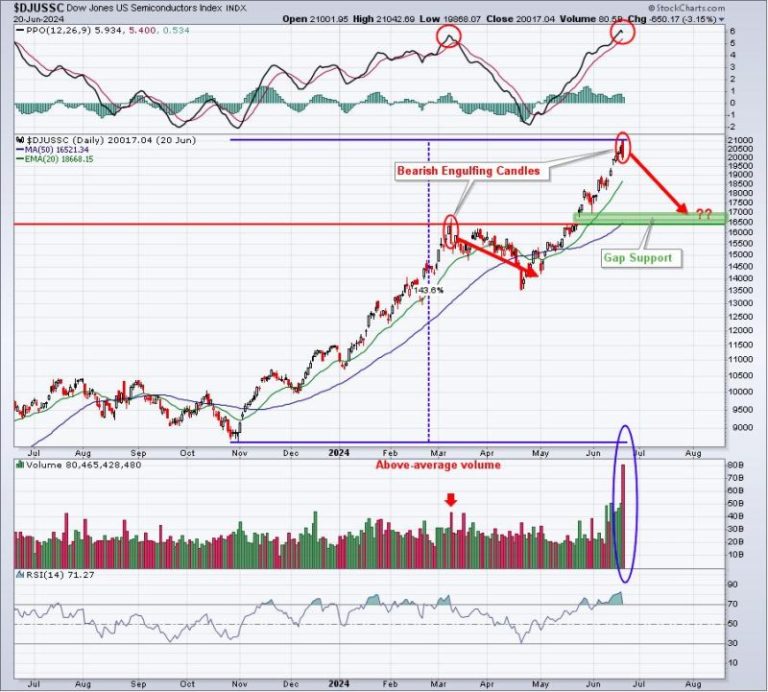
      U.S. stocks are on the cusp of a very impressive breakout to all-time highs, but are still missing one key ingredient. They need help in the form of a semiconductors ($DJUSSC) breakout of its own. When the DJUSSC reached its all-time high on June 20, 2024, one year ago, a nasty bearish engulfing candle printed on extremely heavy volume, I wrote an article, “The Semiconductors Have Topped; Look Elsewhere for Opportunities”. Simply put, it was buyers’ exhaustion”. I looked for a 20% drop in the index, providing this chart at the time:

      There’s now been a lengthy period of sideways consolidation on the semiconductors as you can see from this updated chart as that 20% drop immediately occurred:

      Semiconductor leadership has been held firmly in check by the overhead price resistance just below 22000. Until that resistance is cleared, the QQQ has a lid on it.

      Let’s keep in mind that the QQQ, an ETF that tracks the NASDAQ 100 index, can be broken down into its top 2 industry groups, as follows:

      • Semiconductors ($DJUSSC): 21.65%
      • Software ($DJUSSW): 19.11%

      More than 40% of the QQQ is comprised of semiconductors and software. Here’s what the longer-term, 5-year software chart looks like:

      Software’s relative strength is powerful and we’ve recently seen an absolute price breakout – an awesome combo. On a 5-year weekly chart of semis, it’s quite apparent that when the semiconductors break out, they carry the NASDAQ 100 on their shoulders higher and we’re close to a breakout now:

      We just saw a relative strength breakout on the DJUSSC, there’s only one thing missing – that absolute breakout and it’s coming fairly soon, in my opinion.

      Market Outlook

      A big part of what happens over the next 6-12 months will be highly dependent on the two industry groups above. There are over 100 industry groups and this may be oversimplifying stocks a bit, but make no mistake about it. Higher growth prospects and lower interest rates can result in flying PE ratios and these two groups are home to companies that can expand their businesses very rapidly.

      Market Manipulation

      I’ve discussed the role of market makers and their manipulation of the stock market many times over the past several years and there’s no doubt in my mind we were just exposed to another massive dose of it in the first half of 2025. At EarningsBeats.com, however, we’ve become experts at spotting it and pointing it out. I discussed the importance of being in cash back in late January and in February before the massive Wall Street ripoff started and I also wrote about the importance of getting back in early. Remember my article in the second week of April, “The Bottom is Here or Rapidly Approaching”? These are real-time articles, folks. You need to see the tops and bottoms before they occur. It does little good to talk about it now. We don’t get a “do over.”

      Or do we?

      What do I mean by that? Well, we’ll have plenty more chances to spot tops and bottoms in the future, but you need to learn from this year’s mistakes RIGHT NOW. Don’t let these big-money, Wall Street crooks do it to you again. We have one MASSIVE advantage on our side vs. these big Wall Street firms. We can enter and exit stocks in seconds. It takes them days and weeks.

      If you want to be better-positioned to see this nonsense AHEAD OF TIME the next time it comes around, I’d suggest that you join me on Saturday, June 28th at 10:00am ET for a 100% free event, “Trading The Truth: How Market Manipulation Creates Opportunity”. CLICK HERE to register and learn more about the event! This is a MUST-ATTEND event and seating is limited. Be sure to save your seat and learn how to protect your hard-earned money for the rest of your financial future!

      Happy trading!

      Tom

      Gold was on the decline this week, closing just below US$3,370 per ounce, after tensions in the Middle East pushed it past the US$3,430 level toward the end of last week.

      All eyes were on the US Federal Reserve, which in a widely expected move left interest rates unchanged on Wednesday (June 18) following its two day meeting. The central bank cut rates in December 2024, but has kept them steady for its last four gatherings.

      US President Donald Trump wasn’t pleased, calling Powell ‘too late’ in a Thursday (June 19) post on Truth Social. While speculation that Trump will fire Powell has died down, the president did recently say he intends to announce his next pick for the Fed leader position ‘very soon.’

      Of course, Fed meetings are never just about rate decisions — experts often look to Powell’s post-meeting commentary to read between the lines of what’s said (and not said).

      Tariffs were definitely in focus this time around, with Powell emphasizing that it’s still soon to tell how much of an impact they will have and how the Fed should react.

      ‘We have to learn more about tariffs. I don’t know what the right way for us to react will be. I think it’s hard to know with any confidence how we should react until we see the size of the effects’ — Jerome Powell, US Federal Reserve

      Chris Temple of the National Investor, who offered another perspective on Powell’s comments.

      He noted that while Powell didn’t say the Fed is going to abandon its 2 percent inflation target, it may be leaning in that direction. This is what he said:

      The consensus still — although it was extremely close — is barely still for two 25 basis point rate cuts in the balance of 2025. Whether we get them or not, who knows, (but) that’s the current snapshot, which may well change. But that’s against a backdrop of admitting for the second SEP, summary of economic projections … in a row that inflation is going to continue to move back higher — that we’ve seen the best numbers for inflation — at the same time that GDP slows a bit.

      So okay, you just told us that your favored inflation number, which is a lot of smoke and mirrors to begin with, is going to go back up to north of 3 percent, which is what they said yesterday. And yet you still — the consensus is you’re going to lower interest rates twice in 2025? So he did everything but come right out and admit that the 2 percent inflation target isn’t going to be reached.

      Stay tuned to our YouTube channel for the full interview with Temple.

      Bullet briefing — Silver hits 13 year high, SPUT raising US$200 million

      Is silver’s price rise real?

      Gold has stolen the precious metals spotlight in 2025, but this month silver is shining.

      The white metal has been on the rise since the beginning of June, and this week it broke the US$37 per ounce mark for the first time in 13 years.

      While silver is known to lag behind gold before playing catch up, it’s also known for its volatility. Its move has created excitement, but market participants are also wary of a correction.

      When asked what factors are driving silver, Peter Krauth of Silver Stock Investor he said he sees a ‘perfect storm’ emerging. Here’s how he explained it:

      You’ve got the macroeconomic picture that is I think certainly bullish for silver, like it is for gold and a lot of the other commodities. But I think at the same time you’ve got the market kind of coming to terms with the fact that silver is in a deficit, (and) it’s unlikely to be able to rectify that deficit for several years — in fact, the Silver Institute thinks we’re going to see record deficits at some point over the next five years.

      And silver supply is unable to grow. We saw a peak 10 years ago in mined silver, and overall silver supply is essentially flat.

      So flat supply, growing demand — demand that’s nearly 20 percent above supply — and our ability to meet those deficits is shrinking because we’re tapping into these aboveground stockpiles that have shrunk by about 800 million ounces in the last four years, which is the equivalent of an entire year’s mine supply. So it’s the perfect storm, it’s really all coming together. And I think that the market’s realizing that.

      But does that necessarily mean silver is ready for a big breakout? Krauth has a target of US$40 by the end of 2025, but said silver could potentially go 10 percent above that.

      For his part, Jeffrey Christian of CPM Group attributes the silver price boost to increased demand from investors, especially when it comes to exchange-traded funds and wholesale products.

      He’s projecting a bumpier path forward for the metal:

      You also have — the last time I looked it was like 490 million ounces of open interest in the July Comex futures contract. And that’s two weeks from first delivery. So most of the people (who) have those shorts – those are hedges of their physical inventories. They keep those hedges in place, but they roll them forward. So they’ll be buying back their Julys and selling September futures to keep that hedge in place with the next active futures contract. That buying back of the Julys could push silver prices higher.

      So if you really want to talk granular prices, we wouldn’t be surprised to see the price of silver fall to US$33, US$34 an ounce, and go up to US$40 an ounce and then back to US$33 an ounce over the next four weeks.

      Click the links above to watch the interviews with Krauth and Christian.

      SPUT raising US$200 million

      The uranium spot price made moves this week after the Sprott Physical Uranium Trust (TSX:U.U,OTCQX:SRUUF) announced a US$100 million bought-deal financing on Monday (June 16).

      It was bumped up to US$200 million the same day due to strong demand.

      Spot uranium has been in a consolidation phase since hitting triple-digit levels in early 2024, creating frustration among those who are waiting for the industry’s strong long-term fundamentals to be better expressed. This week’s move past US$75 per pound has helped reinvigorate investors.

      Securities Disclosure: I, Charlotte McLeod, hold no direct investment interest in any company mentioned in this article.

      This post appeared first on investingnews.com

      This week, Microsoft (NASDAQ:MSFT) and OpenAI’s once tight alliance showed signs of strain, while Meta Platforms (NASDAQ:META) continued to source artificial intelligence (AI) talent from rival companies.

      Meanwhile, SoftBank’s (TSE:9434) CEO is considering a new chip and robotics venture in Arizona, and Google (NASDAQ:GOOGL) is looking to bring AI solutions to American cities.

      Read on to dive deeper into this week’s top tech stories.

      1. OpenAI and Microsoft partnership faces tension

      Microsoft and OpenAI’s once-close partnership is reportedly entering a tense period of renegotiation as OpenAI restructures into a public-benefit company and seeks more autonomy.

      According to sources for The Information, recent negotiations have centered on reducing Microsoft’s long-term revenue share in exchange for a 33 percent stake in the newly formed entity. Additionally, OpenAI would like to limit Microsoft’s access to future models such as Windsurf, which OpenAI acquired in May.

      The company has competitive concerns with Microsoft’s GitHub Copilot, according to the people.

      Tensions have risen enough that some OpenAI executives are even weighing antitrust action against Microsoft, according to sources for the Wall Street Journal. In a joint statement, both companies maintained they want to continue working together; however, the Financial Times reported on Wednesday (June 18) that if they can’t reach an agreement, Microsoft is prepared to walk away and rely on its existing contract with the startup, which extends until 2030.

      2. SoftBank floats trillion-dollar robotics hub in Arizona

      SoftBank is reportedly interested in a trillion-dollar infrastructure project and has reached out to Taiwan Semiconductor Manufacturing Company (NYSE:TSM) as a potential collaborative partner.

      Sources for Bloomberg revealed on Friday (June 20) that SoftBank founder Masayoshi Son has approached the Taiwanese chipmaker to play a “prominent role” in a manufacturing park in Arizona codenamed “Project Crystal Land,” which may serve as a major production facility for AI-powered industrial robots.

      The sources said SoftBank has also approached Samsung Electronics (KRX:005930) and other companies with the idea. SoftBank officials have reportedly engaged in discussions with federal and state government officials, including US Secretary of Commerce Howard Lutnick, to explore potential tax incentives for companies onshoring high-tech manufacturing.

      In other semiconductor news, Texas Instruments (NASDAQ:TXN) said on Wednesday that it will spend more than US$60 billion building seven new semiconductor facilities across the US. Meanwhile, Amazon (NASDAQ:AMZN) announced over the weekend that it will invest AU$20 billion to expand data center infrastructure in Australia by 2029.

      3. Intel reportedly planning sizeable layoffs

      Intel (NASDAQ:INTC) is reportedly set to implement substantial layoffs, impacting 15 to 20 percent of its factory workforce, according to an internal memo distributed on Saturday (June 14) and obtained by the Oregonian.

      This move comes amidst continuing efforts to overhaul a company lagging behind its peers.

      For some time, Intel’s offerings have struggled to compete effectively against those of key rivals in the highly competitive market of AI products and chip divisions. In a concerted effort to address this gap and reinvigorate its innovation pipeline, Intel has also been actively recruiting top-tier engineering talent.

      On Wednesday, Intel expanded its sales and engineering leadership team to include experienced professionals from Cadence Design Systems (NASDAQ:CDNS), Apple (NASDAQ:AAPL) and Google.

      These strategic hires are intended to inject fresh perspectives and expertise into crucial engineering departments, directly contributing to the company’s ambitious plans to develop more competitive and advanced AI solutions.

      4. Google partners with Conference of Mayors for city AI strategies

      On Friday, Google announced that it has partnered with the US Conference of Mayors to help speed the adoption of city-wide AI strategies. With the announcement, the company released a playbook titled A Roadmap for America’s Mayor that provides a framework for city leaders to develop and host an “AI Adoption Workshop,’ which would be structured to help cities identify and explore how AI can support specific needs, drawing on experiences from other communities.

      The roadmap suggests cities conduct a general survey to tailor workshop content by gathering information on current AI usage, as well as concerns and ideas for AI applications. Various approaches are suggested for drafting the strategy document, including a dedicated working group, an appointed lead drafter, a hybrid model or engaging external expertise, with a recommended deadline of four to six weeks post-workshop for the first draft.

      5. Meta hires top AI talent

      Sources for the Information indicated on Wednesday that Meta CEO Mark Zuckerberg is bringing Daniel Gross, CEO of Ilya Sutskever’s startup Safe Superintelligence, and former GitHub CEO Nat Friedman onboard.

      According to the report, Gross and Friedman will both join Meta, with Gross leaving his startup to focus on AI products at Meta and Friedman taking on a broader role. Both are expected to work directly with Zuckerberg and Scale AI CEO Alexandr Wang, who signed a US$14.3 billion deal to join Meta last week.

      In exchange, Meta will get a stake in NFDG, the venture capital firm co-owned by Gross and Friedman that has backed companies such as Coinbase Global (NASDAQ:COIN), Figma, CoreWeave (NASDAQ:CRWV), Perplexity and Character.ai.

      On the most recent episode of his brother’s “Uncapped” podcast, OpenAI CEO Sam Altman said that Meta has also offered signing bonuses as high as US$100 million and large compensation packages to OpenAI employees.

      Securities Disclosure: I, Meagen Seatter, hold no direct investment interest in any company mentioned in this article.

      This post appeared first on investingnews.com

      Here’s a quick recap of the crypto landscape for Friday (June 20) as of 9:00 p.m. UTC.

      Get the latest insights on Bitcoin, Ethereum and altcoins, along with a round-up of key cryptocurrency market news.

      Bitcoin and Ethereum price update

      Bitcoin (BTC) is priced at US$103,366, a decrease of 0.9 percent in the last 24 hours. The day’s range for the cryptocurrency brought a low of US$102,624 and a high of US$106,042 as the market opened.

      Bitcoin price performance, June 20, 2025.

      Chart via TradingView.

      The Bitcoin price stalled after reaching around US$106,500, then sank below US$104,000 as an unusually large expiry of options and futures contracts worth US$6.8 trillion occurred on US stock indexes.

      The US Federal Reserve held interest rates steady on Wednesday (June 18), but Christopher Waller, a member of the Federal Reserve Board of Governors, said a cut is possible next month if inflation remains controlled.

      Cuts typically boost risk assets like Bitcoin. Markets have already pushed the US dollar index to a three year low, so a surprise rate cut could further weaken the dollar and propel Bitcoin forward.

      Ethereum (ETH) is currently priced at US$2,415.98, a 3.5 percent decrease over the past 24 hours. Its lowest valuation on Friday was US$2,396.50, and its highest valuation was US$2,556.46 as trading commenced.

      Altcoin price update

      • Solana (SOL) was priced at US$139.45, down 4.1 percent over 24 hours. SOL experienced a low of US$136.98 after peaking at its opening price of US$147.68.
      • XRP pulled back from its opening price of US$2.17, its highest valuation of the day, to trade at US$2.12 as the markets wrapped, a 2.1 percent decrease in 24 hours. Its lowest valuation on Friday was US$2.09.
      • Sui (SUI) closed at US$2.72, a declineof 3.9 percent over the past 24 hours. Its price also peaked this morning at US$2.85 and its lowest valuation was US$2.66.
      • Cardano (ADA) is priced at US$0.5783, down 3.6 percent in 24 hours. Its lowest valuation on Friday was US$0.5636, and its highest valuation was US$0.6044.

      Today’s crypto news to know

      Coinbase launches Stablecoin payments platform for e-commerce

      Coinbase Global (NASDAQ:COIN) has unveiled a new product called Coinbase Payments, designed to help online retailers accept stablecoins like USDC with minimal friction. The system is built to mirror traditional card infrastructure so that merchants can plug it in without having deep cryptocurrency knowledge.

      The platform targets marketplaces such as Shopify (TSX:SHOP,NYSE:SHOP) and eBay (NASDAQ:EBAY), giving small to medium businesses a cost-effective alternative to credit card fees.

      Shopify is the first to integrate the system, allowing merchants to accept USDC payments through Coinbase’s Layer 2 Base network. The platform supports crypto wallets like Coinbase Wallet, MetaMask and Phantom and includes features for transaction authorization, refunds and recurring payments.

      Circle surges as Senate approves Stablecoin Bill

      Circle (NYSE:CRCL) shares continued to rally on Friday, jumping another 11 percent after a 34 percent surge the day before, as momentum builds behind a Senate-approved bill to regulate stablecoins.

      The GENIUS Act, a bipartisan effort, could bring long-awaited legal clarity to stablecoin issuers like Circle, which manages the US$32 billion USDC token. Although the bill still needs approval from the House and requires a signature from US President Donald Trump, investors are already optimistic.

      Circle shares are now trading at US$221, up from an initial public offering price of just US$31 — signaling massive investor confidence amid a changing regulatory climate.

      South Korea’s central bank weighs in on stablecoins

      Bank of Korea Governor Rhee Chang-yong said at a press conference this week that the central bank is not opposed to a won-based stablecoin, but is concerned about managing the FX of the token, according to Reuters report.

      ‘Issuing won-based stablecoin could make it easier to exchange them with a dollar stablecoin rather than working to reduce the use of a dollar stablecoin. That in turn could increase demand for dollar stablecoin and make it difficult for us to manage forex,’ Chang-yong told reporters in Seoul.

      Earlier this month, South Korea’s Democratic Party proposed the Digital Asset Basic Act, which aims to establish a regulatory framework to enable local companies to issue won-denominated stablecoins.

      Parataxis to launch institutional Bitcoin treasury company

      Parataxis Holdings, an affiliate of digital asset-focused investment company Parataxis Capital Management, announced Friday that it has entered a definitive agreement to acquire a controlling interest in biotech company Bridge Biotherapeutics (KOSDAQ:288330) for an investment of 25 billion South Korean won, roughly US$18.5 million.

      Following the closing of the deal, Parataxis will become Parataxis Korea and be repurposed as a treasury vehicle for institutional Bitcoin exposure, joining a growing list of companies holding Bitcoin on their balance sheet.

      “Inspired by the growing interest in BTC treasury strategies seen in companies like Strategy in the US and Metaplanet in Japan, we believe institutional interest in this space is increasing globally,” said Andrew Kim, a partner at Parataxis Capital. “We see South Korea as an important market in the evolution of BTC adoption.”

      “We are incredibly excited to create the first BTC treasury company in South Korea backed by an institutional-grade platform. Given the strategic nature of BTC on the global stage and its finite supply, we believe that building and growing a company like Parataxis Korea and accumulating a BTC treasury will benefit our shareholders as well as the country over the long run,” echoed founder Edward Chin.

      Kraken introduces Bitcoin staking with Babylon partnership

      Kraken, a leading cryptocurrency exchange, made a landmark announcement on Thursday (June 19), revealing a strategic partnership with Bitcoin staking protocol Babylon to introduce a staking product that allows Kraken users to earn interest on their Bitcoin holdings without the need for bridging, wrapping or lending.

      These traditional methods, while enabling some forms of yield generation, can introduce additional risks and technical hurdles for users. Kraken and Babylon aim to provide a more streamlined, secure and accessible way for Bitcoin holders to generate passive income. The interest earned through this new product will come in the form of BABY tokens, the native cryptocurrency of the Babylon protocol.

      Arizona advances bill to create state Bitcoin reserve

      Arizona is one step closer to becoming the second US state with an official Bitcoin reserve, after its Senate narrowly passed House Bill 2324. The bill allows the state to hold abandoned digital assets as unclaimed property and establishes a Bitcoin and digital assets reserve fund for those holdings. The news comes on the heels of House Bill 2749, which was signed into law in April and amended Arizona’s forfeiture laws to recognize digital assets.

      HB2324 will now return to the House for final approval before heading to the governor’s desk. Earlier efforts to invest seized funds directly into BTC were vetoed by Governor Katie Hobbs, who cited concerns over crypto’s volatility.

      If passed, Arizona would join New Hampshire in formalizing a state-level Bitcoin reserve.

      Similar legislation is pending in Texas.

      Securities Disclosure: I, Giann Liguid, hold no direct investment interest in any company mentioned in this article.

      Securities Disclosure: I, Meagen Seatter, hold no direct investment interest in any company mentioned in this article.

      This post appeared first on investingnews.com

      Ericsson (NASDAQ:ERIC) and Rogers Communications (NYSE:RCI) have activated Canada’s first underground private 5G network at the Northern Center for Advanced Technology’s (NORCAT) Sudbury mine.

      The move is part of a bid to transform traditional mining operations with cutting-edge connectivity.

      At the heart of this innovation is the Ericsson Private 5G system, which the company says delivers seamless, high-performance, low-latency coverage from the surface to depths of more than a mile.

      Built on Ericsson’s EP5G technology and integrated with Rogers’ private network expertise, the setup is designed for smart mining applications that Wi‑Fi cannot adequately support. These include autonomous haul trucks, remote-controlled drilling rigs, environmental monitoring sensors and real-time asset tracking.

      ‘The NORCAT Underground Centre provides an extraordinary platform for companies worldwide to showcase their cutting-edge technologies in a real operating mine, shaping the future of the mining industry,’ said NORCAT CEO Don Duval in a Thursday (June 19) press release, calling it an ‘ecosystem like no other in the world.’

      Duval also emphasized the importance of collaboration in making sustainable impacts in mining. Adam Burley, director of IoT and wireless private networks at Rogers, stressed the collaborative roots of the breakthrough as well:

      “Rogers and Ericsson have worked together for more than 35 years … Every industry is looking for operational efficiency, and if you develop or rely on technology for mining, NORCAT is where you go to test and certify products that work within a real-world environment.”

      The company’s private 5G setup is scalable and future proof, allowing agile adaptation as new technology needs emerge — from integrating 4G systems to deploying large-scale sensor networks.

      Use cases across various aspects of mining

      Ericsson views the network as an extension of its quality of service features — ideal for mission-critical mining operations where data reliability matters — that apply in different facets of the mining process.

      Industry forecasts validate the broader relevance of private networks.

      A McKinsey report indicates demographic shifts in mining workforces that make modernization a priority — aging employees are nearing retirement and younger workers are expecting digital environments.

      Around 71 percent of mining leaders cite talent shortages as barriers to production targets, reinforcing the dual mandate of digital adoption and workforce transformation.

      Beyond workforce and safety, remote operations and asset management benefit from the technology.

      Remote control centers with scalable data pipelines and robust connectivity eliminate the need for staff to occupy large numbers of underground positions while maintaining compliance with environmental and safety regulations.

      Similarly, data-centric asset management, powered by sensors, HD video cameras and predictive analytics, brings down costs, extends equipment lifespans and reduces unplanned downtime.

      Mining contributes an estimated US$1.5 trillion to the global economy, per World Mining Data 2020.

      As these operations move toward automation, private 5G networks may prove foundational, enabling safer, faster and greener production systems. NORCAT’s smart mine could become a template for the future, demonstrating how next-generation connectivity can bridge the gap between current operations and fully digitalized mining.

      Securities Disclosure: I, Giann Liguid, hold no direct investment interest in any company mentioned in this article.

      This post appeared first on investingnews.com