
Author

admin

Browsing

Peloton on Tuesday launched its own marketplace for reselling used equipment and gear as the company looks to capitalize on the many bikes and treadmills collecting dust in people’s homes.

The platform, dubbed Repowered, will allow members to post listings for their used Peloton equipment and gear and set a price with help from a generative AI tool, the company said.

Sellers have the final say on how much to list the item for, but the AI tool will suggest a price based on information about the product, such as its age, Peloton said.

It said sellers will get 70% of the sales price, while the rest will be shared between Peloton and its platform provider, Archive. Sellers will get a discount toward new equipment, while buyers will see the activation fee for a used product drop from $95 to $45, the company said.

Buyers will be able to see the equipment’s history on the listing and have the option to get the item delivered for an extra fee, Peloton said.

The resale market for used bikes and treadmills is booming. The company said it wants to streamline the sale process for members and offer a safe and comfortable way for prospective customers to buy equipment. It’s also an opportunity for Peloton to reach a wider array of new users as it plots a pathway back to growth.

Last summer, Peloton said it had started to see a meaningful increase in the number of new members who bought used Bikes or Treads from peer-to-peer markets such as Facebook Marketplace. At the time, it said paid connected fitness subscribers who bought hardware on the secondary market had grown 16% year over year, and it believed those subscribers exhibited a lower net churn rate — or membership cancellation — than rental subscribers.

Peloton has plenty of enthusiastic fans who use the company’s equipment every day, but some people have likened it to glorified clothes racks because so many people stop using them. While those owners paid for their exercise machines when they bought them, many have canceled their monthly subscription, which is how Peloton makes the bulk of its money, according to the company’s financial records.

Peloton is already reaping the subscription revenue from people who bought hardware on the secondary market, but now it will get a cut of that market with little upfront cost.

Repowered is a direct challenger to not just Facebook Marketplace but also the burgeoning startup Trade My Stuff, formerly known as Trade My Spin, which sells used Peloton equipment.

Trade My Stuff founder Ari Kimmelfeld told CNBC he previously met with Peloton to discuss ways to collaborate.

But Peloton said Repowered isn’t connected with Trade My Stuff.

Repowered is launching first in beta in New York City, Boston and Washington, D.C., with plans to go nationwide in the coming months, Peloton said. The platform will launch first to sellers, and once there’s enough inventory available, it’ll go live to buyers, the company said.

This post appeared first on NBC NEWS

Shares of Dollar General jumped nearly 16% on Tuesday after the discounter raised its outlook, saying it drew more middle- and higher-income shoppers amid fears that higher tariffs would hurt consumer spending.

The Tennessee-based retailer beat quarterly expectations for revenue and earnings. The company said it now anticipates net sales will grow about 3.7% to 4.7%, compared to its previous expectation of about 3.4% to 4.4%. It expects diluted earnings per share to range from $5.20 to $5.80, compared to its prior outlook of approximately $5.10 to $5.80. Dollar General anticipates same-store sales will increase 1.5% to 2.5%, higher than its previous guidance of about 1.2% to 2.2%.

Here’s how the retailer did for the fiscal first quarter compared with Wall Street’s estimates, according to a survey of analysts by LSEG:

In the three-month period that ended May 2, Dollar General reported net income of $391.93 million, or $1.78 per share, compared with $363.32 million, or $1.65, in the year-ago quarter.

As of Tuesday’s close, shares of Dollar General have risen about 48% so far this year. That far exceeds the roughly 1% gains of the S&P 500 during the same period. Shares of the retailer closed at $112.57 on Tuesday, bringing Dollar General’s market value to $24.76 billion.

Dollar General’s first-quarter results — and its stock performance — stand out in a retail industry that is already taking a hit from President Donald Trump’s tariffs. Companies including Best Buy, Macy’s and Abercrombie & Fitch have cut their profit outlooks due to tariffs.

On an earnings call Tuesday, Dollar General CEO Todd Vasos said the company has worked to reduce its exposure to China — and limit price hikes for shoppers. He said the retailer has worked with vendors to cut costs, moved manufacturing to other countries and made changes to its products or swapped them out for other merchandise.

He said direct imports make up about a mid- to high single-digit percentage of its overall purchases and indirect imports are about double that.

“While the tariff landscape remains dynamic and uncertain, we expect tariffs to result in some price increases as a last resort, though, we intend to work to minimize them as much as possible,” he said.

CFO Kelly Dilts said on the company’s earnings call that full-year guidance assumes that Dollar General will be able to offset “a significant portion of the anticipated tariff impact on our gross margin, but also allows for some incremental pressure on consumer spending.”

Customer traffic dipped by 0.3% in the first quarter compared to the year-ago period, but shoppers spent more when they visited. The average transaction amount rose 2.7%, as sales in the food, seasonal, home and apparel categories all grew.

Vasos added tariffs have also increased U.S. consumers’ desire to find deep discounts. Vasos said the company’s first-quarter results reflect Dollar General’s gains from “customers across multiple income bands seeking value.”

He said store traffic and the company’s market research indicates that more middle- and higher-income customers have come to its stores more frequently and spent more when they visited.

“We are pleased to see this growth with a wide range of customers and are excited about our ongoing opportunity to grow [market] share with them,” he said.

Those gains have helped as Dollar General’s core customer “remains financially constrained,” Vasos said. According to a survey by the company, he said 25% of customers reported having less income than they did a year ago and almost 60% of core customers said “they felt the need to sacrifice on necessities in the coming year.”

Dollar General’s sales largely come from U.S. consumers who are on a tight budget. About 60% of the retailer’s sales come from households with an annual income of less than $30,000 per year, Vasos said last fall at a Goldman Sachs’ retail conference.

In addition to wooing value-conscious shoppers, Dollar General has tried to tackle company-specific problems that drew government scrutiny and tested customer loyalty. The discounter, which has more than 20,000 stores across the country, has paid steep fines to the Labor Department for workplace safety violations due to blocked fire exits and dangerous levels of clutter.

Vasos highlighted some of the ways that Dollar General has tried to improve the customer experience. Among them, it’s worked to reduce employee turnover, and it took about 1,000 individual items off its shelves so it can keep top-selling items in stock, he said.

Dollar General has launched its own home delivery service, which is now available at more than 3,000 stores. Its deliveries through DoorDash have grown, too, with sales up more than 50% year over year in the quarter.

Dollar General has also bulked up its merchandise categories outside of the food and snack aisles, adding more discretionary items like seasonal decor and home items.

Vasos said sales in those categories have also gotten a boost from middle- and higher-income customers shopping its stores.

Its newer store chain, Popshelf, sells mostly discretionary items and caters to consumers with higher household incomes than Dollar General’s typical shoppers. Vasos did not share a specific metric for the chain, but said Popshelf’s same-store sales delivered strong growth in the quarter. The company recently changed the store layout to emphasize toys, beauty and party candy.

This post appeared first on NBC NEWS

Tesla’s long-awaited entry into the robotaxi market — expected later this month — is coming to Austin, Texas, which has emerged as a key battleground for self-driving technology.

CEO Elon Musk wrote in a post on X last week that the company has been testing Model Y vehicles with no safety drivers on board in the Texas capital for several days.

Tesla’s Austin robotaxi service will kick off with 10 vehicles and expand to thousands, moving into more cities if the launch goes well, Musk said in a May 20 interview with CNBC’s David Faber.

But while the market remains nascent, Tesla already faces a hefty amount of competition.

The electric vehicle maker is one of several companies using Austin as a testing ground and debut market for self-driving technology. They’re all taking advantage of Austin’s robotics and AI talent, tech-savvy residents, affordable housing relative to other technology hubs and a city layout with horizontal traffic lights and wide roads that makes it particularly conducive to mapping software.

But the biggest reason they love Texas may be the state’s robotaxi-friendly regulation.

Already in Austin are Alphabet’s Waymo, Amazon’s Zoox, Volkswagen subsidiary ADMT, and startup Avride.

Waymo began offering robotaxi rides in Austin with Uber in March. Zoox started testing there last year, while ADMT has been testing Volkswagen’s electric ID vehicles in the city since 2023. Avride is headquartered in Austin and is testing its autonomous vehicles and delivery robots in the Texas capital. Avride said it plans to begin offering paid robotaxi rides in the city later this year.

“The winners of the space are emerging, and it’s just a matter of scaling,” said Toby Snuggs, ​​head of sales and partnerships at Avride.

According to Uber, its Austin launch with Waymo has proved successful thus far. Uber CEO Dara Khosrowshahi told investors in May that riders are choosing the robotaxis over regular cars, and the company is preparing to scale its Austin autonomous fleet to hundreds of vehicles in the coming months, ahead of a robotaxi expansion into Atlanta later this year.

“These approximately 100 vehicles are now busier than over 99% of all drivers in Austin in terms of completed trips per day,” Khosrowshahi told investors in May.

Avride, which spun out of former parent company Yandex last year, has delivery robots in a fleet of about a dozen Hyundai Ioniq 5 vehicles in downtown Austin. The company said it plans to expand its Austin fleet to 100 vehicles later this year and aims to begin offering robotaxi rides in Dallas with Uber in 2025.

Tesla primarily relies on camera-based systems and computer vision to navigate its vehicles rather than the Waymo model of using sophisticated sensors such as lidar and radar. Tesla’s “generalized” approach to robotaxis is more ambitious and less expensive than Waymo’s, Musk said during Tesla’s first-quarter earnings call with investors in April. Musk has been promising Tesla investors that a self-driving car is on the way for roughly a decade and has repeatedly missed self-imposed deadlines.

“There’s probably a lot of ways it can be done, but we’re the only ones that have done it,” Waymo co-CEO Tekedra Mawakana told CNBC’s Deirdre Bosa in May. “We’ve been doing it 24 hours a day for almost five years. And so to us, it’s really important to focus on safety … and then cost — not cost and then safety.”

“You have to be able to see at night, you have to be able to have this vision that’s better than humans,” Mawakana said.

In addition to Austin, Phoenix is an AV hub for companies such as Waymo, which has been testing in the region since 2016. Waymo and the auto manufacturer Magna International announced in May that they plan to double robotaxi production at their new plant in the Phoenix suburb of Mesa by the end of 2026.

The San Francisco Bay Area, where Google began working on its self-driving car project in 2009, also has a large fleet of Waymo vehicles. Waymo opened its paid ride-hailing service to all local users almost a year ago, and said earlier this year that it’s expanding its service to include another 27 square miles of coverage in the region. Zoox is also testing in San Francisco.

While Tesla was started in the Bay Area, Musk moved its corporate headquarters to Austin in late 2021. In California, regulators at individual municipalities closely control where and how companies can operate autonomous vehicles. Texas has more relaxed regulations that benefit AV companies.

When Waymo decided on Austin, it “looked at the operational structure and how friendly the regulatory environment is,” said Shweta Shrivastava, Waymo’s senior product and strategy executive. “It’s a tech-forward city — there’s a lot of openness in terms of welcoming and adopting new technologies, so that’s been great.”

Part of that friendliness is a 2017 Texas law that prohibited municipalities from regulating autonomous vehicles, giving the state full authority.

“It’s not like California, where you have certain regulations in LA, separate regulations in San Francisco, and municipalities between,” said Yulia Shveyko, Avride’s head of communications. “In Texas, it’s the same all across the state, and this is one of the great things about being here as an operator.”

The state is responsible for establishing the framework for autonomous vehicle operation, which includes that AVs must adhere to the same regulations as traditional vehicles, including registration, insurance and compliance with traffic laws. Texas law also requires AVs to have data recording systems to document potential accidents and incidents.

The Texas Department of Transportation’s “role is to work with autonomous vehicle (AV) companies on what is needed to ensure the state’s infrastructure is prepared for the safe and efficient rollout of AVs,” a spokesperson said in an emailed statement.

Texas law allows for AV testing and operations on Texas roadways, “as long as they meet the same safety and insurance requirements as every other vehicle on the road.”

Companies are choosing to test their AVs in Austin because of its “lower barriers both in terms of regulation and the acceptance by consumers in the area,” said Wassym Bensaid, chief software officer at EV maker Rivian.

“This is really what makes Austin and San Francisco more open to this technology,” Bensaid added. Rivian in March rolled out a “hands-free version” of its driver-assistance system for highway driving, and the company plans to have an “eyes-off-hands-off” system available by the end of next year, Bensaid said.

Texas’ transportation department created an AV task force in 2019. Formal meetings take place two to four times per year. Members of the task force include representatives from other agencies in the state and public entities as well as key industry stakeholders, its website says.

Waymo is an active member of the task force, the company confirmed.

The state’s transportation department didn’t respond to CNBC’s requests for further information about the task force.

Waymo has built goodwill with Austin officials by engaging with Texas stakeholders since it began testing in the city in 2015, the company told CNBC.

Known then as Google’s self-driving car project, the company started driving on Austin streets a decade ago with safety drivers on board.

Waymo closed Austin operations in 2019 to focus on its testing efforts in Phoenix, the spokesperson said, adding that it returned in March 2023, when the company’s technology was “more mature.”

Long before Waymo began testing in Austin, University of Texas at Austin’s Peter Stone entered his team’s vehicle in the Defense Advanced Research Projects Agency Urban Challenge in 2007. Stone is the director of the Learning Agents Research Group at UT, and his team’s entry was called Austin Robot Technology — one of the first deployments of a partially automated driving system on the streets of Austin.

Stone has been at the university for 23 years and has taught several students who are now employees at Waymo and other car companies, he said. Advancements in machine learning and years of testing have contributed to companies such as Waymo being able to navigate roads better than some human drivers, he said.

Officials from around the U.S. and the world are looking to Texas as a model for self-driving regulations, experts said. Some regulation, however, is still being sorted out.

Lewis Leff, City of Austin assistant director, said that more cities are reaching out to ask, “How do you handle these situations?” Cities that have inquired include New Orleans and Nashville, Tennessee, as well as some outside the U.S., Austin officials told CNBC.

“We were in Japan launching our service with Rakuten earlier this year and the minister of economics, and the questions they were asking was, ‘What is the regulation in Texas like?’” Avride’s Snuggs said.

Meanwhile, the AV industry is pushing for federal-level standards that would ease regulatory uncertainty around putting new tech on public roads. In Tesla’s third-quarter earnings in October, Musk said that should Donald Trump win the coming election, he would use his influence with the administration to push for federal AV regulation.

As president, Trump and his transportation secretary, Sean Duffy, have both been supportive of federal-level standards, Waymo’s Mawakana told CNBC in May, adding that she’s “optimistic” it will be arranged sometime during this presidential term. Waymo supports proposed federal frameworks for national safety standards and has voiced that support to the Trump administration, a company spokesperson said.

“Now’s the time,” Mawakana said, pointing to places such as China, which invests in AV supply chains and grants and has federal AV rules. “We should be in the exact same position.”

The concentration of regulatory power, however, comes with some concern that cities will be mostly powerless should issues arise, experts said.

A state senate transportation hearing in September addressed the lack of regulation in Texas for driverless vehicles.

“To many of our first responders communities, this is new territory for them,” Democratic Texas state Sen. Sarah Eckhardt reportedly said at the hearing. “I mean pulling over an autonomous vehicle, you know, what do you do? An autonomous vehicle in an accident, what do you do?”

In one example, Houston city officials reportedly faced delays in enforcement instructions from state regulators after Cruise cars caused a backup on the city’s Montrose Boulevard in 2023.

Texas has at least 17 companies that have deployed or tested on roads, said Nick Steingart, director of state affairs at Alliance for Automotive Innovation, at the state hearing.

“As the technology matured and evolved, we fully expected that the laws would evolve as well,” Steingart said.

The state is considering legislation that may provide some clarity, according to Austin’s transportation department.

Several AV companies in Austin have safety protocols and proactively work with local first responders. Zoox, for example, has held trainings with first responders and met with city officials, a spokesperson said. But there is technically no requirement for AV companies to engage with emergency services, Austin officials confirmed.

Companies hoping to succeed in Texas often begin their conversations with the state by focusing on safety first, Austin’s Leff said. “They note their technology can recognize a fire vehicle or a hand signal, so there’s a lot of focus on things like that,” he said.

Austin’s transportation department has been collecting information about incidents that pose a risk to public safety and relaying that data to the appropriate operators, the city said. It places “all reports we receive about AV incidents into our dashboard, about half of which over time have come from our city department colleagues,” city officials said.

Waymo, which has become one of the most visible leaders in the robotaxi market, has said it has made safety a priority. Mawakana and co-CEO Dmitri Dolgov told employees at a November all-hands meeting that they should scale up as aggressively as possible but do so with safety at the forefront of all their efforts, people familiar with the matter told CNBC. The people asked not to be named because they were not authorized to speak publicly.

Waymo tracks incidents involving its vehicles but doesn’t share city-level data publicly, a company spokesperson said.

With Texas regulation around AVs relatively lax, some AV makers worry what impact a collision by one of the players in the state could mean for the entire industry.

“It takes a long time to earn trust, and it doesn’t take that long to lose it,” Mawakana said. “There can always be an overreaction by regulators — their job is to protect the public.”

Already, the AV industry has suffered a number of black eyes. General Motors shut down its Cruise robotaxi service in December after one of its vehicles dragged a woman 20 feet on a street in San Francisco in 2023. Uber also pulled out of the self-driving space after one of its self-driving test vehicles struck and killed a woman in Arizona in 2018.

In Austin, a woman posted a TikTok video in April showing a Waymo vehicle that she said had abruptly stopped underneath a highway with her and another passenger inside. After other cars began honking at them, they contacted customer support for help but were told the Waymo couldn’t be moved. The woman said the car locked the passengers inside until they threatened to go live on TikTok.

“Now we’re walking,” the woman says in the video, “and our Waymo is still there. This is insane.”

Riders “always have the ability to pause their ride and exit the vehicle when desired by pulling the handle twice — once to unlock and another to open the door,” a Waymo spokesperson said in response to the video.

Despite such incidents, UT’s Stone said he thinks cities are being overly cautious.

“The standard people are aiming for is perfection, and the standard they should be aiming for is better than people,” he said. “A fatal car accident rarely makes the local news, but if autonomous cars reduce that number, it should be seen as a huge societal win.”

— CNBC’s Lora Kolodny and Deirdre Bosa contributed to this report.

This post appeared first on NBC NEWS

In this video, Mary Ellen highlights key areas of the stock market that gained strength last week, including Staples and Aerospace stocks. She also shares several Dividend Aristocrat stocks that can help stabilize your portfolio in times of market volatility. Whether you’re seeking defensive plays or looking to align with sector rotation trends, this video provides practical insights to strengthen your trading strategy.

This video originally premiered May 30, 2025. You can watch it on our dedicated page for Mary Ellen’s videos.

New videos from Mary Ellen premiere weekly on Fridays. You can view all previously recorded episodes at this link.

If you’re looking for stocks to invest in, be sure to check out the MEM Edge Report! This report gives you detailed information on the top sectors, industries and stocks so you can make informed investment decisions.

Earnings season may be winding down, but a few standout names could still make headlines this week. If you’re looking for potential moves, keep an eye on these three stocks — Dollar Tree, Inc. (DLTR), CrowdStrike Holdings, Inc. (CRWD), and Broadcom, Inc. (AVGO).

Each of these names is at a pretty interesting inflection point right now. It might be worth waiting to see how things play out before making any big bets.

Dollar Tree (DLTR): Quiet Comeback with Room to Run?

Dollar Tree (DLTR) broke out of a long-term downtrend and, as of the last quarter, is back above key moving averages. Many of the beaten-down discount chains, such as Five Below (FIVE) and Dollar General (DG), have started to reverse major downtrends. This week, we will see if earnings momentum can keep going, as DLTR stock has rallied 21% year-to-date.

Investors will be looking for insight into how DLTR is navigating the transition after the $1 billion Family Dollar sale (yes, they paid $8.5 billion in 2015) and how its core stores are performing in the current economic environment. The last two quarters have been relatively calm, as DLTR stabilized with minor gains of 3.1% and 1.9%. That stability comes after a three-quarter losing streak, with average losses of -13.7%.

From a technical standpoint, DLTR made its big move in mid-April as it broke out of a longer-term neutral range and a long-term downtrend. The stock price has eclipsed the 50- and 200-day moving averages and seems to be back on the right track.

The breakout of the rectangular bottom gives an upside target of roughly $98 a share, so there is room for DLTR to run. That move would fill the gap created last September and bring shares into a stronger resistance area around $100. On the downside, there may be an opportunity to enter DLTR, as we have a potential scenario where old resistance becomes support, giving an entry level around $79.50/$80. That would be a good risk/reward set-up for those who may have missed the initial breakout.

Overall, the stock still has room to run, but most of this upside move may already be in the stock, as the price approached an overbought condition with much overhead resistance ahead.

CrowdStrike (CRWD): Heating Up Before Earnings

CrowdStrike (CRWD) has returned from the ashes after last year’s Delta Air Lines, Inc. (DAL) computer outage that caused over 7000 cancelled flights. As it heads into this week’s earnings, shares are trading just under all-time highs.

The cybersecurity company has seen shares decline over the past two results, but that hasn’t stopped its continued momentum. The stock averages a one-day move of +/- 8.5%, so expect volatility.

Technically, CRWD comes into the week at an intriguing pivot point. After breaking out to new highs, the stock pulled back to its old resistance areas from which it broke above.  Will old resistance become support, or are we looking at a potential bull trap?

The relative strength index (RSI) indicates there may be room to run. We have seen some extreme overbought conditions in the past, and we are not there yet. A solid beat and guide could see additional momentum in what continues to be one of the top stocks within the cybersecurity sector.

Speaking of strength, CRWD is shining on a relative basis. It’s up 36.7% year-to-date, outperforming CIBR, the biggest cybersecurity ETF in CIBR, which is up 12.8%. That said, downside risk could be steep given the recent run. Stepping in front of this stock ahead of results could be costly. On weakness, wait for a better risk/reward entry and look for support just around $405.

Broadcom (AVGO): Ready to Step Out of Nvidia’s Shadow?

Broadcom (AVGO) is Nvidia’s baby brother. It is in the $1 trillion market cap club, a top holding in both the Semiconductor ETF (SMH), the Technology ETF (XLK), and the Nasdaq 100 (QQQ).

AVGO has grown mightily in NVDA’s shadow for years now. Shares have rallied just over 500% from their 2022 lows, which pales to the 1250+% rally in Nvidia. However, over the past 52 weeks, AVGO shares have risen 82% compared to Nvidia’s 23% gain.

Now that we’ve seen how price action settled out with NVDA, what could this mean for AVGO?

Technically, if AVGO wanted to step out of NVDA’s shadows, this would be the chance to do so and lead the semiconductors higher. However, momentum is waning, and we continue to see large caps struggle to make new highs.

The table is set for a potentially large breakout. AVGO is at a key resistance area just under $250. It couldn’t break through it last week, but could earnings be the catalyst for getting it over the top? Given the overbought conditions and tough market environment, it should be a challenge. You may be able to buy this stock on a dip and wait for the rest of the market to catch up as we look for more clarity on tariff policy. Look for a pullback to the $220 area to add to or enter the name.

Long-term investors should ignore the noise to come. AVGO has suffered through the worst and should break out in due time. It just may not be this time.

Staples and Tech Swap Positions Again

The weekly sector rotation continues to paint a picture of a market in flux, with defensive sectors gaining ground while cyclicals take a step back. This week’s shifts underscore the ongoing volatility and lack of clear directional trade that’s been characteristic of recent market behavior.

The sudden jump in relative strength for defensive sectors last week has pushed Consumer Staples back into the top 5, at the cost of Technology.

  1. (1) Industrials – (XLI)
  2. (3) Utilities – (XLU)*
  3. (6) Consumer Staples – (XLP)*
  4. (2) Communication Services – (XLC)*
  5. (4) Financials – (XLF)*
  6. (5) Technology – (XLK)*
  7. (8) Real-Estate – (XLRE)*
  8. (9) Materials – (XLB)*
  9. (7) Consumer Discretionary – (XLY)*
  10. (11) Healthcare – (XLV)*
  11. (10) Energy – (XLE)*

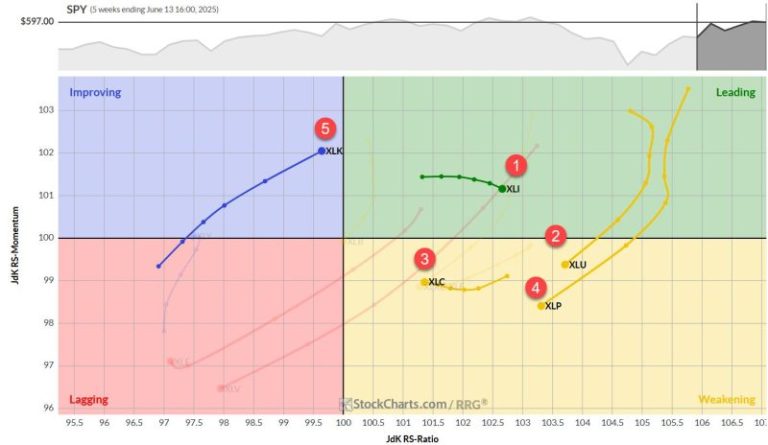
Weekly RRG

Looking at the weekly Relative Rotation Graph (RRG), we’re seeing some interesting movements. Industrials continues its upward trajectory on the RS-Ratio scale, solidifying its top position. Meanwhile, Utilities and Consumer Staples — our #2 and #3 sectors, respectively — are maintaining high RS-Ratio levels despite a momentum setback.

Communication services and financials, rounding out the top 5, find themselves in the weakening quadrant. However, they’re still comfortably above the 100 level on the RS-Ratio scale. This positioning gives them a good shot at curling back into the leading quadrant before potentially hitting lagging territory.

Daily RRG

Switching to the daily RRG, we can see some significant moves over the past week.

Consumer Staples have made a considerable leap, landing deep in the improving quadrant with the highest RS-Momentum reading. This surge explains its return to the top 5. Utilities isn’t far behind, also making a strong move into the improving quadrant. Financials, while in the lagging quadrant, are showing less dramatic movement compared to staples and utilities. Its shorter tail on the RRG indicates a less powerful move, but its high position on the weekly RRG is keeping it in the top 5 — for now.

Industrials: Strength Confirmed

The #1 sector is pushing against overhead resistance around 143 for the third consecutive week. A break above this level could trigger an acceleration higher. The relative strength chart vs. the S&P 500 has already broken out, continuing to pull the RRG lines upward.

Utilities: Bouncing Back

After a weak showing two weeks ago, utilities closed last week at the top of its range. There’s still resistance lurking just below 85 (around 84), but a break above could spark a rally. The raw RS line is grappling with the upper boundary of its sideways trading range, causing the RRG lines to roll over while remaining in the leading quadrant.

Consumer Staples: Testing Resistance

Staples has rebounded to the upper boundary of its trading range, with key resistance between 82 and 83.50. A spike to $83.90 represents the recent high-water mark. Breaking above this barrier could accelerate the move higher.

The raw RS line has peaked against overhead resistance and needs to form a new low to support the RRG lines.

Communication Services: Holding Steady

XLC is trading around $101.40, with overhead resistance a few dollars away, near $ 105. The raw RS line remains within its rising channel, but we’ll need to see improved relative strength soon to maintain this positive trend. The sector sits in the weakening quadrant, but has the potential to push back into leading territory with a strong relative strength (RS) rally.

Financials: At a Crossroads

The financial sector is struggling with old resistance that’s now acting as support. Its RS line is testing the lower boundary of its rising channel. Financials needs a couple of strong weeks in both price and relative strength to maintain its top 5 position.

Portfolio Performance

As of last Friday’s close, our model portfolio is lagging the S&P 500 by just over 5%. This performance gap has widened slightly from last week, but remains in line with the volatile sector rotations we’ve been seeing.

The current market environment presents an apparent dilemma for sector rotation strategies. While defensive sectors are gaining prominence, cyclicals are taking a back seat — at least for now. This flip-flop situation is common in volatile markets seeking direction, but it’s causing more frequent trades in our model than we’d typically expect.

For meaningful trends to emerge, the market needs to stabilize and establish a clear directional bias. Until then, we’re likely to see continued back-and-forth movement as investors grapple with mixed economic signals and shifting sentiment.

#StayAlert and have a great week. –Julius


While lead production figures are helpful in tracking year-to-year activity, lead reserves provide a longer-term picture of which nations are best positioned to dominate the lead market in the future.

These reserves reflect the volume of economically recoverable lead available in each country — a critical factor in global supply chains, especially amid tightening environmental regulations and rising demand for energy storage.

Top lead reserves by country

According to the US Geological Survey, global lead reserves total around 96,000 metric tons. Here’s a look at the top 5 countries with the largest lead reserves, and what’s shaping their role in the market today.

1. Australia

Lead reserves: 35 million metric tons

Australia remains the undisputed global leader in lead reserves with an estimated 35 million metric tons, meaning the nation holds over one third of the world’s lead reserves.

The country also holds vast deposits of zinc and silver, with many polymetallic operations supporting lead output. The Northern Territory and Queensland are home to many of those mines, as well as lead exploration.

Despite flat year-on-year production, Australia remains one of the world’s top producers at 430,000 metric tons, thanks in part to efficient mining operations and strong regulatory frameworks. Most of Australia’s lead output is exported in concentrate form.

2. China

Lead reserves: 22 million metric tons

China boasts the world’s second-largest lead reserves at 22 million metric tons, and it is the world’s largest producer and consumer of lead. However, its lead output slightly declined in 2024 to 1.9 million metric tons amid broader mining reforms and tightening environmental restrictions aimed at curbing pollution.

According to a February 2024 report from the International Lead and Zinc Study Group, China boosted its lead concentrate imports by 9.6 percent in 2024 compared to 2023, bringing in a total of 712,000 metric tons.

3. Russia

Lead reserves: 8.9 million metric tons

Russia ranks third in lead reserves, with 8.9 million metric tons — up from estimates in past years. Production has remained relatively stable, coming in at 220,000 metric tons in 2024, and the country continues to benefit from its vast resource base in Siberia and the Far East.

Given mounting geopolitical tensions and Western sanctions, Russia has sought to strengthen resource independence by prioritizing internal demand and increasing ties with aligned economies. Lead plays a smaller but still strategic role in the country’s mining sector, particularly as a byproduct of polymetallic ore operations.

4. Mexico

Lead reserves: 5.6 million metric tons

Mexico is a major producer of silver and zinc, and lead often comes as a byproduct of those mining operations. The country holds the fourth-largest lead reserves globally at 5.6 million metric tons.

With its mining industry deeply integrated into global supply chains, Mexico is an essential exporter to both North American and Asian markets. The country produced 180,000 metric tons in 2024.

5. Peru

Lead reserves: 5 million metric tons

Rounding out the top five is Peru, a country known for its rich base metal deposits. With 5 million metric tons in lead reserves and a robust annual output of 270,000 metric tons in 2024, Peru remains a pillar of Latin American lead supply.

Other countries with notable lead reserves

While the top five countries above dominate the global reserve landscape, several other nations also hold substantial lead resources:

  • United States – 4.6 million metric tons
  • Iran – 2 million metric tons
  • India – 1.9 million metric tons
  • Sweden – 1.7 million metric tons
  • Turkey – 1.6 million metric tons
  • Bolivia – 1.6 million metric tons

Lead market outlook

Lead demand may be shifting with the rise of substitutes and regulatory changes, but the metal remains vital in energy storage, automotive batteries, radiation shielding and electronics. Countries with large lead reserves are not only crucial today — they are also strategically positioned to shape the future of global resource security.

The lead market in 2024 experienced notable volatility. Prices began the year strong and surged to a high of US$2,343 per metric ton in late May, but then retreated and fluctuated within a narrow range of US$1,950 to US$2,150 per MT.

By the end of the year, prices were down 2.4 percent year-to-date. Analysts attribute the swings to tightening regulations in China, reduced supply and global economic uncertainties.

Global demand for refined lead is expected to rise by 1.9 percent in 2025 to 13.39 million metric tons. Growth will be driven by increased consumption in India and Vietnam, and recovering demand in Europe and Mexico. The EV market remains a crucial new demand vector, with lead-acid batteries still widely used for onboard systems.

Securities Disclosure: I, Giann Liguid, hold no direct investment interest in any company mentioned in this article.

This post appeared first on investingnews.com

Athena Gold Corporation (CSE:ATHA)(OTCQB:AHNRF) (‘Athena Gold’ or the ‘Company’) is pleased to announce that it has entered into a property option agreement (the ‘Agreement’) with Firetail Resources Limited (ASX:FTL) (‘Firetail’) dated May 28, 2025, whereby the Company has granted Firetail the exclusive right (the ‘Option’) to acquire an 80% undivided interest in the Company’s Excelsior Springs Project located in Nevada, USA (‘Excelsior’ or the ‘Property’). If the Option is exercised, Firetail will pay Athena Gold AUD$200,000 in cash and issue 32,000,000 ordinary shares, and Firetail will be required to incur USD$5,000,000 in expenditures over a five-year term. A 1% net smelter return royalty will also be provided to Athena Gold on certain claims comprising the Property. If Firetail successfully earns its 80% interest, the parties will form a joint venture partnership that provides Athena Gold with a 20% free-carried interest until a Definitive Feasibility Study is published.

In addition, the Company is pleased to announce that mobilization for the proposed till program at its Laird Lake project in Red Lake, Ontario, has begun (refer to press release dated April 17, 2025).

‘Our efforts at Excelsior have attracted international interest, and we are pleased that the capable team at Firetail is keen to take on the risk and share the benefits with Athena Gold. The cash and share payments, as well as the exploration spend required for Firetail to earn an 80% interest, surpass the book value of Excelsior. When normalized to a 100% basis from 80%, the total investment approaches our current market capitalization. In addition to our significant shareholding in Firetail, Athena will maintain significant upside in the project through royalties and its 20% free-carried interest to a Definitive Feasibility Study. With Excelsior successfully monetized, we can place our focus on our new flagship project, Laird Lake, where crews have now mobilized for the 2025 field season,’ said Koby Kushner, President & CEO of Athena Gold.

Summary of the Terms of the Agreement

TERM: The term of the Option is five (5) years.

OPTION PERIOD: In consideration for the granting of the right to explore the Property and to purchase the Option Firetail shall pay a non-refundable cash fee of AUD$50,000 within five days from execution of the Agreement. Firetail has three (3) months from execution of the Agreement to determine whether to proceed with exercising the Option.

EXERCISE OF THE OPTION: Firetail can exercise the Option (the ‘Exercise Date’) within the three-month period and acquire the Property by:

  1. Paying AUD$200,000 within five (5) business days of the Exercise Date; and
  2. Issuing 32,000,000 ordinary shares in the capital of Firetail (the ‘Consideration Shares’) within five (5) business days of the Exercise Date. Firetail may at its sole discretion, elect to pay to the Company the value of the Consideration Shares in cash, calculated using the 5-day VWAP of Firetail ordinary shares trading on the Australian Securities Exchange.

Firetail agrees to incur an aggregate of not less than USD$5,000,000 in exploration expenditures on the Property over a five-year period commencing from the Exercise Date. If the Option is exercised, Athena Gold will retain a 20% free-carried interest in the Property until completion of a Definitive Feasibility Study by Firetail.

Potential Joint Venture

Assuming the entering into of a joint venture and prior to, the Company and Firetail agree to enter into a joint venture wherein the Company shall be responsible for 20% of the exploration expenditures on the Property, subject to Firetail having first expended or incurred the initial USD$5,000,000 in exploration expenditures on the Property. On commencement of the joint venture, Firetail will grant a 1% net smelter return royalty to the Company with respect to the production of all metals and minerals from the grounds without pre-existing royalties.

Upon commencement of production, from any and all mineral concessions, interests or rights acquired (collectively, the ‘Interests’), directly or indirectly, within the area of influence, these Interests will be subject to a 1% net smelter return royalty that will be granted to the Company and if any party’s interests are diluted below the 10% percentage share, this party’s said Interest will be converted to an additional 1% net smelter return royalty on the Property.

The Company reserves the right that it may, at its sole election and by providing written notice to Firetail, buy back any royalty that it has granted.

Each party to the joint venture has a right of first refusal on the terms and conditions set out in the Agreement in respect of a transfer of the whole or part of its percentage share and a party may not transfer any part of its percentage share unless and until it has complied with the terms and conditions in the Agreement.

Firetail shall have the option to terminate the Agreement at any time after giving the Company written notice of termination. In the event Firetail does not complete any part of its obligations under the Agreement, the Property will remain with the Company. The Agreement remains subject to the approval of the Canadian Securities Exchange.

About Athena Gold Corporation

Athena Gold is engaged in the business of mineral exploration and the acquisition of mineral property assets. Its objective is to locate and develop economic precious and base metal properties of merit and to conduct additional exploration drilling and studies on its projects across North America. Athena Gold’s Laird Lake project is situated in the Red Lake Gold District of Ontario, covering over 4,000 hectares along more than 10 km of the Balmer-Confederation Assemblage contact, where recent surface sampling results returned up to 373 g/t Au. This underexplored area is road-accessible, located about 10 km west of West Red Lake Gold’s Madsen mine and 34 km northwest of Kinross Gold’s Great Bear project. Meanwhile, its Excelsior Springs Au-Ag project is located in the prolific Walker Lane Trend in Nevada, where it us currently under option by Firetail Resources Limited. Excelsior Springs spans over 1,500 hectares and covers at least three historic mines.

For further information about Athena Gold Corporation and our Excelsior Springs Gold project, please visit www.athenagoldcorp.com.

On Behalf of the Board of Directors
Koby Kushner
President and Chief Executive Officer, Athena Gold Corporation

For further information, please contact:
Athena Gold Corporation
Koby Kushner, President and Chief Executive Officer
Phone: 416-846-6164
Email: kobykushner@athenagoldcorp.com

CHF Capital Markets
Cathy Hume, CEO
Phone: 416-868-1079 x 251
Email: cathy@chfir.com

Forward-Looking Statements

This press release contains forward-looking statements and forward-looking information (collectively, ‘forward-looking statements’) within the meaning of applicable Canadian and US. securities laws. All statements, other than statements of historical fact, included herein, including, without limitation, statements regarding future exploration plans, future results from exploration, and the anticipated business plans and timing of future activities of the Company, are forward-looking statements. Although the Company believes that such statements are reasonable, it can give no assurance that such expectations will prove to be correct. Forward-looking statements are typically identified by words such as: ‘believes’, ‘will’, ‘expects’, ‘anticipates’, ‘intends’, ‘estimates’, ”plans’, ‘may’, ‘should’, ”potential’, ‘scheduled’, or variations of such words and phrases and similar expressions, which, by their nature, refer to future events or results that may, could, would, might or will occur or be taken or achieved. In making the forward-looking statements in this press release, the Company has applied several material assumptions, including without limitation, that there will be investor interest in future financings, market fundamentals will result in sustained precious metals demand and prices, the receipt of any necessary permits, licenses and regulatory approvals in connection with the future exploration and development of the Company’s projects in a timely manner.

The Company cautions investors that any forward-looking statements by the Company are not guarantees of future results or performance, and that actual results may differ materially from those in forward-looking statements.

Readers are cautioned not to place undue reliance on forward-looking statements. The Company undertakes no obligation to update any of the forward-looking statements in this press release or incorporated by reference herein, except as otherwise stated.

Neither the Canadian Securities Exchange nor its regulation services provider accepts responsibility for the adequacy or accuracy of this release.

Source

Click here to connect with Athena Gold Corporation (CSE:ATHA)(OTCQB:AHNRF) to receive an Investor Presentation

This post appeared first on investingnews.com

(TheNewswire)

Brossard, Quebec TheNewswire – June 3, 2025 Charbone Hydrogen Corporation (TSXV: CH; OTCQB: CHHYF; FSE: K47) (the ‘Company’ or ‘CHARBONE ‘), North America’s only publicly traded pure-play company focused on green hydrogen production and distribution, is pleased to announce the closing of Units for debt settlements amounting to $1,342,687.

The Company has settled with certain arm’s length suppliers $1,342,687 of payables through the issuance of units. Each unit offered, priced at $0.075 per Unit, comprised one common share of the Company and one common share purchase warrant. Each Warrant will entitle the holder thereof to purchase one additional common share of the Company at an exercise price of $ 0.10 for 12 months following the closing date. A total of 17,902,489 Units will be issued pursuant to the closing, at a conversion price per unit of $0.075. The Company believes that the settlement of the payables through the issuance of securities is appropriate to advance towards production for its Sorel-Tracy project and the overall need to manage its cash prudently.  A formal agreement will reflect any debt settlement and will be subject to the approval of the TSX Venture Exchange. Any securities issued pursuant to a debt settlement will be subject to a statutory four-month hold period in Canada.

About Charbone Hydrogen Corporation

CHARBONE is an integrated green hydrogen company with strategic distribution capabilities of industrial gases across North America. While continuing to develop its modular green hydrogen production network, CHARBONE also leverages commercial partnerships to supply hydrogen, helium, and other industrial gases without the capital-intensive requirements of production facilities. This approach enhances revenue streams, reduces operational risks, and increases market flexibility. CHARBONE remains North America’s only publicly traded pure-play green hydrogen company, with shares listed on the TSX Venture Exchange (TSXV: CH), the OTC Markets (OTCQB: CHHYF), and the Frankfurt Stock Exchange (FSE: K47). For more information, visit www.charbone.com .

Forward-Looking Statements

This news release contains statements that are ‘forward-looking information’ as defined under Canadian securities laws (‘forward-looking statements’). These forward-looking statements are often identified by words such as ‘intends’, ‘anticipates’, ‘expects’, ‘believes’, ‘plans’, ‘likely’, or similar words. The forward-looking statements reflect management’s expectations, estimates, or projections concerning future results or events, based on the opinions, assumptions and estimates considered reasonable by management at the date the statements are made. Although Charbone believes that the expectations reflected in the forward-looking statements are reasonable, forward-looking statements involve risks and uncertainties, and undue reliance should not be placed on forward-looking statements, as unknown or unpredictable factors could cause actual results to be materially different from those reflected in the forward-looking statements. The forward-looking statements may be affected by risks and uncertainties in the business of Charbone. These risks, uncertainties and assumptions include, but are not limited to, those described under ‘Risk Factors’ in the Corporation’s Filing Statement dated March 31, 2022, which is available on SEDAR at www.sedar.com; they could cause actual events or results to differ materially from those projected in any forward-looking statements.

Except as required under applicable securities legislation, Charbone undertakes no obligation to publicly update or revise forward-looking information.

Neither TSX Venture Exchange nor its Regulation Services Provider (as that term is defined in policies of the TSX Venture Exchange) accepts responsibility for the adequacy or accuracy of this release .

Contact Charbone Hydrogen Corporation

Telephone: +1 450 678 7171

Email: ir@charbone.com

Benoit Veilleux

CFO and Corporate Secretary

Copyright (c) 2025 TheNewswire – All rights reserved.

News Provided by TheNewsWire via QuoteMedia

This post appeared first on investingnews.com

(TheNewswire)

Brossard (Québec) TheNewswire – le 3 juin 2025 — CORPORATION CHARBONE HYDROGÈNE (TSXV: CH OTCQB: CHHYF, FSE: K47 ) (« Charbone » ou la « Société »), la seule compagnie d’Amérique du Nord cotée en bourse axée sur la production et la distribution d’hydrogène vert, a le plaisir d’annoncer la clôture de règlements de dettes par émission d’unités s’élevant à 1 342 687 $.

La Société a conclu avec certains fournisseurs sans lien de dépendance pour un montant total de 1 342 687 $ de comptes à payer par l’émission d’unités. Chaque unité offerte, au prix de 0,075 $ l’unité, comprenait une action ordinaire de la Société et un bon de souscription d’action ordinaire . Chaque bon de souscription permettra à son porteur d’acquérir une action ordinaire supplémentaire de la Société à un prix d’exercice de 0,10 $ pendant 12 mois après la date de clôture . Un total de 17 902 489 d’unités seront émises à la clôture, au prix de conversion unitaire de 0,075 $. La Société estime que le règlement des dettes par l’émission de titres est approprié pour progresser vers la production de son projet phare de Sorel-Tracy et pour répondre à la nécessité générale de gérer sa trésorerie avec prudence. Une entente officielle reflétera tout règlement de dette et sera assujetti à l’approbation de la Bourse de croissance TSX. Tous titres émis dans le cadre de ce règlement de dettes sera assujetti à la période de détention légale au Canada de quatre mois.

À propos de Charbone Hydrogène Corporation

Charbone est une entreprise intégrée d’hydrogène vert disposant de capacités stratégiques de distribution de gaz industriels en Amérique du Nord. Tout en poursuivant le développement de son réseau modulaire de production d’hydrogène vert, Charbone s’appuie également sur des partenariats commerciaux pour fournir de l’hydrogène, de l’hélium et d’autres gaz industriels sans les exigences en capital élevées des usines de production. Cette approche améliore les sources de revenus, réduit les risques opérationnels et accroît la flexibilité sur le marché. Charbone reste la seule société purement axée sur l’hydrogène vert cotée en bourse en Amérique du Nord, avec des actions cotées à la Bourse de croissance TSX (TSXV: CH); sur les marchés OTC (OTCQB: CHHYF); et à la Bourse de Francfort (FSE: K47). Pour plus d’informations, visiter www.charbone.com .

Énoncés prospectifs

Le présent communiqué de presse contient des énoncés qui constituent de « l’information prospective » au sens des lois canadiennes sur les valeurs mobilières (« déclarations prospectives »). Ces déclarations prospectives sont souvent identifiées par des mots tels que « a l’intention », « anticipe », « s’attend à », « croit », « planifie », « probable », ou des mots similaires. Les déclarations prospectives reflètent les attentes, estimations ou projections respectives de la direction de Charbone concernant les résultats ou événements futurs, sur la base des opinions, hypothèses et estimations considérées comme raisonnables par la direction à la date à laquelle les déclarations sont faites. Bien que Charbone estime que les attentes exprimées dans les déclarations prospectives sont raisonnables, les déclarations prospectives comportent des risques et des incertitudes, et il ne faut pas se fier indûment aux déclarations prospectives, car des facteurs inconnus ou imprévisibles pourraient faire en sorte que les résultats réels soient sensiblement différents de ceux exprimés dans les déclarations prospectives. Des risques et des incertitudes liés aux activités de Charbone peuvent avoir une incidence sur les déclarations prospectives. Ces risques, incertitudes et hypothèses comprennent, sans s’y limiter, ceux décrits à la rubrique « Facteurs de risque » dans la déclaration de changement à l’inscription de la Société datée du 31 mars 2022, qui peut être consultée sur SEDAR à l’adresse www.sedar.com; ils pourraient faire en sorte que les événements ou les résultats réels diffèrent sensiblement de ceux prévus dans les déclarations prospectives.

Sauf si les lois sur les valeurs mobilières applicables l’exigent, Charbone ne s’engage pas à mettre à jour ni à réviser les déclarations prospectives.

Ni la Bourse de croissance TSX ni son fournisseur de services de réglementation (tel que ce terme est défini dans les politiques de la Bourse de croissance TSX) n’acceptent de responsabilité quant à la pertinence ou à l’exactitude du présent communiqué.

Pour contacter Corporation Charbone Hydrogène :

Téléphone bureau: +1 450 678 7171

Courriel: ir@charbone.com

Benoit Veilleux

Chef de la direction financière et secrétaire corporatif

Copyright (c) 2025 TheNewswire – All rights reserved.

News Provided by TheNewsWire via QuoteMedia

This post appeared first on investingnews.com