
Author

admin

Browsing

Upsize driven by cornerstone investment from a strategic investor group with a strong conviction in Company’s Colombian exploration focus

Quimbaya Gold Inc. (CSE: QIM) (OTCQB: QIMGF) (FSE: K05) (‘Quimbaya’ or the ‘Company’) is pleased to announce that it has upsized its previously announced non-brokered private placement financing from approximately $2,000,000 to $4,000,000 (the ‘Offering‘), following a cornerstone investment from a strategic investor group with a long-term vision for Quimbaya Gold. No commissions are payable in connection with this strategic investment.

The Company views this as a meaningful endorsement of its regional-scale exploration strategy in Colombia and the progress made to date across its flagship Tahami project. The private placement is expected to close on or about June 27, 2025, and remains subject to customary closing conditions and regulatory approvals. All securities issued pursuant to the Offering will be subject to a four-month and one-day hold period in accordance with applicable securities laws.

‘To see this level of conviction from a well-informed, long-term strategic investor Group with an impressive track record in the industry speaks volumes,’ said Alexandre P. Boivin, President & CEO of Quimbaya Gold. ‘We’ve always believed in the strength of our portfolio, and this capital not only enhances our flexibility, it accelerates our ability to demonstrate that potential with our upcoming drilling campaign’

Up to 11,428,572 units of the Company (each, a ‘Unit’) may be sold by the Company, pursuant to the upsized Offering, at a price of $0.35 per Unit for aggregate gross proceeds of up to approximately $4,000,000. Each Unit will be comprised of one common share in the capital of the Company (a ‘Share’) and one common share purchase warrant (a ‘Warrant’). Each Warrant will entitle the holder to acquire one Share at a price of C$0.60 per Share for a period of 36 months from the issuance date of the Offering. Proceeds from the financing will be used to advance exploration on Quimbaya’s 100% controlled gold assets in Colombia, most importantly the Tahami project in Segovia, adjacent to Aris Mining, and for general working capital purposes.

The Company appreciates the strong interest shown by new and existing shareholders and looks forward to sharing a more detailed operational update in the near future.

The securities being offered have not been, nor will they be, registered under the United States Securities Act of 1933, as amended, and may not be offered or sold in the United States or to, or for the account or benefit of, U.S. persons absent registration or an applicable exemption from the registration requirements. This press release shall not constitute an offer to sell or the solicitation of an offer to buy securities of the Company in the United States, nor shall there be any sale of such securities in any State in which such offer, solicitation or sale would be unlawful.

About the Tahami South Project

Tahami South is a 2,023 hectares gold exploration project located in the Segovia Zaragoza mining district of Antioquia, Colombia, one of the country’s most prolific gold belts. The project lies just northeast of Aris Mining’s Segovia operation and is centered on a structural corridor known to host high-grade epithermal vein systems. Quimbaya Gold is advancing Tahami South as a high-priority asset with potential for district-scale discovery.

About Quimbaya

Quimbaya aims to discover gold resources through exploration and acquisition of mining properties in the prolific mining districts of Colombia. Managed by an experienced team in the mining sector, Quimbaya is focused on three projects in the regions of Segovia (Tahami Project), Puerto Berrio (Berrio Project), and Abejorral (Maitamac Project), all located in Antioquia Province, Colombia.

Contact Information

Alexandre P. Boivin, President and CEO apboivin@quimbayagold.com

Jason Frame, Manager of Communications jason.frame@quimbayagold.com, +1-647-576-7135‎

Quimbaya Gold Inc.
Follow on X @quimbayagoldinc
Follow on LinkedIn @quimbayagold
Follow on Instagram @quimbayagoldinc
Follow on Facebook @quimbayagoldinc

Cautionary Statements

Certain statements contained in this press release constitute ‘forward-looking information’ as that term is defined in applicable Canadian securities legislation. All statements, other than statements of historical fact, included herein are forward-looking information. Generally, but not always, forward-looking statements and information can be identified by the use of forward-looking terminology such as ‘intends’, ‘expects’ or ‘anticipates’, or variations of such words and phrases or statements that certain actions, events or results ‘may’, ‘could’, ‘should’, ‘would’ or ‘occur’. Forward-looking statements herein include statements and information regarding the Offering, including its timing, intended closing date, intended use of proceeds and intended gross proceeds, any expected issuance of the Units or the Shares and Warrants which comprise them, a commitment by any person to purchase Units pursuant to the Offering, receipt by the Company of any applicable regulatory approval, the future plans for the Company, future expectations for the gold sector generally, the Colombian gold sector more particularly, or how global or local market trends may affect the Company, intended exploration on any of the Company’s properties and any results thereof, the strength of the Company’s mineral property portfolio, the potential discover and potential size of the discovery of minerals on any property of the Company’s, including Tahami South, the aims and goals of the Company, and other forward-looking information. Forward-looking information by its nature is based on assumptions and involve known and unknown risks, uncertainties and other factors which may cause the actual results, performance or achievements of Quimbaya to be materially different from any future results, performance or achievements expressed or implied by such forward-looking statements or information. These assumptions include, but are not limited to, that the Offering as described herein will close on terms materially similar to the terms described herein. The future outcomes that relate to forward-looking statements may be influenced by many factors, including but not limited to: future planned development and other activities on the Company’s mineral properties; an inability to finance the Company; obtaining required permitting on the Company’s mineral properties in a timely manner; any adverse changes to the planned operations of the Company’s mineral properties; failure by the Company for any reason to undertake expected exploration programs; achieving and maintaining favourable relationships with local communities; mineral exploration results that are poorer or better than expected; prices for gold remaining as expected; currency exchange rates remaining as expected; availability of funds for the Company’s projects; prices for energy inputs, labour, materials, supplies and services (including transportation); no labour-related disruptions; no unplanned delays or interruptions in scheduled construction and production; all necessary permits, licenses and regulatory approvals are received in a timely manner; the Offering proceeds being received as anticipated; all requisite regulatory and stock exchange approvals for the Offering are obtained in a timely fashion; investor participation in the Offering; and the Company’s ability to comply with environmental, health and safety laws. Although Quimbaya’s management believes that the assumptions made and the expectations represented by such information are reasonable, there can be no assurance that the forward-looking information will prove to be accurate. Furthermore, should one or more of the risks, uncertainties or other factors materialize, or should underlying assumptions prove incorrect, actual results may vary materially from those described in forward-looking statements or information. Readers are cautioned not to place undue reliance on forward-looking information as there can be no assurance that the plans, intentions or expectations upon which they are placed will occur. Forward-looking information contained in this news release is expressly qualified by this cautionary statement. The forward-looking information contained in this news release represents the expectations of Quimbaya as of the date of this news release and, accordingly, is subject to change after such date. Except as required by law, Quimbaya does not expect to update forward-looking statements and information continually as conditions change.

Source

Click here to connect with Quimbaya Gold Inc. (CSE: QIM) (OTCQB: QIMGF) (FSE: K05) to receive an Investor Presentation
This post appeared first on investingnews.com

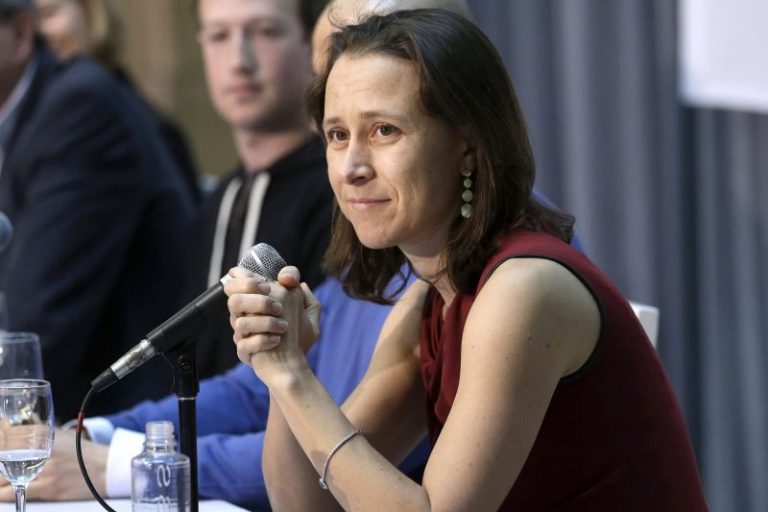
Anne Wojcicki, the co-founder and former CEO of 23andMe, has regained control over the embattled genetic testing company after her new nonprofit, TTAM Research Institute, outbid Regeneron Pharmaceuticals, the company announced Friday.

TTAM will acquire substantially all of 23andMe’s assets for $305 million, including its Personal Genome Service and Research Services business lines as well as telehealth subsidiary Lemonaid Health. It’s a big win for Wojcicki, who stepped down from her role as CEO when 23andMe filed for Chapter 11 bankruptcy protection in March.

Last month, Regeneron announced it would purchase most of 23andMe’s assets for $256 million after it came out on top during a bankruptcy auction. But Wojcicki submitted a separate $305 million bid through TTAM and pushed to reopen the auction. TTAM is an acronym for the first letters of 23andMe, according to The Wall Street Journal.

“I am thrilled that TTAM Research Institute will be able to continue the mission of 23andMe to help people access, understand and benefit from the human genome,” Wojcicki said in a statement.

23andMe gained popularity because of its at-home DNA testing kits that gave customers insight into their family histories and genetic profiles. The five-time CNBC Disruptor 50 company went public in 2021 via a merger with a special purpose acquisition company. At its peak, 23andMe was valued at around $6 billion.

The company struggled to generate recurring revenue and stand up viable research and therapeutics businesses after going public, and it has been plagued by privacy concerns since hackers accessed the information of nearly seven million customers in 2023.

TTAM’s acquisition is still subject to approval by the U.S. Bankruptcy Court for the Eastern District of Missouri.

This post appeared first on NBC NEWS

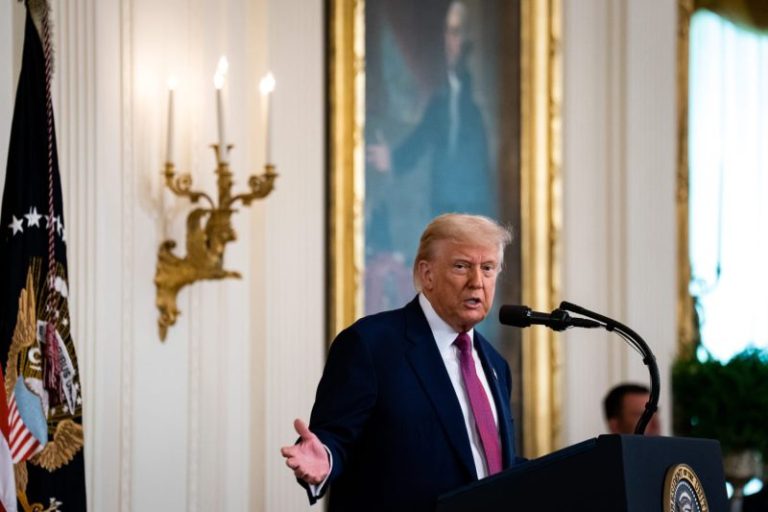
President Donald Trump continues to enjoy income streams from scores of luxury properties and business ventures, many of which are worth tens of millions of dollars, according to a financial disclosure form filed late Friday.

Released by the Office of Government Ethics, Trump’s 2025 financial disclosure spans 234 pages in all, including 145 pages of stock and bond investments. It is dated Friday with Trump’s signature.

One of the largest sources of income is the $57,355,532 he received from his ownership stake in World Liberty Financial, the cryptocurrency platform launched last year. The form shows that World Liberty’s sales of digital tokens have been highly lucrative for Trump and his family. Trump’s three sons, Donald Jr., Eric and Barron, are listed on the company’s website as co-founders of the firm.

Separately, Trump’s meme coin, known on crypto markets simply as $TRUMP, was not released until January and is therefore not subject to the disclosure requirements for this form, which covered calendar year 2024.

It was a lucrative year for Trump when it came to royalty payments for the various goods that are sold featuring his name and likeness.

Among the royalty payments:

The filing also includes a listing of liabilities, including at least $15,000 on an American Express credit card and payments due to E. Jean Carroll, the woman who successfully sued Trump over sexual abuse and defamation, though he is still seeking to appeal the decision.

The rest of the document includes dozens of pages of lengthy footnotes about his various assets.

The form was filed to comply with federal requirements for executive branch office holders. By comparison, the form former President Joe Biden filed in 2024 was 11 pages and consisted largely of conventional sources of income like bank and retirement accounts, while Kamala Harris’ was 15 pages.

Many of Trump’s key assets are held in a revocable trust overseen by Donald Trump Jr., his eldest son. They include more than 100,000 shares of Trump Media and Technology Group, the social media company that went public in 2024. Trump is the largest shareholder, and his nearly 53% is worth billions of dollars. Those holdings were still disclosed in the form.

This post appeared first on NBC NEWS

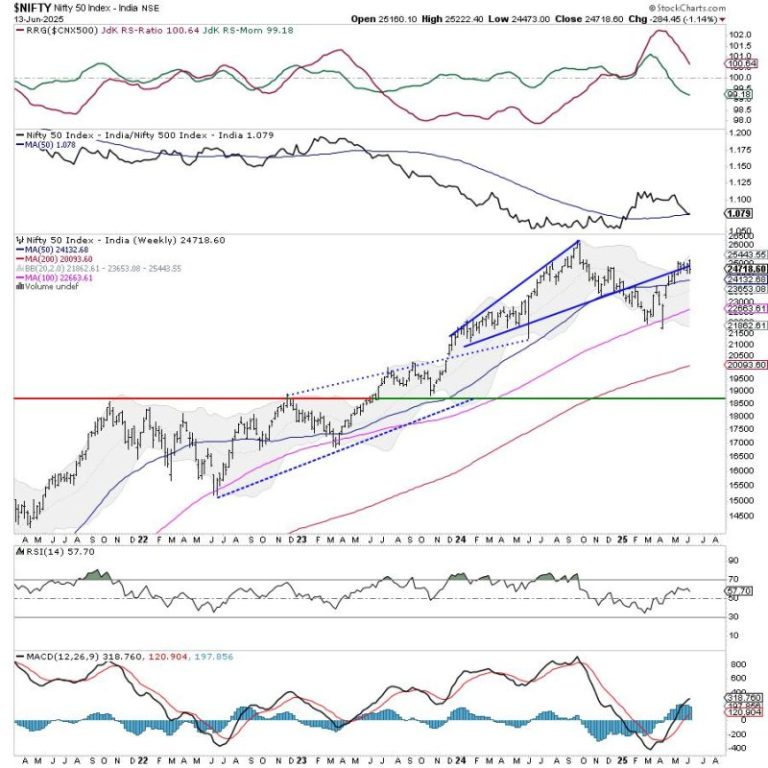
An attempt to break out of a month-long consolidation fizzled out as the Nifty declined and returned inside the trading zone it had created for itself. Over the past five sessions, the markets consolidated just above the upper edge of the trading zone; however, this failed to result in a breakout as the markets suffered a corrective retracement. The trading range stayed wider on anticipated lines; the Index oscillated in a 749-point range over the past week. The volatility rose; the India Vix climbed 3.08% to 15.08 on a weekly basis. The headline Index closed with a net weekly loss of 284.45 points (-1.14%).

We have a fresh set of geopolitical tensions to deal with Israel attacking Iran. The global equity markets are likely to remain affected, and India will be no exception to this. Having said this, the Indian markets are relatively stronger than their peers and are likely to stay that way. Despite the negative reaction to the global uncertainties, Nifty has shown great resilience and has remained in the 24500-25100 trading zone, in which it has been trading for over a month now. There are high possibilities that over the coming week, the Nifty may stay volatile and oscillate in a wide range, but it is unlikely to create any directional bias. A sustainable trend would emerge only after Nifty takes out 25100 on the upside or violates the 24500 level.

The levels of 25100 and 25300 are likely to act as resistance points in the coming week. The supports are likely to come in at 24500 and 24380.

The weekly RSI stands at 57.67; it stays neutral and does not show any divergence against the price. The weekly MACD is bullish and remains above its signal line.

The pattern analysis of the weekly chart shows that the Nifty has failed to break above the rising trendline resistance. This trendline begins from 21150 and joins the subsequent higher bottoms. Besides this, it reinforces the 25100 level as a strong resistance point. For any trending upmove to emerge, it would be crucial for the Index to move past this level convincingly.

Overall, it is unlikely that the Nifty will violate the 24500 levels. The options data shows very negligible call writing below 24500 strikes, increasing the possibility of this level staying defended over the coming days. Unless there is a situation with more gravity to be dealt with, the markets may stay largely in a defined trading range. The sector rotation stays visible in favor of traditionally defensive pockets and low-beta stocks. We continue to recommend a cautious stance as long as the Index does not move past the 25100 level and stays above that point. Until then, a highly stock-specific approach is recommended while guarding profits at higher levels.


Sector Analysis for the coming week

In our look at Relative Rotation Graphs®, we compared various sectors against the CNX500 (NIFTY 500 Index), representing over 95% of the free-float market cap of all the listed stocks. 

Relative Rotation Graphs (RRG) show that the Nifty Midcap 100 has rolled inside the leading quadrant and is set to outperform the broader markets relatively. The Nifty PSU Bank and PSE Indices are also inside the leading quadrant; however, they are giving up on their relative momentum.

The Nifty Infrastructure Index has rolled into the weakening quadrant. The Banknifty, Services Sector Index, Consumption, Financial Services, and Commodities Sector Indices are also inside the weakening quadrant. While stock-specific performance may be seen, the collective relative outperformance may diminish.

The Nifty FMCG Index languishes in the lagging quadrant. The Metal and Pharma Indices are also in the lagging quadrant, but they are improving their relative momentum against the broader Nifty 500 Index.

The Nifty Realty, Media, Auto, and Energy Sector Indices are inside the improving quadrant; they may continue improving their relative performance against the broader markets.


Important Note: RRG charts show the relative strength and momentum of a group of stocks. In the above Chart, they show relative performance against NIFTY500 Index (Broader Markets) and should not be used directly as buy or sell signals.  


Milan Vaishnav, CMT, MSTA

Consulting Technical Analyst

www.EquityResearch.asia | www.ChartWizard.ae

U.S. President Donald Trump said on Friday that concerns over national security risks posed by Nippon Steel’s $14.9 billion bid for U.S. Steel can be resolved if the companies fulfill certain conditions that his administration has laid out, paving the way for the deal’s approval.

Shares of U.S. Steel rose 3.5% on the news in after-the-bell trading as investors bet the deal was close to done. Trump, in an executive order, said conditions for resolving the national security concerns would be laid out in an agreement, without providing details. “I additionally find that the threatened impairment to the national security of the United States arising as a result of the Proposed Transaction can be adequately mitigated if the conditions set forth in section 3 of this order are met,” Trump said in the order, which was released by the White House.

The companies thanked Trump in a news release, saying the agreement includes $11 billion in new investments to be made by 2028 and governance commitments including a golden share to be issued to the U.S. government. They did not detail how much control the golden share would give the U.S. Shares of U.S. Steel had dipped earlier on Friday after a Nippon Steel executive told the Japanese Nikkei newspaper that its planned takeover of U.S. Steel required “a degree of management freedom” to go ahead after Trump earlier had said the U.S. would be in control with a golden share.

The bid, first announced by Nippon Steel in December 2023, has faced opposition from the start. Both Democratic former President Joe Biden and Trump, a Republican, asserted last year that U.S. Steel should remain U.S.-owned, as they sought to woo voters ahead of the presidential election in Pennsylvania, where the company is headquartered.

Biden in January, shortly before leaving office, blocked the deal on national security grounds, prompting lawsuits by the companies, which argued the national security review they received was biased. The Biden White House disputed the charge.

The steel companies saw a new opportunity in the Trump administration, which began on January 20 and opened a fresh 45-day national security review into the proposed merger in April.

But Trump’s public comments, ranging from welcoming a simple “investment” in U.S. Steel by the Japanese firm to floating a minority stake for Nippon Steel, spurred confusion.

At a rally in Pennsylvania on May 30, Trump lauded an agreement between the companies and said Nippon Steel would make a “great partner” for U.S. Steel. But he later told reporters the deal still lacked his final approval, leaving unresolved whether he would allow Nippon Steel to take ownership.

Nippon Steel and the Trump administration asked a U.S. appeals court on June 5 for an eight-day extension of a pause in litigation to give them more time to reach a deal for the Japanese firm. The pause expires Friday, but could be extended.

June 18 is the expiration date of the current acquisition contract between Nippon Steel and U.S. Steel, but the firms could agree to postpone that date

This post appeared first on NBC NEWS

Harvest Gold Corporation (TSXV: HVG) (“Harvest Gold ” or the “Company ”) is pleased to announce the results of its annual general meeting (the “AGM”) held on June 12, 2025. All resolutions presented to the shareholders were approved with over 99% of votes cast being in favour of each resolution.

A total of 21,129,144 common shares were voted representing 23.97% of the issued and outstanding common shares. As a result,

  • Dale Matheson Carr‑Hilton Labonte LLP was re-appointed as the auditor of the Company
  • The number of Directors was set at five with the following nominees elected as directors: Richard Mark, Christopher P. Cherry, Edward Zablotny, Patrick Donnelly and Len Brownlie.
  • The Company’s 10% Rolling Stock Options Plan was re-approved.

Following the AGM, the board appointed Len Brownlie (Chair); Edward Zablotny and Patrick Donnelly to its Audit Committee and Patrick Donnelly (Chair) and Edward Zablotny to its Compensation Committee.

About Harvest Gold Corporation

Harvest Gold is focused on exploring for near surface gold deposits and copper-gold porphyry deposits in politically stable mining jurisdictions. Harvest Gold’s board of directors, management team and technical advisors have collective geological and financing experience exceeding 400 years.

Harvest Gold has three active gold projects focused in the Urban Barry area, totalling 377 claims covering 20,016.87 ha, located approximately 45-70 km west of Gold Fields – Windfall Deposit.

Harvest Gold acknowledges that the Mosseau Gold Project straddles the Eeyou Istchee-James Bay and Abitibi territories. Harvest Gold is committed to developing positive and mutually beneficial relationships based on respect and transparency with local Indigenous communities.

Harvest Gold’s three properties, Mosseau, Urban-Barry and LaBelle, together cover over 50 km of favorable strike along mineralized shear zones.

ON BEHALF OF THE BOARD OF DIRECTORS

Rick Mark
President and CEO
Harvest Gold Corporation

For more information please contact:

Rick Mark or Jan Urata
@ 604.737.2303 or info@harvestgoldcorp.com

Neither TSX Venture Exchange nor its Regulation Services Provider (as that term is defined in the policies of the TSX Venture Exchange) accepts responsibility for the adequacy or accuracy of this release.

Forward Looking Information

This news release includes certain statements that may be deemed ‘forward looking statements’. All statements in this news release, other than statements of historical facts, that address events or developments that Harvest Gold expects to occur, are forward looking statements. Forward looking statements are statements that are not historical facts and are generally, but not always, identified by the words ‘expects’, ‘plans’, ‘anticipates’, ‘believes’, ‘intends’, ‘estimates’, ‘projects’, ‘potential’ and similar expressions, or that events or conditions ‘will’, ‘would’, ‘may’, ‘could’ or ‘should’ occur.

Although the Company believes the expectations expressed in such forward-looking statements are based on reasonable assumptions, such statements are not guarantees of future performance and actual results may differ materially from those in the forward-looking statements. Factors that could cause the actual results to differ materially from those in forward looking statements include market prices, exploitation and exploration successes, and continued availability of capital and financing, and general economic, market or business conditions. Investors are cautioned that any such statements are not guarantees of future performance and actual results or developments may differ materially from those projected in the forward-looking statements. Forward looking statements are based on the beliefs, estimates and opinions of the Company’s management on the date the statements are made. Except as required by securities laws, the Company undertakes no obligation to update these forward-looking statements in the event that management’s beliefs, estimates or opinions, or other factors, should change.

Source

This post appeared first on investingnews.com

With Friday’s pullback after a relatively strong week, the S&P 500 chart appears to be flashing a rare but powerful signal that is quite common at major market tops. The signal in question is a bearish momentum divergence, formed by a pattern of higher highs in price combined with lower peaks in momentum, which indicates weakening buying power after an extended bullish phase.

Today, we’ll share a brief history lesson of previous market tops starting with the COVID peak in 2020. And while we don’t necessarily see a sudden downdraft as the most likely outcome, this bearish price and momentum structure suggests limited upside for the S&P 500 until and unless this divergence is invalidated.

First, let’s review some classic market tops, see how divergences are formed, and learn what often comes next.

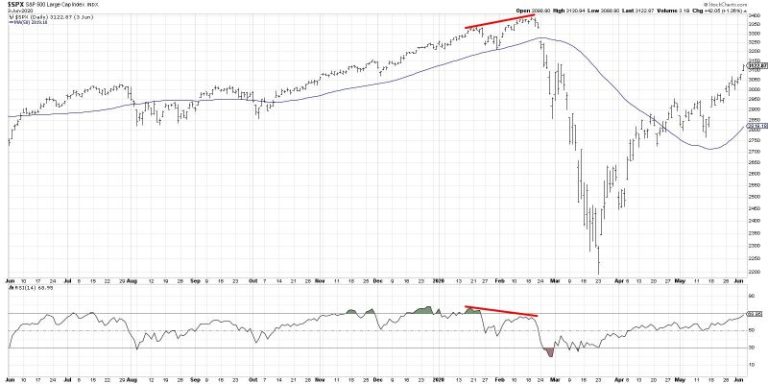
The year 2020 started in a position of strength, continuing the uptrend phase of 2019. But conditions soon deteriorated, with weaker momentum and breadth signals flashing cautionary patterns. In the chart below, we can see the higher highs and higher lows in price action in January and February 2020.

Notice how the RSI was overbought at the January peak but not overbought at the February top? This pattern of higher prices on weaker momentum is what we’re looking for, as it implies a lack of buying power and therefore limited upside.

Almost two years later, the market had been driven higher due to an unprecedented amount of liquidity injected into the financial system. Toward the end of 2021, however, we saw the familiar bearish divergence flash again.

Here, we can see the higher price highs in November 2021 through January 2022 were marked by lower readings on momentum indicators like RSI. It’s worth noting here that these divergences don’t happen in a vacuum. In other words, we can use other tools in the technical analysis toolkit to evaluate the trend and determine if the price is reacting as expected to the bearish divergence.

In the weeks after the 2022 peak, we can see that the price broke down through an ascending 50-day moving average. The RSI eventually broke below the 40 level, confirming the rotation from a bullish phase to a bearish phase. So while the divergence itself does not imply a particular path in the months after the signal, it alerts us to use other indicators to validate and track a subsequent downtrend move.

More recently, the February 2025 market peak featured some classic momentum patterns going into the eventual top.

Starting in August 2024, we can see a series of higher price highs that were accompanied by improving RSI peaks. As the price was moving higher, the stronger momentum readings confirmed the uptrend phase. Then, starting December 2024, the next couple price peaks were marked with weaker momentum readings. This bearish divergence with price and RSI once again signaled waning momentum going into a major market peak.

That brings us to the current S&P 500 chart, featuring yet another bearish momentum divergence. And based on what we’ve reviewed so far, you can probably understand why I’m a bit skeptical going into next week!

To be fair, I’ve highlighted price and momentum divergences from significant market tops, many of which came after extended bull market phases. In this case, we’re still only two months off a major market low. However, I would argue the basic premise still holds true. With Friday’s pullback, the S&P 500 appears to be flashing this same pattern of higher prices on weaker momentum. Considering this negative rotation on momentum, I would anticipate at least a retest of the May swing low around 5770.

What would change this tactical bearish expectation? The only way for a bearish divergence to be negated is for the price to continue higher on stronger momentum. So, until we see the price make a new peak combined with the RSI pushing back up to overbought levels, a pullback may be the most likely scenario in the coming weeks.

RR#6,

Dave

P.S. Ready to upgrade your investment process? Check out my free behavioral investing course!


David Keller, CMT

President and Chief Strategist

Sierra Alpha Research LLC

marketmisbehavior.com

https://www.youtube.com/c/MarketMisbehavior


Disclaimer: This blog is for educational purposes only and should not be construed as financial advice. The ideas and strategies should never be used without first assessing your own personal and financial situation, or without consulting a financial professional.

The author does not have a position in mentioned securities at the time of publication. Any opinions expressed herein are solely those of the author and do not in any way represent the views or opinions of any other person or entity.

Catching a sector early as it rotates out of a slump is one of the more reliable ways to get ahead of an emerging trend. You just have to make sure the rotation has enough strength to follow through.

On Thursday morning, as the markets maintained a cautiously bullish tone, I checked the New Highs panel on the StockCharts Dashboard, scanning the 1-, 3-, 6-, and 9-month highs list. A clear theme emerged—biotech and healthcare stocks dominated the shorter-term highs.

Seeing strength in healthcare and biotech, I checked the Market Summary BPI panel to compare breadth across sectors. Healthcare posted a 63.93% reading—an early sign the sector may be turning higher.

Comparing the broader sector with the biotech industry, the Key Ratios – Offense vs. Defense panel showed that Biotech outperformed Healthcare by a modest 2.31% over the past three months. This panel compares the SPDR S&P Biotech ETF (XBI), which represents the biotech sector, with the broader Health Care Select Sector SPDR Fund (XLV).

Are Biotech and Healthcare Starting a Bullish Rotation?

So, are we seeing an early rotation of both industry and sector toward the upside, and could either be shaping up as an opportunity for investment? Let’s take a comparative look at both relative to the SPDR S&P 500 ETF (SPY), our broad market stand-in.

Comparing XBI and XLV to SPY: Signs of Leadership?

FIGURE 1. PERFCHARTS OF XBI, XLV, AND SPY. This is typical of what you’d see during an early-stage rotation.

This PerfCharts view shows a one-year snapshot of relative performance, with biotech lagging behind healthcare, and both trailing the SPY in negative territory. Yet XBI and XLV are showing signs of recovery, with XBI exhibiting a sharper angle of ascent.

Seasonal Strength in Healthcare and Biotech Stocks

Now here’s an interesting addition to the current analysis: what if we considered the industry and the sector from a seasonality perspective? The reason for this is that certain sectors and the industries within them tend to exhibit recurring patterns of strength or weakness during specific times of the year. If we’re seeing a potential turning point in either, could a seasonality lens offer additional insight or clarity to the analysis?

Biotech Seasonality: Strong Months for XBI

Let’s start with XBI, and notice how it’s now entering a cluster of seasonally-favorable months.

FIGURE 2. SEASONALITY CHART OF XBI. The industry is entering a cluster of seasonally strong months.

According to this 10-year seasonality chart, June, July, August, and November tend to be strong months for XBI, with positive closing rates well above 50% (see figures above each bar) and higher-than-average returns (see figures at the bottom of the bars). Among them, June and November stand out as XBI’s strongest seasonal months.

XLV Seasonality: November Still Reigns

FIGURE 3. SEASONALITY CHART OF XLV.  According to this, July is XLV’s second-strongest month after November.

XLV’s seasonal profile shares a similar pattern, with a few key differences. July emerges as XLV’s second-strongest month, boasting a close rate of 89% and an average return of 3.1%. Like XBI, November is XLV’s top month in terms of average return.

What this tells us is that the biotech industry and the broader healthcare sector have historically performed well during these periods (especially November), suggesting that seasonal strength could serve as a tailwind if the current rotation continues to build momentum.

Charting the Rotation: XBI Trend Structure Shows Some Clarity

Next, let’s take a look at their current price action, starting with a daily chart of XBI.

FIGURE 4. DAILY CHART OF XBI. Notice how the trend structure is well-defined by the Fibonacci retracement, providing clear measurements for you to gauge the subsequent directionality once the market decides which way XBI will go.

XBI’s price action shows it reversed at the 50% Fibonacci Retracement level (November high to April low). Will the bears take control, or will XBI’s near-term reaction strengthen into an uptrend, eventually pushing XBI past the 61.8% retracement level, a threshold wherein bears may fold their positions and bulls increase theirs?

In light of the latter, the Relative Strength Index (RSI) is at 61 and rising, indicating room for upside, but only under the condition that the current bullish swing maintains its trajectory.

A few actionable tips. If you’re bullish on XBI and planning to add it to your portfolio, consider the following:

  • If XBI were to pull back deeper, watch to see if it bounces near the last recent swing low area at $76.
  • If XBI reverses to the upside, expect resistance at the 61.8% Fib retracement at around $91. Also, watch the yellow-shaded zone around $94, an area of concentrated trading activity which may also act as a strong resistance zone.

If XBI rotates in a bullish fashion, these key levels can help guide your analysis.

XLV Technical Setup: Strength, But Not Yet a Breakout

Next, shift over to a daily chart of XLV. You’ll notice it’s quite different despite also exhibiting a recovery.

FIGURE 5. DAILY CHART OF XLV. Unlike the previous example, XLV’s price action is more muddled.

XLV’s recovery doesn’t appear as convincing just yet, as it still needs to clear multiple swing highs and resistance levels clustered between $139 and $141 (highlighted in green). If it manages to break above this zone, the next resistance range—shaded in yellow—sits between $148 and $150. In short, the sector proxy faces several hurdles and technical headwinds ahead.

The RSI, at 58 and rising, is nowhere near overbought territory, but it may not immediately indicate bullishness unless XLV is able to establish an uptrend. For now, it isn’t clear if that will happen, so exercise caution.

From an actionable standpoint, the current technical structure doesn’t offer a clear entry setup. That’s largely because the trend lacks a well-defined sequence of higher swing highs and higher swing lows—something you’d typically look for when establishing favorable entry and exit positions.

At the Close

If healthcare and biotech are starting to rotate higher, XBI and XLV are the charts to watch. XBI shows a stronger trend structure, while XLV still faces resistance.  With seasonality on their side, add them to your ChartLists to track key levels and price action.


Disclaimer: This blog is for educational purposes only and should not be construed as financial advice. The ideas and strategies should never be used without first assessing your own personal and financial situation, or without consulting a financial professional.

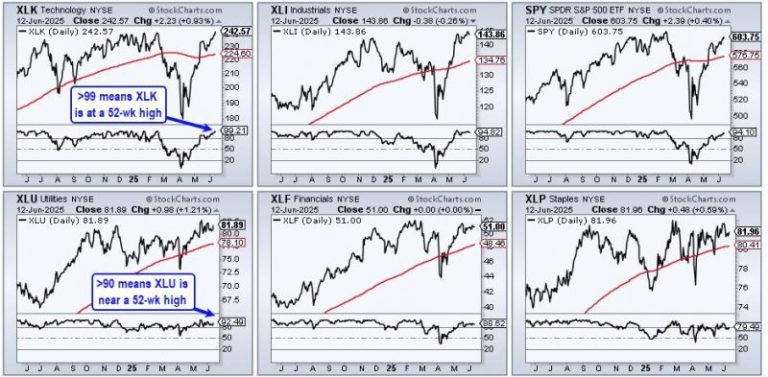
Three sectors stand out, with one sporting a recent breakout that argues for higher prices. Today’s report will highlight three criteria to define a leading uptrend. First, price should be above the rising 200-day SMA. Second, the price-relative should be above its rising 200-day SMA. And finally, leaders should trade at or near 52-week highs. Let’s compare the Utilities SPDR (XLU) to see how it stacks up.

The CandleGlance charts below show the top five sectors and SPY. I am ranking performance using Fast Stochastics (255,1). Stochastic values reflect the level of the close relative to the high-low range over the given period. 255 trading days is around 1 year. An ETF is at a 52-week high when the value is above 99 (XLK) and an ETF is near a new high with a value above 90 (XLU). The CandleGlance charts show XLK, XLI and XLU with values above 90, which means the are near new highs.

***********************

TrendInvestorPro is following the breakout in XLU, the bull flag in GLD, a small wedge in AMLP, a breakout in XLP and more. We also covered trailing stop alternatives for the pennant breakouts in some key tech related ETFs. Take a trial and get three free bonus reports.

***********************

Now let’s turn to price action. XLU is trading above its rising 200-day SMA. Thus, the long-term trend is up. XLU also broke falling channel resistance in early May. The pink lines show a falling channel that retraced around 61.8% of the July-December advance (23.6%). Both the pattern and the retracement amount are typical for corrections within a bigger uptrend. The early May breakout signals a continuation of the long-term uptrend and new highs are expected. The May lows mark first support at 78. A close below this level would warrant a re-evaluation.

And finally, let’s measure relative performance using the price-relative (XLU/RSP ratio). The lower window shows the price-relative in an uptrend for over a year and above its 200-day SMA since early March. This shows long-term relative strength. The pink trendlines show relative performance corrections when XLU underperformed for short periods. XLU is currently experiencing an underperformance correction because the broader market surge from early April to early June.

TrendInvestorPro is following the breakout in XLU, the bull flag in GLD, a small wedge in AMLP, a breakout in XLP and more. We also covered trailing stop alternatives for the pennant breakouts in some key tech related ETFs. Click here to learn more and gain immediate access.

//////////////////////////////////////////////////

Here’s a quick recap of the crypto landscape for Friday (June 13) as of 9:00 p.m. UTC.

Get the latest insights on Bitcoin, Ethereum and altcoins, along with a round-up of key cryptocurrency market news.

Bitcoin and Ethereum price update

Bitcoin (BTC) was priced at US$105,555, a decrease of 1.6 percent in 24 hours after an earlier slide of over 4 percent. The day’s range for the cryptocurrency brought a low of US$104,309 and a high of US$105,918.

Bitcoin price performance, June 13, 2025.

Chart via TradingView.

Bitcoin dropped sharply after Israel’s airstrikes on Iran, with over US$400 million in long trades wiped out before its price consolidated at around US$105,000. This came just days after Bitcoin came close to its May 22 record of US$111,940.

Gold and oil prices rose while Bitcoin fell, and a Bollinger band analysis shows a typical three-push pattern, often signaling the end of a rally. Popular trader CrypNuevo said there could be “more upside” to come as long as the price doesn’t dip below the US$100,000 level.

Ethereum (ETH) ended the day at US$2,529.19, a 6.3 percent decrease over the past 24 hours, after reaching an intraday low of US$2,513.97 and a high of US$2,576.80.

Altcoin price update

  • Solana (SOL) closed at US$145.08, down 6.3 percent over 24 hours. SOL experienced a low of US$144.19 and reached a high of US$148.20 on Friday.
  • XRP was trading at US$2.13, down by 3.6 percent in 24 hours. The cryptocurrency’s lowest valuation today was US$2.12, and its highest was US$2.16.
  • Sui (SUI) was trading at US$3.01, showing a decreaseof 7.5 percent over the past 24 hours. It reached an intraday low of US$2.98 and a high of US$3.07.
  • Cardano (ADA) closed at US$0.6319, down 5.5 percent over the past 24 hours. Its lowest valuation on Friday was US$0.6291, and its highest valuation was US$0.6426.

Today’s crypto news to know

Tether expands gold exposure

Tether Investments has acquired a 31.9 percent stake in Canadian gold royalty firm Elemental Altus Royalties through the purchase of 78,421,780 common shares from La Mancha Investments. Valued at C$1.55 (US$1.14) per share, the transaction cost Tether roughly US$89.4 million and brings its total stake in the royalty firm to 33.7 percent.

While the official announcement didn’t come until Thursday, the deal was finalized on Tuesday, June 10. The company also shared that it signed an option agreement that will allow it to acquire a further 34,444,580 common shares owned by AlphaStream subsidiary Alpha 1 SPV. Executing the option would bring Tether’s interest in Elemental Altus to 47.7 percent.

“Tether’s growing investments in gold and Bitcoin reflect our forward-looking strategy to build a more resilient and transparent financial system,” Paolo Ardoino, CEO of Tether, said. “By gaining exposure to a diversified portfolio of gold royalties through Elemental, we are strengthening the backing of our ecosystem while advancing Tether Gold and future commodity-backed digital assets.”

Retail giants explore stablecoin issuance

Walmart (NYSE:WMT) and Amazon (NASDAQ:AMZN) are reportedly in talks to launch their own stablecoins, according to sources cited in a Wall Street Journal report published early on Friday morning. The move would mark a shift in how these two major retailers manage payments, with the potential to eliminate billions in bank fees and streamline e-commerce and cross-border transactions.

This report comes days after the US Senate advanced the Guiding and Establishing National Innovation for US Stablecoins, or GENIUS Act, in a 68-30 procedural vote. On Thursday, a notice was issued by Senate Democrats of a full chamber vote on the GENIUS Act scheduled for Tuesday, June 17, coinciding with the start of the Federal Open Market Committee two-day meeting.

Betting platform becomes second-largest ETH holder after Ethereum Foundation

Sports betting platform SharpLink Gaming (NASDAQ:SBET) has become the world’s largest publicly traded ETH holder with its latest acquisition of 176,271 ETH for approximately US$463 million, an average acquisition price of US$2,626 per coin.

According to an announcement on the company’s page on Friday, the company has increased its ETH holdings by 11.8 percent per share since June 2, 2025, primarily using US$79 million raised through its stock sales, in addition to an earlier private investment.

The company said over 95 percent of its ETH was deployed in staking and liquid staking platforms, earning yield while contributing to Ethereum’s network security.

“This is a landmark moment for SharpLink and for public company adoption of digital assets,” said Rob Phythian, CEO of SharpLink Gaming. “Our decision to make ETH our primary treasury reserve asset reflects deep conviction in its role as programmable, yield-bearing digital capital.”

Coinbase announces several new offerings

Coinbase made a series of announcements on Thursday at its annual State of Crypto Summit, unveiling a plan to evolve from a crypto exchange into a full-scale decentralized and centralized financial app.

First, the company’s chief legal officer, Paul Grewal, revealed that all tokens on Coinbase’s Ethereum Layer 2 network, Base, are now tradable directly on the Coinbase platform, giving developers building on Base access to Coinbase’s ecosystem of over 100 million users. Meanwhile, Max Branzburg, Coinbase’s vice president of consumer and business products, announced that the company will soon offer perpetual futures contracts under Commodity Futures Trading Commission oversight, marking a major easing of restrictions for US crypto traders.

Also at the event, a partnership was announced between Coinbase and Shopify (NYSE:SHOP) that Shopify has begun accepting payments in USDC stablecoin from customers on Base. Currently in early access, the new payment option could help normalize on-chain payments among mainstream e-commerce businesses and consumers.

Coinbase also introduced the Coinbase One Card, a co-branded American Express (NYSE:AXP) credit card slated for release this fall that will offer up to 4 percent cashback in Bitcoin. Finally, it revealed Coinbase Business, a new full-stack platform offering for streamlining financial workflows with features including instant crypto payment settlements, up to 4.1 percent annual percentage yield on USDC and streamlined integration with accounting tools such as Intuit (NASDAQ:INTU) QuickBooks and XERO (NASDAQ:XRX).

These announcements help further Coinbase’s vision to position itself as a one-stop shop for businesses operating in the Web3 space.

Securities Disclosure: I, Giann Liguid, hold no direct investment interest in any company mentioned in this article.

Securities Disclosure: I, Meagen Seatter, hold no direct investment interest in any company mentioned in this article.

This post appeared first on investingnews.com