Author

admin

Browsing

Here’s a quick recap of the crypto landscape for Monday (August 25) as of 9:00 a.m. UTC.

Get the latest insights on Bitcoin, Ethereum and altcoins, along with a round-up of key cryptocurrency market news.

Bitcoin and Ethereum price update

Bitcoin (BTC) was priced at US$111,481, a 2.6 percent decrease in 24 hours. Its lowest valuation of the day was US$110,788, and its highest was US$114,779.

Bitcoin price performance, August 25, 2025.

Chart via TradingView

Bitcoin tumbled sharply on Sunday (August 24) after a whale dumped 24,000 BTC, triggering a flash crash that wiped out roughly US$550 million in long positions and drove prices briefly below US$111,000.

By Monday (August 25), markets recovered slightly but remained in a downtrend overall as broader crypto sell-offs and cautious sentiment prevailed.

ETH was priced at US$4,642.54, down by 2.7 percent over the past 24 hours. Its lowest valuation was US$4,538.58 and its highest was US$4,946.05.

Altcoin price update

  • Solana (SOL) was priced at US$198.05, down by 3.1 percent. Its lowest was US$195.54 and its highest as of Monday was US$212.69.
  • XRP was trading for US$2.95, up by 2.4 percent in the past 24 hours. Its highest valuation of the day was at US$3.12 and its lowest was US$2.93.
  • Sui (SUI) was trading at US$3.48, down by 3.9 percent over the past 24 hours. Its lowest valuation of the day so far was US$3.345 and its highest was US$3.84.
  • Cardano (ADA) was trading at US$0.8653, down by 3.3 percent over 24 hours. Its lowest valuation for the day was US$0.8575 and its highest was US$0.9587.

Today’s crypto news to know

Bitcoin whale selloff triggers US$80 billion market slide

Crypto markets turned sharply lower late Sunday after a dormant whale unloaded roughly US$2.7 billion worth of Bitcoin.

Onchain data shows the entity, inactive since 2019, moved 24,000 BTC originally linked to a withdrawal from the HTX exchange. The whale rotated into Ether, amassing more than 400,000 ETH while opening leveraged longs and staking positions.

The timing coincided with a shift in sentiment following Fed Chair Jerome Powell’s Jackson Hole remarks, which were initially read as dovish but left traders questioning how soon rate cuts might arrive.

By Monday, leveraged liquidations topped US$715 million, erasing more than US$80 billion from total crypto market capitalization. CME’s FedWatch tool still prices September cuts as highly likely, but analysts warn Powell’s speech was more cautious than markets first assumed. T

The pullback ended a brief rally that had lifted Ether nearly 10 percent and XRP over 5 percent earlier in the week.

Metaplanet enters FTSE Japan index, buys more Bitcoin

Metaplanet, the Tokyo-listed hotel operator that has rebranded as a Bitcoin treasury firm, will join the FTSE Japan Index following FTSE Russell’s September 2025 review.

The upgrade moves Metaplanet from small-cap to mid-cap status, with index inclusion set after markets close on September 19.

CEO Simon Gerovich called the milestone proof of the firm’s ambition to be Japan’s top Bitcoin holding company, while also confirming a fresh purchase of 103 BTC, lifting reserves to 18,991 BTC.

The company’s stock base expanded by 4.9 million shares last week after stock acquisition rights were exercised, which provided new funds for Bitcoin buys but diluting existing investors.

Bloomberg reported last week that Eric Trump, who joined as a strategic adviser in March, is expected at Metaplanet’s shareholder meeting in Tokyo next month.

Japan’s Finance Minister Backs Crypto in Diversified Portfolios

Japan’s Finance Minister Katsunobu Kato said Monday that crypto assets can serve as part of a diversified portfolio, even as he cautioned about their volatility.

Speaking at an event in Tokyo, Kato emphasized the government’s role in fostering innovation while avoiding excessive regulation. Contextually, his remarks come as Japan faces mounting public debt exceeding 200 percent of GDP, raising the likelihood of financial repression measures.

Notably, Japan has recently updated its stablecoin regulations and approved its first yen-denominated token.

Philippine lawmaker proposes Bitcoin Reserve to address national debt

A Philippine congressman has introduced legislation to create a sovereign Bitcoin reserve designed to pay down the country’s debt.

The Strategic Bitcoin Reserve Act, filed by Rep. Miguel Luis Villafuerte, mandates the Bangko Sentral ng Pilipinas to acquire 2,000 BTC annually over five years, totaling 10,000 BTC.

The holdings would be locked for two decades, with sales permitted only to retire government debt, and capped at 10 percent of assets in any two-year span thereafter. Villafuerte likened the reserve to the US Strategic Petroleum Reserve or Canada’s maple syrup stockpile, arguing it would diversify the Philippines’ financial base.

The country’s debt reached US$285 billion, or 60 percent of its GDP, as of January.

Securities Disclosure: I, Giann Liguid, hold no direct investment interest in any company mentioned in this article.

Securities Disclosure: I, Meagen Seatter, hold no direct investment interest in any company mentioned in this article.

This post appeared first on investingnews.com

The Trump administration said Friday that it had taken a 10% stake in Intel, the president’s latest extraordinary move to exert federal government control over private business.

The United States will not seek direct representation on Intel’s board and pledged to vote with the current Board of Directors on matters requiring shareholder approval, ‘with limited exceptions,’ according to a joint release from the Trump administration and Intel. The move also comes as the United States vies with China in the race to dominate the artificial intelligence industry.

President Donald Trump announced the deal on his Truth Social platform Friday, praising the company’s CEO just two weeks after he called on the executive to resign over alleged China ties.

‘It is my Great Honor to report that the United States of America now fully owns and controls 10% of INTEL, a Great American Company that has an even more incredible future,’ he wrote. ‘I negotiated this Deal with Lip-Bu Tan, the Highly Respected Chief Executive Officer of the Company. The United States paid nothing for these Shares, and the Shares are now valued at approximately $11 Billion Dollars. This is a great Deal for America and, also, a great Deal for INTEL. Building leading edge Semiconductors and Chips, which is what INTEL does, is fundamental to the future of our Nation.’

While the U.S. held temporary stakes in firms at the center of the 2008-2009 global financial meltdown as part of a bailout, this move is unusual since the economy is not embroiled in a crisis. Congress published a study in 2003 that examined the impact of the federal government taking direct stakes in public companies, concluding that doing so would “not offer a free lunch” and expose taxpayers to “greater risk” alongside the upside potential.

The stake will be paid for through $5.7 billion in grants previously awarded to Intel under the 2022 U.S. CHIPS and Science Act, plus $3.2 billion awarded to the company as part of a program called Secure Enclave. It’s a formerly classified initiative that Congress appropriated funds for in 2024 after lobbying by Intel, Politico reported in 2024.

Including $2.2 billion in CHIPs grants Intel has received so far, the total investment is $11.1 billion, or 9.9%. Intel is valued at about $108 billion on the stock market.

Trump continues to bulldoze through long-held norms regarding government and business, departing from the free-market ethos that has long prevailed in both major U.S. political parties.

This month, Trump persuaded the chipmakers Nvidia and AMD to pay the U.S. government 15% of their revenues from some sales to China in return for securing export licenses there.

While those firms have seen their fortunes rise amid the larger artificial intelligence boom, a windfall from any of them is no sure thing. In the case of California-based Intel, the company has struggled to keep up with rivals in recent years, with its shares down some 60% from the highs seen during the pandemic.

But amid the ongoing artificial intelligence arms race — and the goal of making computer chips a national security priority — Trump officials zeroed in on Intel as a means of leveling up U.S. control over semiconductor production.

Earlier this week, Japan’s SoftBank also announced it would invest $2 billion in Intel to “deepen their commitment to investing in advanced technology and semiconductor innovation in the United States.’

Some Democrats signaled they were on board with the move.

‘U.S. leadership is critical for both our economy and national security,’ U.S. Senator Mark Warner, D-Virginia, said in a statement Friday evening.

‘Taking an equity stake in Intel may or may not be the right approach, but one thing is clear: allowing cutting-edge chips to flow to China without restraint will erode the value of any investment we make here at home. We need a strategy that protects American innovation, strengthens our workforce, and keeps the technologies of the future firmly in American hands.’

This post appeared first on NBC NEWS

Summer camp: It’s for munching on s’mores, seizing victory in tug-of-war and making lifelong friends.

For this group of successful businesswomen, though, it’s also about trading tactical advice about managing boards of directors and selling companies. And fighting to get a piece of an investment world dominated by men.

Welcome to Camp Female Founders Fund, a coastal oasis in Montauk, New York, on eastern Long Island, where female business leaders broaden their networks, share their struggles and triumphs and have some fun.

This post appeared first on NBC NEWS

From American Eagle to Swatch, brands appear to be making a lot of blunders lately.

When actress Sydney Sweeney’s jeans campaign came out last month, critics lambasted the wordplay of good “jeans” and “genes” as tone deaf with nefarious undertones.

More recently, an advert from Swiss watchmaker Swatch sparked backlash for featuring an Asian model pulling the corners of his eyes, in an offensive gesture.

Colgate-Palmolive’s ad for Sanex shower gel was banned in the U.K. for problematic suggestions about Black and white skin tones. And consumers derided Cracker Barrel’s decision to ditch its overalls-clad character for a more simplistic text-based logo as “sterile,” “soulless,” and “woke.”

The new Cracker Barrel logo.Wyatte Grantham-Philips / AP

Meanwhile, recent product launches from Adidas and Prada have raised allegations of cultural appropriation.

That has reignited the debate about when an ad campaign is effective and when it’s just plain offensive, as companies confront increased consumer scrutiny.

“Each brand had its own blind spot,” David Brier, brand specialist and author of “Brand intervention” and “Rich brand, poor brand” told CNBC via email.

He noted, however, that too many brands are attempting to respond to consumers with an outdated playbook.

“Modern brands are trying to navigate cultural complexity with corporate simplicity. They’re using 1950s boardroom thinking to solve 2025 human problems,” he continued.

“These aren’t sensitivity failures. They’re empathy failures. They viewed culture as something to navigate around rather than understand deeply.”

Some companies have had success in tapping into the zeitgeist — and, in some cases, seizing on other brands’ shortcomings.

Gap, for instance, this week sought to counter backlash against Sweeney’s advertisement with a campaign in which pop group Katseye lead a diverse group of dancers performing in denim against a white backdrop.

Brier said companies should consider how they can genuinely connect with consumers and be representative, rather than simply trying to avoid offense.

“No brand can afford to fake understanding. No brand can ‘committee its way’ to connection. No brand can focus-group its way to authenticity. In 2025, customers can smell the difference from a mile away,” he added.

Nevertheless, ads are meant to spark conversation, and at a time when grabbing and maintaining consumers’ attention — and share of wallet — is increasingly difficult, brands have a fine balance to tread.

“Brands live and die by standing out and grabbing attention. On top of that, iconic and culturally relevant brands want to stand for something and be recognized for it. Those are tough asks,” Jonathan A.J. Wilson, professor of brand strategy and culture at Regent’s University London.

In an age of social media and with ever more divided public opinions, landing one universal message can be difficult, Wilson noted. For as long as that remains the case, some brands may still see value in taking a calculated risk.

“It’s hard to land one universal message, and even if you try and tailor your message to various groups, others are watching,” he said.

“Controversy grabs attention and puts you at the front of people’s minds. It splits crowds and forces people to have a decision when otherwise they probably wouldn’t care. That can lead to disproportionate publicity, which could be converted into sales.”

This post appeared first on NBC NEWS

Statistics Canada released July’s consumer price index (CPI) data on Tuesday (August 19). The figures show that inflation decelerated in the month, posting a 1.7 percent year-on-year gain, down from the 1.9 percent recorded in June.

The most significant contributor to the fall was a 16.1 percent decline in gasoline prices from the same period last year.

Excluding the lower costs at the pumps, CPI remained steady at 2.5 percent, the same increase as May and June.

The national reporting agency released June’s mineral production survey on Wednesday (August 20).

The data indicates that production and shipments increased across the board, with copper production rising to 39.17 million kilograms, gold rising to 16,935 kilograms and silver increasing to 29,081 kilograms.

For shipments, copper increased to 45.96 million kilograms from 34.38 million kilograms, gold shipments rose to 18,554 kilograms from 16,725, and silver jumped to 31,391 kilograms from 27,614 kilograms.

On Thursday (August 21), Canadian Prime Minister Mark Carney had a phone call with US President Donald Trump. Although the prime minister’s office has provided few details, the two leaders reportedly had a “productive and wide-ranging conversation” about the current trade dispute, as well as economic and security relations.

Carney and Trump are expected to speak again soon.

South of the border, US Federal Reserve Chair Jerome Powell gave his speech at the Jackson Hole Economic Policy Symposium on Friday (August 22). In his remarks, he said that the Fed’s dual mandate goal is in balance, with the labor market remaining near maximum employment, while inflation has eased from post-pandemic highs.

However, he also said that “a shifting balance of risks may warrant adjusting our policy stance,” hinting at a near-term cut to the Fed’s benchmark interest rate. Expectations are high for a 25 basis point cut in September.

Markets and commodities react

Canadian equity markets were positive this week. The S&P/TSX Composite Index (INDEXTSI:OSPTX) was in record territory, closing the week up 1.44 percent to set at another all-time high of 28,333.13. The S&P/TSX Venture Composite Index (INDEXTSI:JX) did even better, climbing 2.45 percent to finish Friday at 803.61. The CSE Composite Index (CSE:CSECOMP) slumped mid-week but recovered on Friday to post a slight gain of 0.48 percent to 158.82.

US equity markets were mixed this week, but strong gains on Friday following Powell’s comments kept them in record high territory. The S&P 500 (INDEXSP:INX) was up 1.52 percent on Friday, but down by 0.16 percent over the past five days to 6,466.92, while the Nasdaq 100 (INDEXNASDAQ:NDX) rose 1.51 percent on Friday, but sank 1.33 percent on the week to 23,497.83 on Wednesday. Meanwhile, the Dow Jones Industrial Average (INDEXDJX:.DJI) was the sole weekly gainer, rising 1.89 percent on Friday and 1.04 percent on the week to post a new record high of 45,631.73.

The gold price was largely flat this week, but also surged on Friday after Powell hinted at a near-term rate cut, rising 1.11 percent on the week to US$3,373.21 per ounce by 4:00 p.m. EDT on Friday.

Silver saw similar movements, but ended the week with a more significant gain of 2.62 percent US$38.90 per ounce.

Copper saw little change again this week, posting a 0.22 percent decrease to US$4.52 per pound. The S&P GSCI (INDEXSP:SPGSCI) commodities index posted an increase of 1.92 percent by close on Friday, finishing at 545.11.

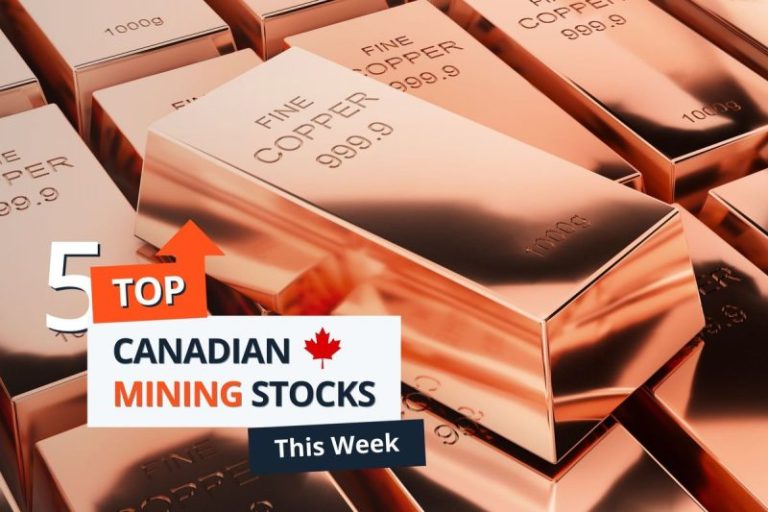
Top Canadian mining stocks this week

How did mining stocks perform against this backdrop?

Take a look at this week’s five best-performing Canadian mining stocks below.

Stock data for this article was retrieved at 4:00 p.m. EDT on Friday using TradingView’s stock screener. Only companies trading on the TSX, TSXV and CSE with market caps greater than C$10 million are included. Mineral companies within the non-energy minerals, energy minerals, process industry and producer manufacturing sectors were considered.

1. StrategX Elements (CSE:STGX)

Weekly gain: 63.64 percent
Market cap: C$11.57 million
Share price: C$0.18

StrategX Elements is advancing a portfolio of projects in the Northwest Territories and Nunavut, Canada.

Its most recent focus has been its Nagvaak project in Nunavut, which hosts a 6 kilometer mineralized zone with deposits of nickel, vanadium, cobalt, copper, silver and platinum-group metals.

On March 3, the company discovered a wide zone of high-grade graphite mineralization at Nagvaak, with one assay returning an average of 15 percent graphitic carbon over 32 meters, including an intersection of 22 percent graphitic carbon over 17 meters. StrategX said the hole also returned encouraging concentrations of other minerals, including nickel, copper and silver, supporting potential for a multi-mineral system.

The most recent news from the project came on July 30, when the company announced it was in the process of mobilizing for a 2025 drill program intended to delineate and validate the discoveries.

On Tuesday, the company completed a non-brokered private placement for 3.71 million shares, raising gross proceeds of C$296,960. It announced the placement on August 7 and said funds would be used for general working capital.

2. Max Resource (TSXV:MAX)

Weekly gain: 62.5 percent
Market cap: C$12.59 million
Share price: C$0.065

Max Resource is an explorer working to advance a portfolio of projects in Colombia.

Its Sierra Azul property is a district-scale copper and silver project consisting of 20 mining concessions covering an area of 188 square kilometers in northeastern Colombia.

The asset is covered by a May 2024 earn-in agreement with Freeport-McMoRan (NYSE:FCX), in which Freeport can receive up to an 80 percent stake by funding of C$50 million over 10 years. The site hosts multiple target areas with high-grade copper and silver mineralization, including a 20 kilometer red-bed style copper system at the AM district.

Max also owns the Florália hematite direct-shipping ore iron project located in the Minas Gerais region. The company completed the acquisition of the property in October 2024 from Jaguar Mining (TSX:JAG,OTCQX:JAGGF) for total cash considerations of US$1 million and 4 million performance share units, contingent upon reaching certain milestones. The site hosts hematite deposits with grades over 60 percent iron. Max intends to use a direct-shipping ore process to mine, crush and screen the ore before exporting the material directly to steel mills.

The company’s most recent announcement came this past Tuesday, when it secured the right to acquire Mora title, which lies adjacent to Aris Mining’s (TSX:ARIS,NYSEAMERICAN:ARMN) Marmato mine. The property hosts 40 historic workings with five active mines, with reserves with grades of 3.2 grams per metric ton (g/t) gold from 31.3 million metric tons and a resource of 9 million ounces of gold grading 3 g/t from 61.5 million metric tons.

3. Maple Gold Mines (TSXV:MGM)

Weekly gain: 50 percent
Market cap: C$45.6 million
Share price: C$0.105

Maple Gold Mines is a gold exploration company focused on the advancement of its Douay and Joutel projects located in the Abitibi greenstone belt in Québec, Canada.

The Douay project covers an area of 357 square kilometers. In a 2022 technical report, the company said the site hosts an indicated resource of 511,000 ounces of gold from 10 million metric tons with an average grade of 1.59 g/t gold, with an additional inferred resource of 2.53 million ounces from 76.7 million metric tons at 1.02 g/t.

Joutel is located directly south of Douay. The company announced on May 5 that it had staked an additional 128 mining claims, bringing the total land area at the property to 111 square kilometers from the original 39. The site hosts Agnico Eagle Mines’ (TSX:AEM,NYSE:AEM) past-producing Eagle-Telbel gold mine, which operated from 1974 to 1993. To date, the company has used 250,000 meters of historic drill results to create 3D models to aid in current exploration efforts.

The most recent news from Maple came on Wednesday when it announced a C$5 million non-brokered private placement led by strategic investor Michael Gentile. Additionally, the company reported that Agnico Eagle has indicated it intends to participate in the offering to maintain its pro rata ownership interest in Maple Gold.

The release also said that it has appointed Marc Legault and Chris Adams to the board of directors.

4. Capitan Silver (TSXV:CAPT)

Weekly gain: 40.45 percent
Market cap: C$113.2 million
Share price: C$1.25

Capitan Silver is an explorer focused on advancing silver and gold projects in Durango, Mexico.

The company’s flagship asset is the 100 percent owned Cruz de Plata project, in the heart of Mexico’s historic Penoles Mining District. The district is known for hosting significant silver mineralization and historic mining.

The Cruz de Plata project encompasses two historic silver mines — Jesus Maria and San Rafael — and the El Capitan oxide gold prospect, all within a 22.9 square kilometer land package.

To date, the company has completed 86 diamond drill holes totaling over 11,550 meters.

A 2020 technical report demonstratesd an inferred resource of 16.99 million ounces of contained silver and 331,000 ounces of contained gold from 28.3 million metric tons of ore with grades of 18.7 g/t silver and 0.36 g/t gold.

The most recent news from Capitan came on Friday, when it announced it executed a definitive agreement to acquire a strategic land package at its Cruz de Plata property from Fresnillo (LSE:FRES,OTC Pink:FNLPF) for total cash considerations of US$4 million. The transaction was initially announced in June.

The new parcel consists of seven mineral concessions covering an area of 2,171.4 hectares and increases its total holdings in the area by 85 percent and the surface expression of the silver and gold trend by 1.2 kilometers to the east.

5. District Metals (TSXV:DMX)

Weekly gain: 36.9 percent
Market cap: C$163.98 million
Share price: C$1.15

District Metals is a uranium exploration company focused on advancing a portfolio of assets in Sweden.

Its flagship Viken property covers an area of 38,657 hectares in Jämtland County and in addition to uranium hosts mineral deposits of vanadium, molybdenum, nickel, copper and zinc.

On June 13, District filed a technical report for the project’s updated mineral resource estimate. It shows an indicated resource of 176 million pounds of U3O8 from 456 million metric tons of ore with a grade of 175 parts per million (ppm) U3O8 and an inferred resource of 1.54 billion pounds of U3O8 from 4.3 billion metric tons with a grade of 161 ppm.

The company has also been advancing its Tomtebo-Stollberg zinc project in South-Central Sweden. The project is part of an October 2023 definitive agreement in which Boliden (STO:BOL) can earn an 85 percent interest in the property by spending C$10 million over four years and District can earn a 15 percent stake in Boliden’s Stollberg property.

Tomtebo covers an area of 5,144 hectares and hosts the historic Tomtebo and Lovas mines, while Stollberg covers an area of 5,180 hectares and is located near Boliden’s Garpengerg mine.

The most recent update from Tomtebo came on July 29, when District released assays from a five hole, 2,485 meter drill program conducted between February and April. One highlighted drill hole recorded multiple zones of silver and base metals mineralization, including 88 g/t silver, 3 percent zinc and 1.9 percent lead over 7.85 meters.

The company has not released any news since.

FAQs for Canadian mining stocks

What is the difference between the TSX and TSXV?

The TSX, or Toronto Stock Exchange, is used by senior companies with larger market caps, and the TSXV, or TSX Venture Exchange, is used by smaller-cap companies. Companies listed on the TSXV can graduate to the senior exchange.

How many mining companies are listed on the TSX and TSXV?

As of February 2025, there were 1,572 companies listed on the TSXV, 905 of which were mining companies. Comparatively, the TSX was home to 1,859 companies, with 181 of those being mining companies.

Together the TSX and TSXV host around 40 percent of the world’s public mining companies.

How much does it cost to list on the TSXV?

There are a variety of different fees that companies must pay to list on the TSXV, and according to the exchange, they can vary based on the transaction’s nature and complexity. The listing fee alone will most likely cost between C$10,000 to C$70,000. Accounting and auditing fees could rack up between C$25,000 and C$100,000, while legal fees are expected to be over C$75,000 and an underwriters’ commission may hit up to 12 percent.

The exchange lists a handful of other fees and expenses companies can expect, including but not limited to security commission and transfer agency fees, investor relations costs and director and officer liability insurance.

These are all just for the initial listing, of course. There are ongoing expenses once companies are trading, such as sustaining fees and additional listing fees, plus the costs associated with filing regular reports.

How do you trade on the TSXV?

Investors can trade on the TSXV the way they would trade stocks on any exchange. This means they can use a stock broker or an individual investment account to buy and sell shares of TSXV-listed companies during the exchange’s trading hours.

Article by Dean Belder; FAQs by Lauren Kelly.

Securities Disclosure: I, Dean Belder, hold no direct investment interest in any company mentioned in this article.

Securities Disclosure: I, Lauren Kelly, hold no direct investment interest in any company mentioned in this article.

This post appeared first on investingnews.com

A broad selloff in heavyweight tech stocks at the start of the week abruptly reversed after US Federal Reserve Chair Jerome Powell delivered a speech that bolstered expectations of a September interest rate cut.

Speaking at the Jackson Hole Economic Policy Symposium, Powell took a more dovish tone than investors may have been expecting, noting a slowdown in both worker supply and demand that could lead to employment risks.

He stated that the shifting balance of risks may warrant adjusting the Fed’s policy stance, stressing the need to balance both sides of the central bank’s dual mandate when goals are in tension.

This is a change from the Fed’s previous stance, which had been more focused on the need to keep rates high to fight inflation. Powell acknowledged the visible, though likely temporary, effects of tariffs, cautioning about the potential for persistent inflation, but signaled that the Fed is now also seriously considering the downside risks to employment.

A risk-on rally ensued, impacting various market sectors: the S&P 500 (INDEXSP:.INX), Dow Jones Industrial Average (INDEXDJX:.DJI) and Nasdaq Composite (INDEXNASDAQ:.IXIC) all closed up by more than 1.5 percent.

Bitcoin climbed above US$116,800, the Russell 2000 Index (INDEXRUSSELL:RUT) surged by 3.9 percent and 10 year treasury yields decreased by 0.07 percentage points to 4.26 percent. Traders now have higher expectations for a September rate cut, with probabilities exceeding 83 percent according to CME Group’s (NASDAQ:CME) FedWatch tool.

Here’s a look at the other drivers that shaped the tech sector this week.

1. Softbank to invest US$2 billion in Intel

Intel’s (NASDAQ:INTC) share price got a boost this week after a series of major announcements, beginning with SoftBank Group’s (TSE:9984) Monday (August 18) announcement that it plans invest US$2 billion in the company.

“Semiconductors are the foundation of every industry. For more than 50 years, Intel has been a trusted leader in innovation,’ said Masayoshi Son, chairman and CEO of SoftBank, in a press release.

‘This strategic investment reflects our belief that advanced semiconductor manufacturing and supply will further expand in the United States, with Intel playing a critical role,” he added.

Following that news, sources confirmed last week’s reports that the US government was seeking an equity stake in Intel in exchange for Biden-era Chips Act funding. Then, on Friday (August 22), US Secretary of Commerce Howard Lutnick announced that Intel had agreed to sell an 8.9 percent stake to the federal government, a move that will convert billions of dollars in previously awarded grants into a passive ownership stake.

Intel performance, July 28 to August 18, 2025.

Chart via Google Finance.

These developments have sent Intel’s market value soaring, with its share price increasing over 28 percent from the start of the month. Shares of Intel closed up on Friday at US$24.80.

2. Figure files for Nasdaq IPO

Figure Technology filed for an initial public offering (IPO) on the Nasdaq on Monday under the ticker symbol FIGR, joining a growing list of crypto-related companies looking to access public markets following the successful debut of stablecoin issuer Circle Internet Group (NYSE:CRCL).

Figure leverages blockchain to streamline financial services. The company’s filing reveals a strong financial performance, with profit reaching US$29 million in the first half of 2025, compared to a US$13 million loss in the same period last year. Its revenue for the first half of the year was US$191 million.

Goldman Sachs (NYSE:GS), Jefferies Financial Group (NYSE:JEF) and Bank of America Securities are acting as lead underwriters for the offering. The number of shares and price ranges are yet to be confirmed.

3. Google unveils new Pixel and more

Google (NASDAQ:GOOGL) made headlines this week with several new developments spanning its business lines.

The week kicked off with the tech giant announcing it has increased its stake in data center operator and Bitcoin miner TeraWulf (NASDAQ:WULF) to roughly 14 percent, worth US$3.2 billion.

The company also revealed a partnership with advanced nuclear startup Kairos Power and the Tennessee Valley Authority to power its data centers in Tennessee and Alabama using a new nuclear reactor.

On Wednesday (August 20), Google unveiled its latest Pixel smartphone, the Pixel 10, and accessories, with upgrades including a health coach powered by artificial intelligence (AI).

The week culminated with reports of a US$10 billion cloud computing agreement with Meta Platforms (NASDAQ:META) to provide the necessary servers and infrastructure for Meta’s expanding AI operations. The news sent Google’s share price up by over 3 percent and Meta’s up by over 2 percent.

4. NVIDIA tumbles amid China tension and chip sales

NVIDIA (NASDAQ:NVDA) experienced a volatile week, with its share price slipping in early trading on Monday following reports of renewed tensions with China. The downturn was triggered by news that Beijing will move to restrict sales of the H20 AI chip, the company’s most advanced product approved for the Chinese market.

China’s internet and telecom regulator, as well as the state planning agency, issued informal guidance to major tech companies, instructing them to halt new orders of the H20 chips, citing security concerns.

According to unnamed officials who spoke to the Financial Times, the decision was also influenced by “insulting” remarks from US Secretary of Commerce Howard Lutnick.

In response to the Chinese directive, NVIDIA has reportedly instructed its component suppliers, including Foxconn Technology (TPE:2354), Samsung Electronics (KRX:005930) and Amkor Technolgy (NASDAQ:AMKR), to suspend production of the H20 chip; the company also said it is working on a new AI chip for China.

Alphabet, NVIDIA, Palo Alto Networks and Meta Platforms performance, August 19 to 22, 2025.

Chart via Google Finance.

NVIDIA saw the greatest losses midweek, falling over 4 percent between Tuesday and Thursday. The company recovered some of its losses during Friday’s rally, but finished the week over one percent lower.

5. Palo Alto Networks rises on strong forecast

Palo Alto Networks (NASDAQ:PANW) surged over 7 percent on Tuesday after the cybersecurity company forecast that revenue and profit for its 2026 financial year will come in above estimates.

The company gave a strong performance in its 2025 fiscal year, with total revenue increasing 15 percent year-on-year to US$9.2 billion, fueled by an increase in revenue from newer, cloud-based security products. This growth occurred alongside a 24 percent rise in its future contracted business to US$15.8 billion.

The company also surpassed a US$10 billion revenue run rate while maintaining its “Rule-of-50” status — a measure of the balance between growth and profitability — for the fifth consecutive year.

Securities Disclosure: I, Meagen Seatter, hold no direct investment interest in any company mentioned in this article.

This post appeared first on investingnews.com

ROCHESTER, Minnesota, Aug 22 (Reuters) – U.S. farmers will harvest a record corn crop in 2025 after ideal weather across much of the Midwest this summer, but the bounty will fall short of the U.S. government’s lofty outlook as pockets of plant disease and heat stress dented yields in spots across the farm belt, crop consultancy Pro Farmer said on Friday.

Growers are also expected to reap a bumper soybean crop, although dry conditions in parts of the eastern Midwest and pockets of disease pressure in Iowa may limit yield potential, Pro Farmer said after its annual four-day tour across seven top-producing states this week.

The United States is the world’s top corn exporter and No. 2 soybean exporter, and favorable weather in most of the main growing states supported crops but pushed futures prices to recent multi-year lows.

The warm and wet conditions that fueled crop growth also fostered fungal diseases such as tar spot, southern rust and northern blight in corn, and sudden death syndrome in soybeans.

“Each day we’ve noted the disease pressure in corn. Tar spot, southern rust more widespread than we’ve ever seen before. Those are going to be some real yield robbers,” said Lane Akre, Pro Farmer economist and one of the leaders of the tour’s eastern leg.

Pro Farmer projected 2025 U.S. corn production at a record 16.204 billion bushels, with an average yield of 182.7 bushels per acre, and soybean production at 4.246 billion bushels, with an average yield of 53.0 bpa.

The outlook is below the U.S. Department of Agriculture’s latest forecast for corn production at a record 16.742 billion bushels with yields averaging 188.8 bpa, and soybean production at 4.292 billion bushels with record average yields of 53.6 bpa.

Crop scouts on the Pro Farmer tour saw more disease-hit fields than normal across the Midwest farm belt this week, although it is not yet clear whether these diseases will blow up into significant yield loss.

At one stop in northwest Illinois, the corn field appeared healthy and green from the roadside, but 30 to 40 steps in, leaves were streaked with rust, leaving crop scouts covered in color. Overhead, bright yellow crop dusters banked low as they sprayed wide white plumes of fungicide.

Jake Guse, a Minnesota row crop farmer and crop scout on the eastern leg of the tour, said disease levels were the worst and most widespread that many crop scouts had ever seen on the tour.

“As we traveled across Indiana, we started seeing more (disease). In Illinois, started getting bad — and it was all over Iowa,” Guse said of three of the largest producing states.

However, crop scouts also found exceptional yield prospects that could help cushion any disease-related yield decline.

The strong production prospects may not be welcome news to farmers, who are facing a third straight year of declining corn prices due to excess supplies and only a modest improvement in soybean prices, according to USDA data.

Production costs remain high while trade tensions with key markets like China, the top soybean importer, have left demand uncertain.

While the USDA is forecasting that the nation’s farm economy will improve in 2025, that boost will largely come from a massive influx of federal funding the Trump administration plans to send to rural America, according to USDA data.

Corn and soybean futures on the Chicago Board of Trade firmed this week as reports from the crop tour suggested that recent USDA harvest forecasts may be too high.

The benchmark CBOT December corn contract CZ25 ended the week up 1.5%, its first weekly gain in a week in five weeks, while November soybeans SX25 also rose 1.5% and hit a one-month high.

This post appeared first on NBC NEWS

Citing a shifting economic situation in the US, Federal Reserve Chair Jerome Powell indicated that the central bank is ready to adjust interest rates during his speech at the Jackson Hole Economic Policy Symposium.

Powell indicated that the Fed’s dual mandate goal is essentially in balance, saying the labor market remains close to maximum employment and that inflation has eased from post-pandemic highs, although it remain elevated.

However, the Fed head also noted that “the balance of risks appears to be shifting,” with significant uncertainty in the economy as a result of higher tariffs, tighter immigration and a slowdown in the pace of growth in the labor market.

“Over the longer run, changes in tax, spending, and regulatory policies may also have important implications for economic growth and productivity,” Powell added in his Friday (August 22) address.

The biggest challenge for the Fed is maintaining its dual mandate of ensuring too much slack doesn’t enter the labor market, which Powell said could happen quickly, while also attempting to ease inflation to the target 2 percent.

“A material slowing in employment growth may not be a signal that the economy is entering a downturn, but a symptom of structural shifts in the economy. For this reason, Powell and others in the Federal Open Market Committee (FOMC) have pointed to the unemployment rate as a more useful indicator of the health of the labor market,” she said.

Although tariffs are likely to take some months to work their way through the economy, with Powell suggesting there is still high uncertainty, he also indicated that “the shifting balance of risks may warrant adjusting our policy stance.”

His remarks are in line with analysts’ expectations of a 25 basis point cut to the benchmark rate in September.

In 2024, the Fed made three cuts: a 50 basis point cut in September, followed by two 25 basis point cuts in October and November. So far, it has not made reductions in 2025; however, it faced dissent from two committee members at its July meeting, the first time more than one member has voted against the committee since December 1993.

The gold price jumped following Powell’s remarks on Friday, gaining nearly 1 percent in morning trading, reaching US$3,370 per ounce by 1:00 p.m. EDT. Silver rose more than 2 percent to hit US$38.94 per ounce.

Equity markets were also in positive territory during morning trading.

The S&P 500 (INDEXSP:INX) climbed 1.49 percent to 6,465 points, and the Nasdaq 100 (INDEXNASDAQ:NDX) rose 1.48 percent to 23,485 points. Meanwhile, the Dow Jones Industrial Average (INDEXDJX:.DJI) surged 2 percent to trade in record territory at 45,687 points.

Securities Disclosure: I, Dean Belder, hold no direct investment interest in any company mentioned in this article.

This post appeared first on investingnews.com

Here’s a quick recap of the crypto landscape for Wednesday (August 22) as of 9:00 a.m. UTC.

Get the latest insights on Bitcoin, Ethereum and altcoins, along with a round-up of key cryptocurrency market news.

Bitcoin and Ethereum price update

Bitcoin (BTC) was priced at its lowest valuation of the day at US$112,016, a 1 percent decrease in 24 hours. Its highest valuation of the day was US$113,827.

Bitcoin price performance, August 22, 2025.

Chart via TradingView

Ethereum (ETH) was priced at US$4,228.45, trading flat over the past 24 hours. Its highest valuation of the day was US$4,347.92 and its lowest valuation was US$4,211.66.

Altcoin price update

  • Solana (SOL) was priced at US$178.40, down by 2.9 percent over 24 hours, and its lowest valuation of the day. Its highest was US$185.97.
  • XRP was trading for US$2.80, down by 3.5 percent in the past 24 hours and its lowest valuation of the day. Its highest was US$2.92.
  • Sui (SUI) was trading at US$3.34, down by 3.1 percent over the past 24 hours and tallying its lowest valuation of the day. Its highest valuation of the day was US$3.47.
  • Cardano (ADA) was trading at its lowest valuation today at US$0.8274, down by 4.8 percent over 24 hours. Its highest valuation today was US$0.8766.

Today’s crypto news to know

Coinbase approves Trump-backed stablecoin

Coinbase has listed USD1, a stablecoin issued by World Liberty Financial, the crypto project linked to former President Donald Trump and his sons.

The exchange announced the move on Thursday, while Eric Trump reposted the news on X and hinted that additional updates about the project are coming soon.

With the addition, Coinbase now offers US users a wide range of stablecoins including USDT, USDC, PYUSD, DAI, and others. World Liberty launched USD1 earlier this year as part of its push into decentralized finance, positioning the token for use in a forthcoming platform built on Ethereum with Aave technology.

However, the platform is not yet live, but the company has said it will eventually support lending and borrowing services.

The listing comes as the US stablecoin sector gains momentum following the passage of the GENIUS Act, which set national standards for stablecoin issuance and trading.

Still, World Liberty’s political connections remain controversial, especially after reports linked USD1 to a multibillion-dollar investment in Binance from an Abu Dhabi sovereign fund.

Ripple, SBI to bring RLUSD to Japan

Ripple and SBI Holdings have unveiled plans to bring Ripple USD (RLUSD) to Japan, aiming to launch the stablecoin in early 2026.

The rollout will be handled by SBI VCTrade, a licensed digital payments provider, under Japan’s new regulatory framework for stablecoins.

RLUSD, first introduced in December 2024, is backed by dollar deposits, short-term US Treasuries, and cash equivalents, with monthly attestations from an independent firm.

Ripple says this design ensures regulatory clarity and sets the coin apart as an institutional-grade product. SBI executives described the partnership as a milestone for Japan’s financial system, stressing that the stablecoin will enhance trust and convenience for users.

Ripple officials framed RLUSD as a bridge between traditional finance and decentralized networks, particularly just days after Japan approved its first yen-based stablecoin.

Austrac directs Binance to appoint external auditor

Binance is facing renewed scrutiny in Australia after the country’s financial watchdog directed it to appoint an external auditor.

Austrac said the exchange failed to meet standards for anti-money laundering and counter-terrorism financing controls, citing gaps in oversight and risk management. The agency also pointed to Binance’s high staff turnover and limited senior management presence in Australia as red flags.

Austrac chief Brendan Thomas warned that global crypto exchanges must adapt to local compliance requirements, regardless of their size.

The action adds to a growing list of regulatory challenges for Binance worldwide, including a record US$4.3 billion fine in the United States last year for failing to block illicit users.

Its founder, Changpeng Zhao, is also serving a four-month prison sentence related to those violations. Meanwhile, in Nigeria, Binance is still battling tax evasion and illegal foreign exchange allegations, with a court trial pushed back to October.

Securities Disclosure: I, Giann Liguid, hold no direct investment interest in any company mentioned in this article.

Securities Disclosure: I, Meagen Seatter, hold no direct investment interest in any company mentioned in this article.

This post appeared first on investingnews.com

Copper has become a hot topic due to its role in the green energy transition and its necessity for urbanization. However, the lack of incoming supply in the long term has experts concerned.

Due to its importance in construction, energy transmission and new technologies, copper is a critical metal needed to power the future of our society. However, mined supply has not kept pace with demand, with few new operations coming online, and older mines facing decreasing grades and lower outputs.

The term “peak copper” was coined because some experts believe that copper reserves may be diminishing. According to the US Geological Survey (USGS), more than 700 million metric tons of copper have been mined throughout history, and current economic global copper reserves stand at 980 million metric tons.

Nearly all of that mined copper is still in circulation, as the red metal’s recycling rate is higher than that of any other engineering metal, but it is still not enough to keep up with escalating demand. As a result, it’s prudent to know the top copper reserves by country, especially when considering investing in the copper mining industry.

Reserve data for this article was sourced from the USGS’s 2025 Mineral Commodity Summary and supplemented with datasets from Mining Data Online (MDO) and the UN Comtrade Database.

Top 5 copper reserves by country

The countries with the largest copper reserves are Chile, Australia, Peru, the Democratic Republic of Congo (DRC) and Russia. These five countries hold more than 55 percent of the world’s total copper reserves and will be critical to a world with soaring demand for copper.

Read on to learn about these copper kingpins.

1. Chile

Copper reserves: 190 million metric tons

Chile holds the largest copper reserves globally at 190 million metric tons, nearly as much as Australia and Peru hold combined. Additionally, Chile is also the world’s top copper producer, with its 5.3 million metric tons of copper in 2024 representing nearly a quarter of global output.

The mining industry is essential to the Chilean economy, making up more than 50 percent of the country’s exports and contributing US$40 billion of its GDP in 2023. Copper alone accounting for more than US$29 billion of that total.

Due to the sheer quantity of copper in the country, it should come as no surprise that Chile is home to the world’s largest copper mine, Escondida. According to MDO, Escondida produced 927,000 metric tons of copper in concentrate in 2024 and sits atop proven and probable copper reserves of 37.62 million metric tons. The mine is a 57.5/30/12.5 joint venture between BHP (ASX:BHP,NYSE:BHP,LSE:BHP), Rio Tinto (ASX:RIO,NYSE:RIO,LSE:RIO) and Japan’s JECO.

2. Australia

Copper reserves: 100 million metric tons

Australian copper reserves are pegged at 100 million metric tons, tying it for the second largest country by copper reserves. The resource industry is an essential sector in Australia, contributing AU$385 billion during the 2024/2025 fiscal year. Of that, copper was the sixth largest contributor with AU$13.2 billion, a AU$1.8 billion increase over 2023/2024.

While Australia hosts significant copper reserves, it lags the other countries on the list with similarly sized reserves in terms of production at 800,000 metric tons in 2024. More than a quarter of that came from BHP’s Olympic Dam mine in South Australia, which produced 216,000 metric tons of copper cathode. The polymetallic mine contains substantial proven and probable copper reserves totaling 10.68 million metric tons.

Another significant operation in Australia is Newmont’s (TSX:NGT,NYSE:NEM,ASX:NEM) Cadia Valley mine, which hosts probable reserves of 3.1 million metric tons of contained copper. Cadia Valley produced 87,000 metric tons of copper in concentrate in 2024.

2. Peru

Copper reserves: 100 million metric tons

Copper reserves in Peru stand at 100 million metric tons, tying it with Australia for the second largest copper country. Much like its neighbor Chile, copper is an essential part of Peru’s economy, accounting for 49 percent of the value of its US$47.7 billion in mining exports.

Peru is home to some of the world’s biggest mining operations, and produced 2.6 million metric tons of copper last year. Two mines accounted for a third of the country’s total output.

The top producer in the country is the Cerro Verde Complex, a 55/21/19.6 venture with Freeport-McMoRan (NYSE:FCX), Sumitomo Metal Mining (TSE:5713) and Minas Buenaventura (NYSE:BVN). Cerro Verde hosts hosts proven and probable reserves of 11.45 million metric tons of copper and produced 949 million pounds of copper metal in concentrate in 2024.

Not to be outdone, the second highest is Antamina, a 33.75/33.75/22.5/10 joint venture between BHP, Glencore (LSE:GLEN,OTC Pink:GLCNF), Teck Resources (TSX:TECK.B,TSX:TECK.A,NYSE:TECK) and Mitsubishi (TSE:8058). Last year, output at the mine fell just short of Cerro Verde’s at 941 million pounds of copper in concentrate. Antamina hosts a proven and probable reserve of 4.53 million metric tons of contained copper.

The mine with the largest copper reserves in Peru is Southern Copper’s (NYSE:SCCO) Toquepala mine, home to 13.79 million metric tons of copper in proven and probable reserves. The mine produced 496 million pounds of copper in concentrate last year.

4. Democratic Republic of Congo

Copper reserves: 80 million metric tons

Copper reserves in the Democratic Republic of Congo stood at 80 million metric tons in 2024, making it the fourth largest country by copper reserves. The DRC’s economic copper reserves have seen a staggering rise in recent years, climbing from an estimated 19 million metric tons in 2019.

The mining sector has been critical to GDP growth in the DRC, with copper being the largest contributor. World Bank reports that the extraction sector has outpaced other segments of the DRC’s economy, increasing 12.8 percent in 2024, while non-mining sectors grew by only 3.2 percent.

According to data from the United Nations, in 2023 the DRC exported US$17 billion in refined copper and unwrought alloys, a large jump from US$7.34 billion in 2019. The country’s copper ore exports contributed US$2.16 billion in 2023, nearly double the US$1.11 billion four years prior.

Among the contributing factors in the rise in mining and export activity has been the development of the Lobito Corridor, which connects mineral-rich regions in Zambia, the DRC and Angola to the port at Lobito in Angola.

This link allows greater access for large-scale operations like Ivanhoe Mines (TSX:IVN) and Zijin Mining’s (HKEX:2899,SHA:601899) Kamoa-Kakula complex in the Southern DRC. One of the largest copper operations in the world, Kamoa-Kakula hosts a probable reserve of 17.69 million metric tons of contained copper and produced 964 million pounds of copper in concentrate in 2024.

4. Russia

Copper reserves: 80 million metric tons

Russia’s copper reserves are estimated to be 80 million metric tons, tying it with the DRC. While commodities are important to the Russian economy, contributing US$417 billion in 2024, the metals sector represented 15 percent of that total at US$60 billion.

Russia has been under significant sanctions since it invaded Ukraine in February 2022. According to the UN Comtrade Database, Russia’s copper exports from in 2021 were valued at US$5.98 billion.

In 2024, Russia produced 930,000 metric tons of copper, an increase from the 890,000 metric tons produced in 2023. Among the main contributing factors was a ramp-up in production at Udokan Copper’s Udokan mine in Siberia, which was expected to produce 135,000 metric tons in 2024 and, according to the mine’s website, hosts a JORC-compliant copper resource of 26.7 million metric tons.

Securities Disclosure: I, Dean Belder, hold no direct investment interest in any company mentioned in this article.

This post appeared first on investingnews.com